Medical Equipment Buying: Four TCO Scenarios from a Quality Reviewer
· Elena Varga
“Best” Is a Bad Specification
I'm a quality/brand compliance manager at a medical device company. I don't choose whether a hospital purchases a CPAP, an electrosurgical generator, or an autoclave. I do review the documentation behind those purchases: labels, instructions for use, package claims, and training slides. It's roughly 200 deliverables a year—or maybe 180; I'd need to check our tracker. The exact number doesn't matter. What matters is that I see where buying decisions tend to break.
One phrase I hear too often is “which one is best overall?” Overall doesn't exist in medical equipment. The same device can be a strong purchase for one sleep center and a costly mistake for a clinic with a different workflow. I'm not saying that to be diplomatic. Total cost depends on who uses it, where they use it, and what failure would cost.
The sticker price is just the first conversation. The second conversation includes setup, training, consumables, reprocessing, tracking, and the cost of being wrong.
I don't have a universal recommendation. Instead, I use four scenarios. Almost every buying request I review fits one of them.
Scenario 1: The patient uses the device at home every night
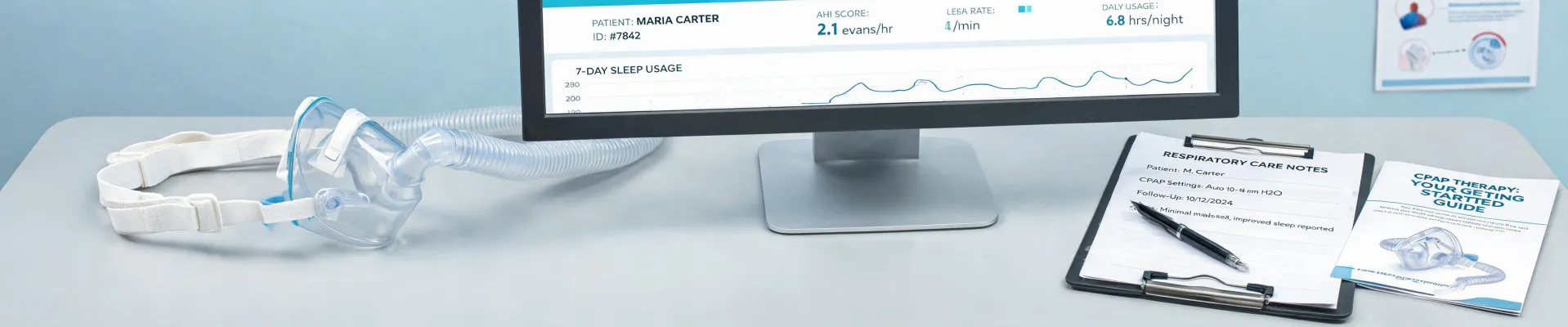
Sleep therapy is the clearest case. A respiratory practice or sleep center often requests 50 units of the ResMed AirSense 10 AutoSet CPAP machine with heated humidifier. From a purchase order perspective, that line looks simple: machine plus humidifier. But you're not only buying a machine; you're buying months of setup and support.
The integrated heated humidifier is itself a total-cost feature. It eliminates the work of matching a separate humidifier and reduces loose parts. Yet the larger hidden cost is mask configuration. A CPAP has pressure settings, and it also needs to know which mask interface the patient is using. The ResMed AirSense 11 mask setting, for example, isn't a cosmetic field. It tells the device what kind of seal is attached, so leak detection and comfort features are calibrated to the mask that is actually in the box.
Why does a quality reviewer care? I've seen complaints that the machine “doesn't work” end up traced to a configuration step. In our Q1 2024 quality audit, several user-facing issues traced back to ambiguous setup instructions, not to product failure. That ambiguity is a real cost. It creates technical support calls, return shipping, delayed therapy, and clinician time. The cheapest CPAP on the purchase order can become the most expensive once those hours appear.
Here's the non-obvious suggestion: if you have to cut cost, don't cut patient or caregiver training. Cut features your patients won't use. If no one knows how to check the mask setting or fit the chosen interface, the patient calls more and may stop using the device. An unused CPAP doesn't save anyone money.
Scenario 2: The device is used in a procedure room
A surgical energy device is rarely a single line item. It may be a generator plus handpieces, cables, and return electrodes. A vendor can offer a low capital price and make margin later on consumables. If you compare only the generator list price, you miss the largest cost driver: per-case instruments and reprocessing.
Before you sign, ask for a per-completed-procedure model. Include single-use instruments, reusable instrument cleaning, staff training, service coverage, and expected case volume. A console that seems more expensive at first can deliver a lower cost per procedure if its disposables are reasonably priced and the system is reliable. Another quote can look attractive until you add the accessories. Ask what happens when a handpiece fails. Is a loaner available? How long is repair turnaround? Those are TCO line items.
This is also the place to check reprocessing instructions before signing. If a reusable component says “fully submersible” but your sterile processing department has to send it off-site, that expense arrives in the middle of the contract, not in the first quote.
Scenario 3: The product remains with the patient
A dental implant is not purchased like a disposable or a capital item. It is inventory that must be tracked, stored, and connected to a patient for years. The lowest fixture price can look great until the system doesn't have the matching abutment, or the clinic has to order a special component at rush freight rates.
From my quality perspective, traceability comes first. If a clinic cannot tell which patient received which implant lot, a recall or adverse event becomes extremely difficult. The price of traceability is process, not hardware. Someone has to log the lot number, attach it to the record, and double-check it before the procedure. A supplier can make that easy or impossible.
Counter-intuitive purchasing advice for this scenario: don't reduce implant inventory too aggressively. Carrying a few extra lengths and diameters looks like waste until a surgery needs a different size. Then an expedited shipment and rescheduling cost more than the inventory would have. The total cost of an implant program includes what is missing from the shelf.
Scenario 4: The device makes other instruments safe
A common search phrase for dental practices is how to use a dental autoclave. That tells me the person doing the research may be a practice manager or new staff member, not a sterilization specialist. That's fine. But for a buyer, the question is not just chamber size or listed cycle time.
I am not an infection-prevention specialist, so I won't write a step-by-step sterilizer procedure here. My quality perspective is the same one I use with any reprocessing device: the machine is only as good as the evidence that a cycle worked. If a lower-priced autoclave cannot run the wrapped loads your state or country requires, or if it needs daily cleaning that your staff won't actually do, the first quote was not the total cost of ownership.
This is the scenario where I disagree with “faster is always better.” Sterilization speed matters less than complete cycle time. A cycle that finishes in 20 minutes but leaves pouches damp means instruments cannot be stored as sterile. In a busy clinic, add drying time, cooling, and documentation to the real cycle. The machine that produces a dry, documented, ready-to-store load is the one that protects your schedule.
How to Decide Which Scenario You're In
If you're comparing products across categories, use this flow:
- If a patient will use the product at home every night, compare support costs, configuration costs, and training costs.
- If a clinician uses it during procedures, compare per-procedure costs, not just the capital purchase price.
- If the product is placed in the patient's body, compare traceability, component availability, and long-term inventory risk.
- If the product prepares other devices for patient contact, compare full-cycle capacity, documentation, and maintenance requirements.
Then force yourself to answer one more question: what does a failure cost after delivery? A wrong spec on a CPAP can mean a patient starts therapy late. A malfunction with a surgical energy device can cancel a list. An untraceable dental implant can turn into a regulatory problem. A wet autoclave load can delay surgery and invite infection. Each has a different failure cost.
This framework came from reviewing specifications in a mid-sized medical device company. If you run a two-chair dental office or a small sleep clinic, you don't need my full quality apparatus. You need the questions: what is the total cost if this is hard to set up, hard to track, hard to reprocess, or hard to document?
In four years of reviewing deliverables, I have rejected products with correct clinical claims but confusing instructions. I do not see that as a documentation problem only. I see it as the most common hidden line in procurement. Buy the equipment that is hard to get wrong, count the cost of being wrong, and let total cost of ownership drive the decision.

Elena Varga
Elena Varga is a medical imaging systems analyst covering CT scanners, MRI systems, ultrasound platforms, digital radiography, mammography, and ophthalmic imaging equipment. She references IEC 60601-2-44 for CT safety and essential performance while examining CTDIvol, dose-length product, spatial resolution, slice thickness, field uniformity, throughput, uptime, and DICOM interoperability. Her work helps radiology leaders, medical physicists, biomedical engineers, and procurement teams compare image quality, radiation management, workflow integration, serviceability, and lifecycle cost.