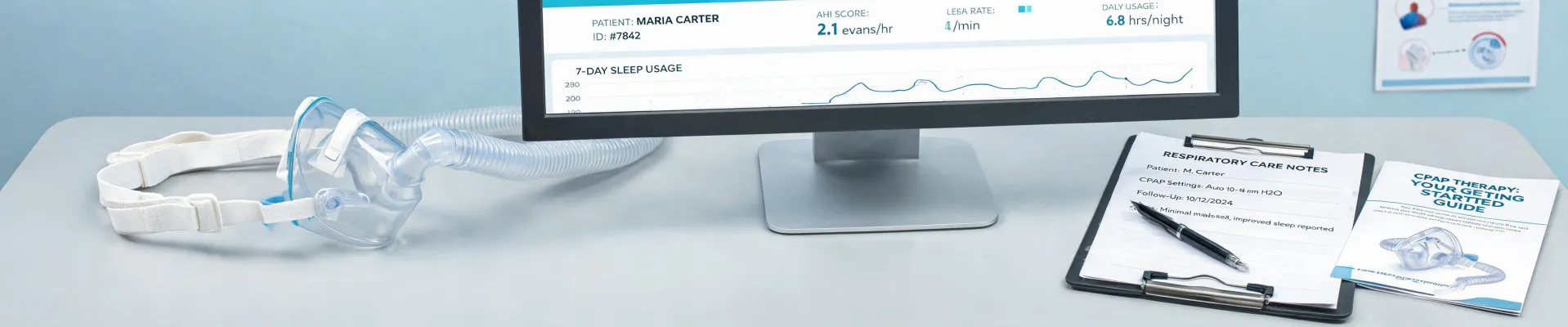
A 100-Piece ResMed AirFit™ P10 Nasal Pillow CPAP Mask Order Taught Me to Ask What's Not Included
· Elena Varga
Quick background: I'm the supply purchasing supervisor for a medical group with sleep labs, wound care clinics, an imaging center, and a pain management service. That means I buy ResMed masks for CPAP patients, wound care products for home-health nurses, and I've supported purchases that go all the way up to mammography systems and spinal cord stimulator inventory. In every one of those categories, the lowest unit price is not automatically the lowest total cost. I learned that the hard way with a 100-piece order of the ResMed AirFit™ P10 Nasal Pillow CPAP Mask in February 2023.
It took me about four years and more than 250 supply orders to reach that conclusion. Before that order, I still believed a clean price list was a transparent price list. Now I know the difference.
The $64 quote that felt like a win
Our sleep medicine director had just received approval for a satellite clinic. Her email was short and direct: New CPAP onboarding starts in March. We need mask inventory for the first 100 patients.
We already used the AirFit P10 in our main sleep labs. It is a nasal pillow mask, which means a low-profile frame, lightweight headgear, and two small silicone cushions that rest at the nostrils rather than covering the whole nose. A lot of CPAP patients prefer it because there is less material on the face. That preference mattered, but it only mattered if we ordered the right sizes.
A distributor we had started using a few months earlier sent a quote that looked like exactly what I wanted to see: $64 per complete mask. Our previous supplier was billing us around $82 for the same product. I compared the product numbers, forwarded the quote to the sleep medicine director, and placed the order. 100 units at $64 each came to $6,400 plus freight. I approved it quickly because the number looked like a negotiation win.
Here is the part that is hard to admit: the quote was accurate. It was not a bait-and-switch and nobody tried to hide a fee. The real problem was that the name of this ResMed product hides a choice. The AirFit P10 is sold as a complete nasal pillow mask, but the pillows themselves come in size options, usually small, medium, and large. The distributor's ordering portal had a size selector, and the default was medium. I did not stop to open that field. I looked at the price column and moved on.
The cartons were only the beginning
The delivery arrived on a Tuesday. Forty-five minutes later, the clinical supervisor for the sleep lab texted me a photo of an open box. The cushion inside was labeled Medium. Her message was not long: our new patient population will not all fit Medium.
She pulled the fit data from our two existing labs. The split had been running roughly 35 percent small, 30 percent medium, and 35 percent large. I want to say those were the exact numbers at the time, but I might be misremembering the precise split. The point was not hard to grasp, though. A hundred Medium masks would only serve a fraction of the expected patients.
The fix got expensive. The distributor accepted unopened cartons back, but the return policy included a 25 percent restocking fee plus return freight. We returned 60 Medium masks, kept 40, and placed a rush order for Small and Large masks with a different supplier who actually asked how many of each size we needed. That second order cost around $92 per mask plus expedited shipping because we no longer had volume pricing or lead time. When I added up the restocking fee, the return freight, and the difference between the original quote and the emergency order, the mistake cost us roughly $3,800 more than a correctly sized order would have cost. That does not include two weeks of delayed patient setups or the phone calls I had to answer.
From the outside, the original quote looked like a clean win: 100 ResMed AirFit P10 nasal pillow CPAP masks at $64 each. The reality was that the one-page quote did not say which cushion size was included, who would confirm the patient mix, or how expensive the order would be to reverse if we got it wrong. I assumed that because the unit price was transparent, the rest of the purchase was transparent too. It wasn't. I should add that the supplier did nothing wrong. The invoice matched the order. The mistake happened on our side because I let a low price replace careful questions.
Our next mask purchase showed me the difference. One vendor quoted $72 per mask with almost no detail. Another vendor quoted $79 per mask but listed the size options, the complete system contents, the return terms, and the shipping window on the same page. The $79 quote looked more expensive until we realized that the extra $7 per mask bought information. The total cost was lower because we did not have to fix anything after delivery.
What I ask before I buy now
That mistake is now the first story in our buying checklist. Before any significant order, I ask what is physically included in the box, what variations the clinical team actually needs, what the return or restocking policy is, and what is not included in the quoted price. I have learned to ask what is NOT included before I ask what the price is. That single question would have caught the entire AirFit P10 mistake in one email.
The same discipline applies beyond sleep medicine. When the words resmed new cpap mask show up in my inbox now, I slow down and ask what actually changed before ordering a single unit. A familiar brand name does not make an unfamiliar product less risky. That rule has saved us on wound care product contracts, mammography equipment quotes, and spinal cord stimulator purchases too.
Looking back, I should have replied to that February 2023 quote with one question instead of a purchase order. The lowest price can still be the right price, but only if someone can tell you, in writing, what you are actually getting and what you are not. That is the difference between a cheap quote and a good one.

Elena Varga
Elena Varga is a medical imaging systems analyst covering CT scanners, MRI systems, ultrasound platforms, digital radiography, mammography, and ophthalmic imaging equipment. She references IEC 60601-2-44 for CT safety and essential performance while examining CTDIvol, dose-length product, spatial resolution, slice thickness, field uniformity, throughput, uptime, and DICOM interoperability. Her work helps radiology leaders, medical physicists, biomedical engineers, and procurement teams compare image quality, radiation management, workflow integration, serviceability, and lifecycle cost.