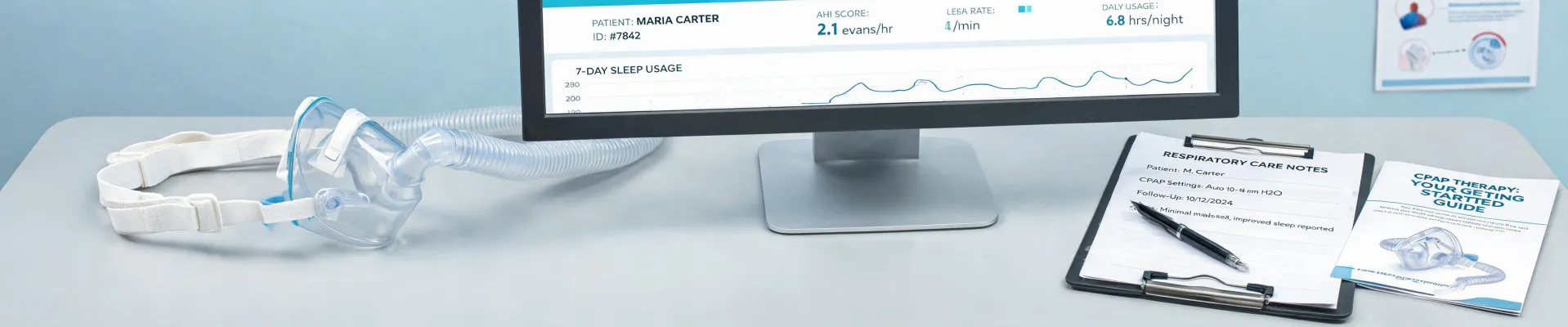
ResMed S10 CPAP Machine, Nasal Masks, and Other Urgent Medical Supply FAQs
· Elena Varga
-
1. Which ResMed S10 CPAP machine should actually be on the truck?
-
2. What does “ResMed mask nasal” mean when a patient needs a mask today?
-
3. What is a neuromonitoring system, and when is it urgent?
-
4. What should you verify before accepting a rush order of surgical gowns?
-
5. What is clinical chemistry, and why does it end up in urgent supply orders?
-
6. Can a compatible mask work for a ResMed S10 CPAP machine emergency?
-
7. How do you keep a genuinely urgent order from becoming rework?
I coordinate urgent medical supply orders for hospitals, sleep centers, and surgery centers. When I first took this role, I thought an urgent request was a shipping problem. It took two mistakes to learn otherwise: one overnight box with the wrong pressure mode, one Friday delivery that arrived after receiving closed. Since then, I ask more questions up front.
Below are the questions I’m asked when there is no time to browse a catalog. These answers come from the supply side, not from a clinical protocol.
1. Which ResMed S10 CPAP machine should actually be on the truck?
Most orders that say “ResMed S10 CPAP machine” are for the AirSense 10 AutoSet. That model senses the patient’s breathing and adjusts pressure automatically. It also records compliance data. But the S10 name covers more than one configuration. The AirSense 10 also comes in a fixed-pressure version. If the order doesn’t mention AutoSet or fixed pressure, ask before you ship.
Why does one word matter? Because pressure mode affects therapy. A fixed-pressure unit might be right for someone who has already titrated in a lab; the AutoSet is more common for new starts. In an emergency, delivering the wrong unit means another delay. That 30-second clarification is the best use of time all day.
2. What does “ResMed mask nasal” mean when a patient needs a mask today?
The phrase “ResMed mask nasal” usually means one thing to the person typing it and another to the person fitting it. ResMed’s nasal options include nasal pillows, nasal masks, and nasal cradle/cushion designs. Nasal pillows sit just under the nostrils, like the AirFit P10. A nasal mask such as the AirFit N20 covers the nose with a cushion around the bridge and lower face. A nasal cradle like the AirFit N30i is lighter than a traditional nasal mask but still fits under the nose.
The key is not to assume “medium fits everyone.” Mask sizing depends on facial geometry. If you are rushing a mask, carry two sizes when possible. The extra size costs less than a callback from a patient who could not sleep because of the leak.
3. What is a neuromonitoring system, and when is it urgent?
An intraoperative neuromonitoring system tracks neural structures during surgery. In plain English, it helps an OR team know when the spinal cord or a nerve pathway may be at risk. These systems can use SSEPs, MEPs, EMG, or EEG signals, depending on the procedure. The phrase “neuromonitoring system” covers more than one piece of hardware: it can mean stimulators, electrodes, amplifiers, or monitoring software.
When a scheduler asks to rush one, the first question is not only “how fast?” It’s “which system, and who will run it?” Hardware without a person trained to interpret the signals is not a ready case. In my experience, the operational delay is more often missing clinical coverage than missing equipment.
4. What should you verify before accepting a rush order of surgical gowns?
This is where I learned my lesson. Surgical gowns are classified by fluid barrier performance. In the U.S., ANSI/AAMI PB70 is a common standard. AAMI Level 1 offers minimal fluid resistance, Level 2 offers low resistance, Level 3 offers moderate resistance, and Level 4 offers high resistance against blood and fluid exposure. Seeing “surgical gown” on a box is not enough.
I once skipped the level check because a vendor said “same gowns as always.” They weren’t. The shipment was Level 1, and the procedure area expected Level 3. We paid overnight freight to replace them and lost a full day. The assumption saved me ten minutes and cost far more.
In any rushed gown order, verify level, size, and whether the gowns need to be sterile. Then let the truck leave.
5. What is clinical chemistry, and why does it end up in urgent supply orders?
Clinical chemistry is the laboratory testing area that measures chemical substances in blood, urine, and other body fluids. Common clinical chemistry tests include glucose, creatinine, electrolytes, liver enzymes, and lipid panels. Hospitals use clinical chemistry analyzers to run these tests. If a request says “need clinical chemistry supplies,” that does not mean much until someone identifies the analyzer model and the specific test menu.
Why would this question show up on a rush order? Because the person placing the order may not know whether a consumable fits an existing analyzer. Laboratory rush orders fail more often because the right category but wrong test menu was ordered than because the courier was too slow. Specify the analyzer, the reagent name, and the sample type. That turns a guess into an order.
6. Can a compatible mask work for a ResMed S10 CPAP machine emergency?
You can physically connect many compatible cushions to a ResMed mask frame. Whether they work clinically is a different question. A mask is not just silicone that touches the skin. The cushion shape and the exhalation port affect leak, pressure, and the data the clinician sees. A substitute that fits the frame may still change how the system behaves.
The safest route is to order the exact ResMed part number. If no exact part can arrive in time, do not send the patient home with an untested substitute. Test it at therapy pressure and check the estimated leak before discharge. Our service log shows that “compatible” parts are a common source of high-leak alarms at home. The words “it fits” are not enough when clinical decisions depend on reliable therapy data.
7. How do you keep a genuinely urgent order from becoming rework?
I run the same three questions mentally every time:
How many hours until the product has to be physically in someone’s hands? Not “in transit.” Someone has to receive it, verify it, and put it into use.
Which exact model or code is needed? Does the prescription, procedure, or patient fit require a specific version?
If the vendor cannot deliver in time, who has local stock that could cover the gap?
The time element is not flexible. If receiving closes at 4:00 p.m., an overnight shipment that arrives at 5:00 p.m. is not a solution. A local courier may be the actual emergency route. If the product cannot arrive before the clinical deadline, do not pretend otherwise. Name the risk and move to the backup plan. It is less comfortable, but it gets people closer to a working answer.
We did not always have a checklist for this. The third time a rush order stalled because nobody asked “will someone be there to receive it?” I finally wrote it down. The checklist did not slow things down. It redirected the rush toward what actually mattered.

Elena Varga
Elena Varga is a medical imaging systems analyst covering CT scanners, MRI systems, ultrasound platforms, digital radiography, mammography, and ophthalmic imaging equipment. She references IEC 60601-2-44 for CT safety and essential performance while examining CTDIvol, dose-length product, spatial resolution, slice thickness, field uniformity, throughput, uptime, and DICOM interoperability. Her work helps radiology leaders, medical physicists, biomedical engineers, and procurement teams compare image quality, radiation management, workflow integration, serviceability, and lifecycle cost.