Replacing Medical Equipment? A Cost Manager's 3-Scenario Guide
· Elena Varga
Replacing Medical Equipment? A Cost Manager's 3-Scenario Guide
Six years ago, I inherited procurement for a medical group with clinics in three states. The first thing I did was audit our spending—all of it, going back through invoices, service logs, and purchase orders. It was not one spreadsheet. It was five. And what I found wasn't one problem either. It was three.
We were applying the same replacement logic to a $90 mask cushion, a $4,000 cryosurgery device, and a $25,000 blood analyzer. That is like having one financial rule for groceries, rent, and payroll. It doesn't work. There is no single answer to when you should replace medical equipment. But there is a better question: which of these three categories does this purchase belong to?
Here are the three scenarios I use now, with the cost logic that goes with each.
Scenario 1: Patient-facing items that reorder themselves
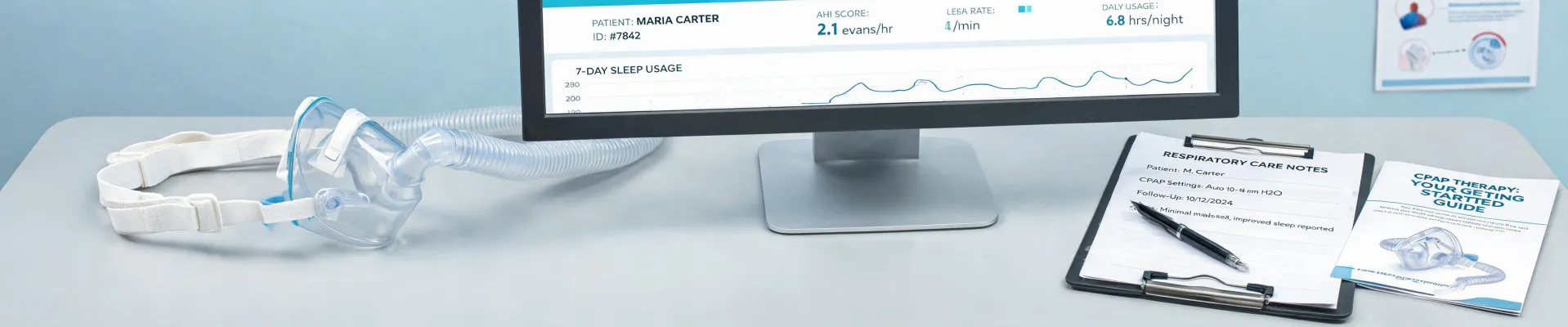
Some medical purchases repeat whether you plan them or not. ResMed mask replacement is a perfect example. The CPAP machine itself is durable, but the mask—especially the cushion—is a consumable. It absorbs oils, gets cleaned, wears out. Patients rarely call to announce their mask has failed. They just start sleeping worse, take the mask off at 3 a.m., and eventually stop using therapy altogether.
If you look at ResMed mask replacement costs line by line, it's tempting to extend every cushion as long as possible. That was our approach at first. What I learned is that a patient who quietly quits therapy is a much more expensive problem than a replacement cushion. That's not a warm-hearted marketing sentence; it's what the reimbursement data shows when a patient needs re-education, re-fitting, or a new compliance download session.
The counterintuitive part for a cost person: the cheapest way to run this category is usually standardization, not shopping for the lowest single-unit price. In our sleep lab, we used to stock seven different mask models. Every clinician had a favorite. Then we consolidated our default to the ResMed AirFit F20 with multiple cushion sizes, plus one nasal pillow option for people who can't tolerate a full-face mask. The per-unit price improved, but the bigger saving was in freight. When a specific size was missing, we used to pay for next-day shipping. Nobody tracks that line item when they search for mask replacement costs—but it's real.
If you're comparing replacement masks, I'd also ask vendors for evidence behind “same as original” claims. Per FTC guidelines (ftc.gov), advertising claims have to be substantiated, and a responsible seller should be able to show you that documentation. As a buyer, asking for it is normal. Most people just don't.
A few practical rules from our side: track mask-related patient complaints rather than relying only on a calendar; replace before visible breakdown becomes a compliance problem; and if a patient is using therapy well, don't change a mask model that works in order to save two dollars. Consistency has value, even if it doesn't appear on a purchase order.
Scenario 2: Capital equipment that rarely fails—until it does
The second category is expensive equipment that runs for years and then fails in a way that affects clinical operations. A cryosurgery device in a dermatology practice is a good example. It isn't a high-volume purchase. But when it stops working reliably, procedures slow down and appointments get rearranged.
In 2023, our dermatology clinic's cryosurgery device started taking longer to reach working pressure. The first service visit cost $420. It seemed reasonable. Four months later, the same device needed another repair—$780 this time, for a valve assembly. We had now spent $1,200 in repairs on a unit with a replacement cost around $4,500. I kept approving repairs because every single repair was cheaper than replacement, and that mindset was exactly the problem. The pattern mattered more than any single invoice.
My rule now: if a piece of capital equipment needs two non-warranty repairs in 12 months, or if a repair estimate exceeds about 40% of replacement value, we start a replacement project. We don't necessarily buy immediately. We plan it—because buying while the old unit still runs is always cheaper than buying after it dies.
The autoclave exception
Autoclave machine decisions deserve extra caution. A failing autoclave machine isn't only a repair problem; it's an infection-control problem. You can run a load that fails a biological indicator, and suddenly you're pulling instruments, notifying staff, and reviewing reprocessing records. That process costs more than the autoclave itself. When our clinic's autoclave machine failed its second spore test in six months, replacing it felt premature—the chamber held pressure, the cycles ran, and the display showed no error. But from a cost standpoint, waiting for a third failure was gambling with surgery schedules. We replaced it before it forced us to cancel cases.
That's the opposite of how many clinics buy. They wait until equipment stops working, then buy under emergency pressure, often paying a premium for expedited shipping and installation. The cheapest time to replace critical equipment is while it is still running. The second-cheapest time is before the next repair.
Scenario 3: The blood analyzer, where the workflow is the product
The third scenario looks like a capital equipment purchase, but behaves more like a workflow redesign. Blood analyzers fall here. If you have asked “how does a blood analyzer work,” you are probably at the start of one of these projects, so here's the plain-English version: a CBC analyzer pulls a blood sample through a narrow channel and counts or classifies cells using electrical impedance or light scatter. A chemistry analyzer does something different—it mixes serum or plasma with reagents and measures the reaction to determine concentrations. Either way, the analyzer is only part of the system. Reagents, controls, calibrators, daily quality checks, and data entry are the rest. And that's where the real money sits.
Our lab had a working analyzer a few years ago. It produced accurate results. But it had no bidirectional interface with our electronic records, so staff manually transcribed results. In a three-month audit, we found 214 manual result entries and 11 transcription errors. None of the errors caused harm, but each one had to be found, corrected, and documented. That is not a laboratory problem; it is a cost problem hiding in workflow.
When we compared replacement options, one vendor offered a lower upfront price but required a monthly minimum test volume we only hit in the winter. Over three years, that “cheap” analyzer would have cost us about $2,900 more than the higher-priced option with no minimum and lower per-test reagent cost. The spreadsheet made the choice obvious—once we actually built the spreadsheet. Most clinics compare purchase prices. Fewer compare reagent contracts, training time, interface costs, and the hourly labor involved in duplicate data entry.
The efficiency argument matters here, but it has limits. A newer analyzer won't fix a lab that doesn't have enough staff to run it or enough volume to justify it. If your clinic runs twenty tests a day, a high-throughput analyzer with automated middleware is an expensive way to feel modern. The right question is not “is this the best analyzer?” It's “what is the cheapest way to get accurate results into the chart with the least human error?” Sometimes that means a new analyzer. Sometimes it means middleware on the old one.
How to know which scenario you're in
You can figure out your own situation with three questions.
1. Does this item generate frequent, small purchases? If yes, you are in scenario one. Stop treating each order as a one-off. Consolidate your inventory, standardize the models you stock, and review the pattern of complaints or compliance data before setting replacement intervals.
2. What happens when this machine fails without warning? If the answer is “we'd have to stop seeing patients” or “we'd lose a day of procedures,” you are in scenario two. Track repair history, set a repair-to-replacement threshold, and start planning the replacement before the failure happens.
3. Is the equipment's weakness actually the workflow around it? If you have a device that works fine but requires manual data entry, duplicate steps, or constant troubleshooting, you are in scenario three. Treat the purchase as a process improvement project, and measure the total cost of reagents, labor, training, and interfaces—not just the machine's price.
This framework has limits. I can only speak to a multi-specialty clinic context with moderate volumes. If you run a solo practice, a reference lab, or a large hospital with in-house biomedical engineers, the numbers will shift. A hospital can carry redundant equipment and tolerate a repair cycle that a three-room clinic cannot.
The bottom line
There is no universal replacement schedule for medical equipment because there is no universal cost structure. Patient-facing consumables should be standardized and replaced based on actual use. Intermittent capital equipment should be replaced on a repair threshold, ideally before it fails. Diagnostic instruments should be evaluated as workflow systems, not boxes with a test menu.
For our group, the biggest improvement came from tackling scenario one first. Switching all of our ResMed replacement mask orders to one standing quarterly order cut our freight costs by roughly $2,200 a year—I'd have to check the exact figure, but it was significant. It wasn't glamorous. It was just the place where the savings were hiding.
Prices and regulations change; verify current product availability and requirements with official sources before making purchasing decisions.

Elena Varga
Elena Varga is a medical imaging systems analyst covering CT scanners, MRI systems, ultrasound platforms, digital radiography, mammography, and ophthalmic imaging equipment. She references IEC 60601-2-44 for CT safety and essential performance while examining CTDIvol, dose-length product, spatial resolution, slice thickness, field uniformity, throughput, uptime, and DICOM interoperability. Her work helps radiology leaders, medical physicists, biomedical engineers, and procurement teams compare image quality, radiation management, workflow integration, serviceability, and lifecycle cost.