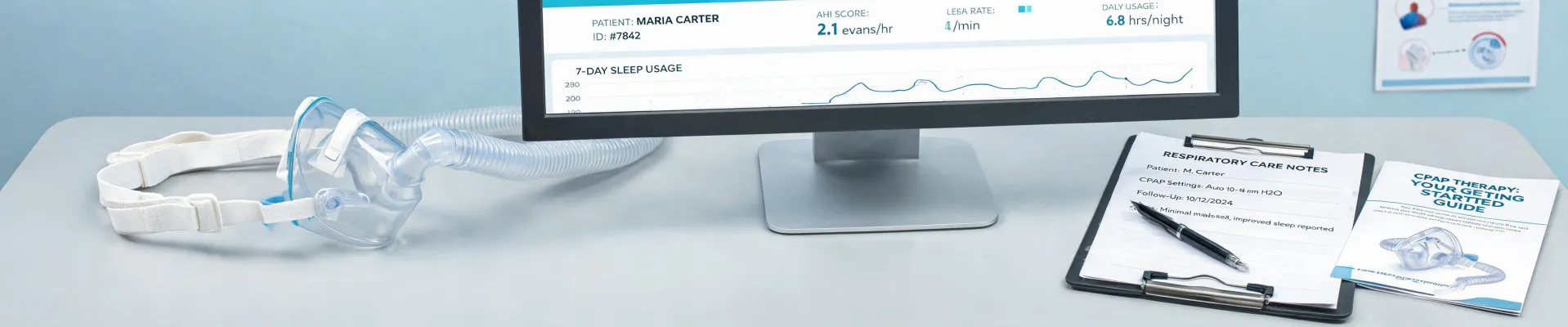
Why the Cheapest ResMed AirSense 11 Mask Usually Costs More
· Elena Varga
The quote that looked like a win
In Q2 2023, I was auditing our respiratory and diagnostics spend. I manage procurement for a 220-person clinic network. I’ve handled our respiratory and imaging equipment budget—about $1.8 million annually—for seven years, negotiated with 40+ vendors, and documented every order in our cost tracking system.
That quarter, a distributor sent us a third-party cushion for the ResMed AirSense 11 at $39. The ResMed sleep mask we normally stocked was $89. The math looked simple: save $50 per mask, about $14,000 across our resupply list. My team pushed for the cheaper option. I almost signed it.
Then I added the columns we usually ignore: returns, clinician calls, resupply speed, leak complaints, and patient drop-off. The $39 mask stopped looking cheap.
The surface problem: everyone is staring at the sticker price
From my perspective, this is the same mistake I see in almost every equipment category. The buyer asks for the lowest unit price. The vendor gives it. Then operations pays the difference later.
With a ResMed AirSense 11, the mask is not a minor accessory. It is the interface between the machine, the pressure algorithm, and the patient’s face. If you ask me, the best mask for ResMed AirSense 11 is not a single SKU. It is the mask that fits that patient’s face shape, sleep position, pressure setting, and tolerance for headgear. A cheap mask that leaks is a red flag, not a bargain.
We learned that the hard way. In my first year, I made the classic spec error: I assumed ‘compatible’ meant ‘same fit.’ It does not. Cost us about $1,100 in staff time and 30 returns on a small cushion order.
The deeper problem: you are not buying plastic, you are buying adherence
Here is what took me too long to understand. CPAP therapy only works if the patient keeps using it. A mask that feels fine in the clinic can fail at home. It leaks when the patient rolls over. It leaves marks. It gets noisy. The patient loosens it, then the leak gets worse, then the machine ramps up, then the patient takes it off.
That chain is expensive. It triggers nurse callbacks, mask refits, replacement requests, and sometimes a full therapy restart. The unit price is a tiny part of the real cost.
ResMed’s ecosystem helps here, but only if you use it properly. The AirSense 11 has support tools, and ResMed publishes fitting resources for its mask portfolio. MyAir can show usage patterns, so we can spot adherence issues before they become drop-offs. That data is not perfect, but it is way more useful than a spreadsheet column that only tracks purchase price.
To be fair, a lower-cost mask can work for some patients. I get why a buyer wants to test it. But for our clinic, the return rate and clinician time made it a deal-breaker.
What the hidden costs actually look like
We ran a 120-patient pilot in 2023. We mixed third-party masks with ResMed sleep masks on AirSense 11 units. The third-party option saved about $4,200 on the invoice. Then the other costs showed up:
- 18% return or exchange rate, versus 6% for our standard ResMed masks.
- 46 extra clinical hours for refits and leak troubleshooting.
- $2,800 in rush replacements when patients could not wait for standard shipping.
- Lower 90-day adherence in the third-party group, which meant more follow-up calls.
That $4,200 saving turned into roughly $9,600 in extra labor and replacement cost. Not a disaster, but not a win either. The bottom line: the cheapest mask was the most expensive one we tried that quarter.
The same pattern shows up outside sleep therapy. A cheap blood pressure monitor can look great until cuff calibration fails and nurses repeat readings. A low-bid mammography service contract can save money until downtime pushes patients into rescheduling. And if you have ever asked how does hematology analyzer work, you know the analyzer price is only the entry fee. Reagents, service contracts, calibration, and downtime are where the budget actually goes.
That does not mean every premium product is automatically better. It means the comparison has to include the whole system. A blood pressure monitor without reliable cuffs is not a monitor. A mammography contract without uptime guarantees is not a contract. A hematology analyzer without reagent transparency is not a closed deal.
After 150 orders, I changed the question
It took me three years and about 150 equipment orders to understand that vendor relationships and support matter more than a low unit price. I used to ask, ‘What is the cheapest option?’ Now I ask, ‘What does this cost us over 18 months?’
Even after we standardized on ResMed sleep masks, I kept second-guessing. What if the cheaper cushions held up? The two weeks until our leak and resupply report came back were stressful. When the data showed fewer refits and fewer urgent replacements, I stopped worrying. But I still review the TCO every quarter.
The fix is boring, and that is fine
Our procurement policy now requires a TCO sheet for any clinical purchase above $2,500. It is not fancy. It has columns for unit price, expected return rate, clinician time, downtime, training, calibration, reagents, service, and resupply speed.
For ResMed AirSense 11 masks, we do three things:
- Keep a fitting trial kit instead of locking into one mask style.
- Track 30- and 90-day leak and adherence data, not just invoice price.
- Negotiate mask bundles with ResMed and our distributor based on total annual volume.
For blood pressure monitors, mammography, and hematology analyzers, the logic is the same. Ask the vendor for the full cost picture. If they cannot show it, that is a red flag. If they can, the decision usually gets easier.
Bottom line
The lowest quote is usually not the lowest cost. In my experience, the best mask for a ResMed AirSense 11 is the one that keeps the patient on therapy with the fewest hidden costs. The same goes for a blood pressure monitor, a mammography service, or a hematology analyzer. Value over price is not a slogan. It is the only math that survives an audit.

Elena Varga
Elena Varga is a medical imaging systems analyst covering CT scanners, MRI systems, ultrasound platforms, digital radiography, mammography, and ophthalmic imaging equipment. She references IEC 60601-2-44 for CT safety and essential performance while examining CTDIvol, dose-length product, spatial resolution, slice thickness, field uniformity, throughput, uptime, and DICOM interoperability. Her work helps radiology leaders, medical physicists, biomedical engineers, and procurement teams compare image quality, radiation management, workflow integration, serviceability, and lifecycle cost.