Lab Equipment Buying: Verify First, Then Compare Price
· Elena Varga
Verify first, then compare price
The fastest way to waste money on lab equipment is to treat it like office supplies. My rule is simple: verify the supplier, the documentation, the service path, and the compliance fit before you compare price. That sequence has saved us about $8,000 in avoided rework over two years—give or take a few hundred.
I'm the office administrator for a 220-person diagnostics company. I manage lab and office equipment ordering—roughly $1.2 million annually across 14 vendors. I report to operations and finance. When I took over purchasing in 2020, I thought my job was to get three quotes and pick the lowest one. In our 2024 vendor consolidation project, I learned the job is actually to prevent bad purchases from reaching the PO stage.
This matters for everything from Beckman Coulter products to a CPAP machine. The categories look different, but the failure modes are similar: missing paperwork, unclear service terms, and assumptions about who handles calibration or patient support.
Why I trust this checklist
Processing 60-80 orders annually sounds manageable until you add lab equipment. In 2022, I found a great price from a new vendor—$2,400 cheaper than our regular supplier on a small equipment bundle. Ordered it. They couldn't provide a proper invoice (handwritten receipt only). Finance rejected the expense report. I ate $2,400 out of the department budget. Now I verify invoicing capability before placing any order.
I only believed the spec-check advice after ignoring it once. Everyone told me to always check specifications before approving. I skipped that step on an electronic pipette accessory order and ate an $800 mistake because the calibration kit didn't match our model. The vendor said the listing was compatible. It wasn't compatible enough. That was a reverse validation I did not enjoy.
I also went back and forth between the established vendor and the new one for two weeks during the 2024 consolidation. Established offered reliability and clear service credits; new one offered 25% savings. Ultimately chose reliability because the project was too important to risk. The savings looked real on paper, but the downside—missed calibration windows and unclear documentation—felt worse.
When I compared our rush orders and standard orders side by side over a full year, I finally understood something: we were paying artificial emergency premiums for things that weren't emergencies. A ton of our urgent buys were really poor planning. Now we batch non-urgent items and reserve rush fees for actual clinical or research deadlines.
The pre-purchase checklist I use
I don't use a 40-point checklist. I use six questions, and I adapt them by product. The first four are non-negotiable for any lab equipment order.
- Can the supplier invoice correctly? PO number, itemized lines, tax treatment, shipping terms, and a real W-9 or equivalent. No proper invoice, no order. This is the cheapest insurance we have.
- Is the exact model and configuration documented? Not a family name. The model number, voltage, plug type, software version, accessory list, and warranty terms. For a Beckman Coulter product, that means matching the catalog number to the current datasheet or manual, not a reseller's shortened title.
- Who does installation, calibration, and service? Manufacturer field service, authorized distributor, or in-house? What's the response time? Are calibration certificates included or extra? For an electronic pipette, ask for the calibration protocol and whether it follows ISO 8655. That standard is a real reference point for piston-operated volume measuring instruments, and it's the first thing our lab director asks about.
- What does compliance require here? For clinical use, check CLIA certificate scope, test complexity, and package insert instructions. For research use, check institutional biosafety and radiation safety rules where relevant. This is not clinical advice; verify current requirements with your lab director and official sources.
The next two questions change by category.
Beckman Coulter products and the Hemoccult test
According to Beckman Coulter's official product pages (beckman.com), its portfolio spans clinical chemistry analyzers, hematology analyzers, immunoassay analyzers, centrifuges, flow cytometers, mass spectrometers, coagulation analyzers, and life sciences automation such as NGS automation. That breadth is useful, but it means the buyer has to slow down. A hematology analyzer and a flow cytometer do not have the same site requirements, service plan, or training path.
For a Beckman Coulter Hemoccult test order, I treat it as a clinical workflow item, not a commodity. I confirm the exact kit configuration, expiration dating, specimen collection instructions, storage requirements, and whether our lab's testing certificate covers the method. I also check that the package insert matches what the lab director expects. If the kit arrives with a different collection device or an unclear lot number, the lab cannot just make it work. That is a rework risk I want to catch before the PO.
For larger Beckman Coulter products, I ask for the current user manual and site preparation guide before I sign anything. If a reseller cannot produce the manual, that is a warning. I should add that manufacturer documentation is not a nice-to-have. It is how facilities plans power, heat load, plumbing, and bench space.
Electronic pipettes
An electronic pipette looks simple until you compare service terms. I ask three things: the calibration interval, the spare parts path, and whether the warranty covers the charging stand. Our lab techs care about ergonomics and repeatability; finance cares about total cost. The cheapest pipette can get expensive if calibration turnaround takes three weeks and the lab has to borrow units.
For verification, I keep a simple checklist: model number, volume range, compatible tips, calibration certificate, and service contact. I once had a vendor quote a calibration bundle that was really just a shipping box and a sticker. That is why I read line items out loud to the lab lead before approval. Five minutes of reading beats five days of correction.
How does a microplate reader work?
This is the question I ask vendors to explain in plain language, because if they cannot, I don't trust their service support. A microplate reader works by sending light through or into a sample in a microplate well and measuring what comes back. In absorbance mode, a light source passes through the well and a detector measures how much light was absorbed. In fluorescence mode, the instrument excites a sample at one wavelength and measures emitted light at another. In luminescence mode, it measures light produced by a chemical or biological reaction without an excitation light source.
The path is basically: light source → filter or monochromator → microplate well → detector. The detector might be a photomultiplier tube, a photodiode, or a camera system, depending on the reader. The practical buying questions are: which detection modes do we need, what plate formats are supported, what software is included, and who validates performance after installation? A free software license can become a real cost if it only runs on one PC and the lab needs a second workstation.
CPAP machines are a different boundary
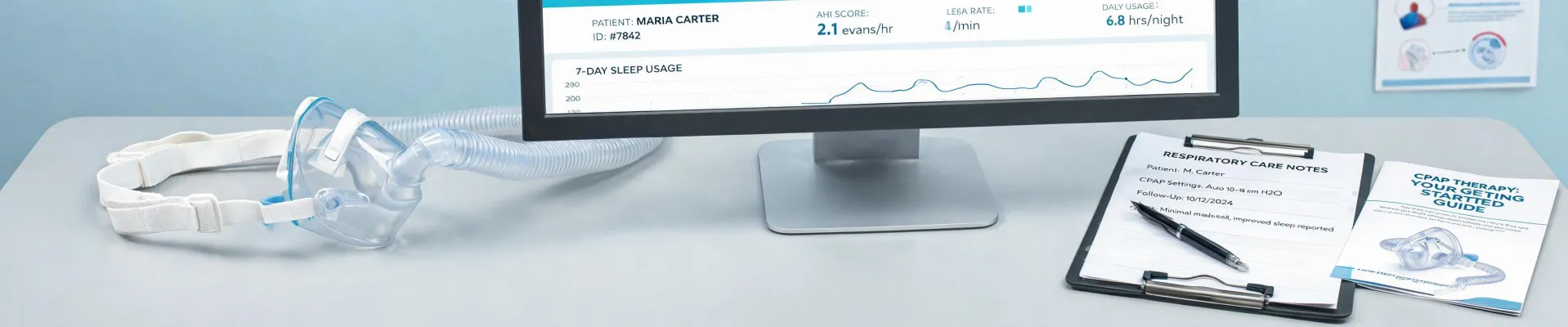
A CPAP machine usually sits outside a clinical diagnostics portfolio. It is a Class II medical device, and according to the FDA (fda.gov), CPAP devices require proper prescription and supplier compliance. If our company orders one for occupational health or a sleep research study, I don't assume the lab equipment vendor can supply it. I verify durable medical equipment (DME) supplier status, prescription handling, patient fitting support, and replacement supply terms. That is a different supply chain from a Beckman Coulter analyzer.
Where this approach breaks down
This is overkill for a $40 box of gloves. It is also unnecessary for sole-source consumables where the manufacturer is the only realistic path. And it cannot replace clinical judgment. A procurement checklist can confirm that the paperwork and service path are clean; it cannot decide whether a test is clinically appropriate for a patient. That call belongs to the lab director or clinician.
One more boundary: pricing and regulations change. I verified supplier documentation and standards references when I checked our files in 2025; current requirements may differ. Verify current rates and rules with official sources. But if you are buying anything that touches patient results, lab calibration, or research data, the sequence is still right: verify first, then compare price.

Elena Varga
Elena Varga is a medical imaging systems analyst covering CT scanners, MRI systems, ultrasound platforms, digital radiography, mammography, and ophthalmic imaging equipment. She references IEC 60601-2-44 for CT safety and essential performance while examining CTDIvol, dose-length product, spatial resolution, slice thickness, field uniformity, throughput, uptime, and DICOM interoperability. Her work helps radiology leaders, medical physicists, biomedical engineers, and procurement teams compare image quality, radiation management, workflow integration, serviceability, and lifecycle cost.