ResMed Mask Mistake: Why 5 Minutes of Checking Beats 5 Weeks of Fixing
· Elena Varga
-
Lesson 1: The ResMed mask that was “the usual”—and completely wrong
-
Lesson 2: What a blood pressure monitor cuff taught me about “compatible”
-
Lesson 3: The IV catheter that almost wasn’t a saving
-
Lesson 4: “What is clinical microbiology?” is a question I’m not afraid to ask
-
Two objections worth answering
-
Check before you click
I’m not a clinician, and I’m going to spend part of this article admitting that. I’m the office administrator for a physician-run clinic group—about 140 people across three locations. In practice, that means I buy the equipment and supplies that keep us running: roughly $300,000 a year in orders, everything from ResMed masks for the sleep lab to blood pressure monitors in the exam rooms to IV catheters for the minor-procedure area.
Five years in, here’s the opinion I keep repeating: most supply problems are not vendor problems, and they’re not delivery problems. They’re pre-order problems. The expensive mistake usually happens in the 30 seconds between reading a request and clicking “submit.” A product name gets shortened. A specification gets skimmed. A “same as last time” gets assumed. By the time the error shows up—a patient waiting, a clinician frustrated, a restocking fee on an invoice—it costs ten times more than the check would have cost.
So I stopped treating verification as a nice-to-have. I’d rather spend five minutes checking a spec than five weeks fixing an order. That isn’t a slogan. It’s a rule I learned the hard way.
Lesson 1: The ResMed mask that was “the usual”—and completely wrong
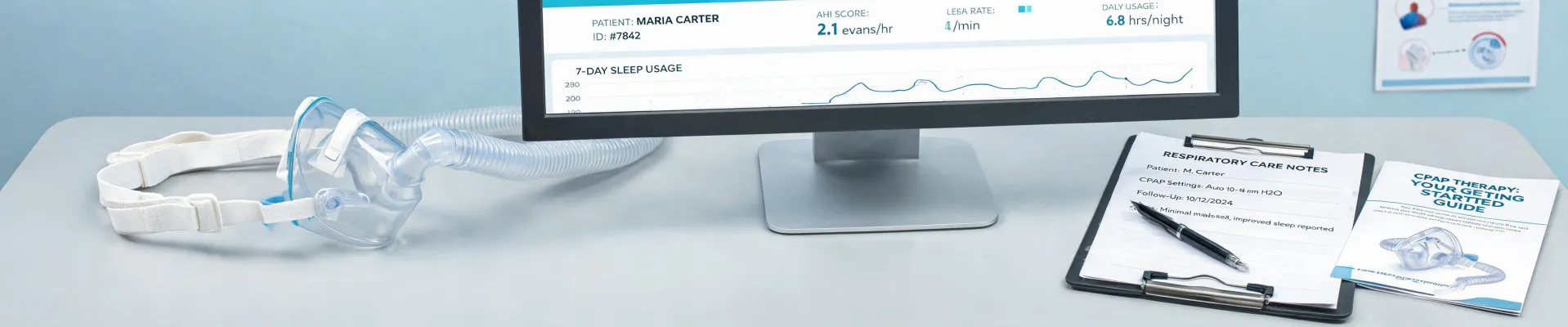
In my second year, a respiratory therapist mentioned in the hallway that we should stock “the ResMed masks.” In my head, that meant one thing: the ResMed CPAP mask N20 we’d been ordering all along. It’s a nasal mask, it sits over the nose, and it works well for a lot of CPAP patients. So I set up the next quarter’s auto-order and didn’t think about it again.
What I missed was the rest of the sentence. The therapist had been asking for the ResMed AirFit F30 as an option for patients who mouth-breathe or need higher pressures. It’s a full-face mask with an under-the-nose cushion, so it covers the mouth without resting on the bridge of the nose. She didn’t say “instead of the N20.” She said “in addition to the N20.” I heard “the usual.”
The mask matters because positive airway pressure (PAP) is the first-line treatment for adult obstructive sleep apnea, according to the American Academy of Sleep Medicine’s clinical guidance—and the patient interface can make or break therapy adherence. A nasal mask and a full-face mask might both be “ResMed masks.” They solve different clinical problems.
Two weeks later, we had a closet full of N20 masks and no F30s. A patient who needed a full-face option had to wait while we borrowed stock from a sister clinic. The wrong product wasn’t defective. That’s the trap. A perfectly good mask is still the wrong mask if it’s not the one the clinician asked for. The problem wasn’t ResMed’s catalog. It was my assumption that a familiar product name meant the request was familiar too.
Lesson 2: What a blood pressure monitor cuff taught me about “compatible”
The same pattern appeared with blood pressure monitors, and the word that fooled me was “universal.”
In 2024, our general medicine team switched to a new monitor vendor. The brochure said the cuffs were compatible across the monitor series. I read “compatible” as meaning “all of them.” When the nurse manager asked for a pediatric cuff, I picked one from the same brand, checked the arm-size range, and ordered it. I didn’t check the connector. It turned out the cuff was designed for the vendor’s older monitor model, not the new one in every exam room. Same logo. Same color scheme. Wrong fitting.
The dollar loss was small—mostly return shipping. But it taught me that a big part of my job is translation. The clinical need was “a small cuff for a child.” The product description said “small cuff.” Neither one means “this cuff connects to the monitor we own.” Verification is usually one phone call away, and that call is cheaper than the email to finance explaining why we paid return shipping on a box of useless cuffs.
Lesson 3: The IV catheter that almost wasn’t a saving
Then there was the IV catheter decision. The nursing lead in our procedure room wanted to standardize on a 22G safety catheter, and I found one that was roughly 18% cheaper than the current SKU. Same gauge. Similar product photos. On paper, it looked like a win. I was close to switching the standing order.
By then, I’d learned to get samples before making a change. When the nursing team tested the sample, the reaction was immediate and not what I expected. The safety mechanism deployed differently. The grip felt different. One nurse said, “it doesn’t feel right, and I can’t tell you exactly why.” That isn’t a spec-sheet objection; it’s clinical judgment. We stayed with our existing catheter.
Did we lose a discount? Yes. Did we avoid a product that clinicians would have swapped out or struggled with? Probably. A price is only a saving if the product actually gets used. Prevention, in that case, meant asking the people doing the procedure before I locked us into a year of inventory.
Lesson 4: “What is clinical microbiology?” is a question I’m not afraid to ask
Here’s where I’ll fully embarrass myself. If you asked me to explain what is clinical microbiology in any real depth, I’d probably say “it’s the lab discipline that studies microorganisms in patient samples” and hope the conversation moves on. That’s the honest edge of my knowledge.
Admitting that boundary is part of prevention. A while ago, a physician asked me to order supplies for a microbiology send-out, and I didn’t recognize half the items. The easy move would have been to search for a kit, pick the first result, and let the lab sort it out. Instead, I asked the lab tech two questions: what are we testing, and which specific product does your lab accept? She answered in under a minute. The order turned out to be simple—once I stopped pretending I knew what I was doing.
The same logic applies beyond microbiology. The more I learn about medical products, the more I realize a little knowledge is dangerous. It gives you just enough confidence to skip the question. My rule now: if I can’t explain what something does and why a clinician wants it, I don’t order it on autopilot. I ask.
Two objections worth answering
By now, some people will be thinking this sounds slow. You can’t interrogate every order in a busy clinic. Fair enough. So let’s be specific about what a check actually looks like. It’s not reading manuals. It’s usually four questions:
- What is the exact product name and model, not the shorthand?
- Is this a replacement for something we already use, or a new item?
- Does it work with the equipment we already own?
- Does the clinical lead confirm the size, quantity, or brand change?
That’s five minutes. Given that most supply orders take one to two weeks to arrive anyway, the time cost is nearly zero. The correction cost is what gets expensive: wasted supplies, return shipping, restocking fees, rescheduled appointments, and the slow loss of trust when a clinician can’t rely on the person placing orders.
Another reasonable objection: I’m an administrator, not a clinician, so why am I checking clinical product choices at all? That’s actually the right question. I don’t choose between a nasal and a full-face mask for a patient. I make sure the product named on the purchase order matches what the clinical team specified. If the request says “ResMed AirFit F30” and the order history says “ResMed CPAP mask N20,” someone needs to catch the mismatch before it becomes a patient delay. That’s a process job, not a clinical one—and it’s where a non-clinical buyer adds real value.
Check before you click
Bottom line: prevention isn’t a soft value. It’s the cheapest thing I buy. You don’t need to know every clinical detail to be a good medical equipment buyer. You need enough humility to ask the full name, check the connector, request a sample, and admit when you don’t know what you’re ordering.
Some buyers worry they’ll annoy people by asking too many questions. My experience has been the opposite. The clinicians I support would rather answer one follow-up question than deal with a five-week correction. After five years, they’ve come to expect my questions. Honestly, I think that’s why they trust me with a $300,000 budget.
Every time I’ve skipped the five-minute check to save time, the time has found me again—as a restocking fee, a delayed patient, or an awkward conversation with finance. I’ve never regretted the five minutes I spent checking. I’ve regretted the five weeks of fixing many times.

Elena Varga
Elena Varga is a medical imaging systems analyst covering CT scanners, MRI systems, ultrasound platforms, digital radiography, mammography, and ophthalmic imaging equipment. She references IEC 60601-2-44 for CT safety and essential performance while examining CTDIvol, dose-length product, spatial resolution, slice thickness, field uniformity, throughput, uptime, and DICOM interoperability. Her work helps radiology leaders, medical physicists, biomedical engineers, and procurement teams compare image quality, radiation management, workflow integration, serviceability, and lifecycle cost.