ResMed Support Issues That Are Actually Workflow Issues: Lessons From 143 Tickets
· Elena Varga
72% of the 143 ResMed support issues we logged at our sleep center between August 2023 and December 2024 were avoidable. That's not a criticism of ResMed—it's a criticism of us, and of a lot of well-meaning advice patients get before they ever call for help.
To put that number in context: I'm not a respiratory therapist or an engineer. I'm the clinical equipment coordinator at a hospital-affiliated sleep center, which means I order the ResMed machines and masks, set them up, train patients, handle the first round of troubleshooting, and escalate to ResMed support when something really needs to go further. I've done that job for about six years.
I started logging every issue in a spreadsheet because I was convinced we had a mask quality problem. We didn't. Once we hit 143 tickets, the pattern was too consistent to ignore:
- Most ResMed AirTouch F20 full face mask complaints were actually cushion fit, age, and cleaning issues—not defects.
- Most remote patient monitoring alerts went unseen because nobody had a defined job to review them.
- A surprising amount of patient confusion came down to basic therapy education, especially around oxygen and what high flow oxygen actually is.
Once we fixed those three workflow problems, our support volume dropped by roughly half. Here's what I learned the hard way.
The ticket that forced me to start tracking everything
In January 2024, a patient came back with an AirTouch F20 mask he said was defective. He had red marks on his nose, visible leaks, and he'd stopped using the machine for 11 nights because it was so uncomfortable. I was ready to process a warranty replacement.
Then I found out what happened. A clinical assistant had told him to clean the gray memory foam cushion with mild soapy water. That sounds harmless. It isn't. The AirTouch F20 cushion is not like the AirFit F20 silicone cushion. It's a memory foam cushion that absorbs moisture and facial oils. When you wash it with soap and water, the foam starts breaking down much faster. The patient was doing exactly what we told him, and the mask stopped sealing because the cushion was degrading.
The mask wasn't defective. Our advice was. That entire issue cost us about four staff hours, a patient who nearly gave up on CPAP therapy, and the uncomfortable realization that we had never checked our own teaching materials. I only fully believed the cleaning guidance after I saw what ignoring it did to that patient's therapy.
What AirTouch F20 full face mask reviews usually miss
If you read ResMed AirTouch F20 full face mask reviews online, you'll see a repeating complaint: comfortable for the first week or two, then it starts leaking. In our experience, that pattern is rarely about the mask frame. It's about the cushion's life cycle.
The AirTouch F20 uses ResMed's memory foam cushion, and the foam is the whole value proposition. It feels softer than silicone and seals well without needing to be cranked down. But memory foam has tradeoffs. It absorbs skin oils. It can't be washed the way silicone can. And it has a shorter usable life than a standard AirFit silicone cushion—usually around a month of daily use, in my experience.
When a patient calls us saying their full face mask leaks after three weeks, our first question now is: how old is the cushion, and what has been used to clean it? More often than not, the cushion is compressed, saturated with facial oils, or being held together by a patient who tightened the straps trying to fix a leak that no amount of strap pressure would solve.
That's also why I'm cautious when I see reviews that rate the AirTouch F20 as either fantastic or terrible. For patients with heavy facial oils, or patients who don't want to replace a cushion every month, the silicone AirFit F20 might be the better choice. For patients who want a softer seal and don't mind the maintenance rhythm, AirTouch usually works well. The mask isn't universally good or bad. It's a fit for some lifestyles and not others.
Remote patient monitoring needs a workflow, not just a dashboard
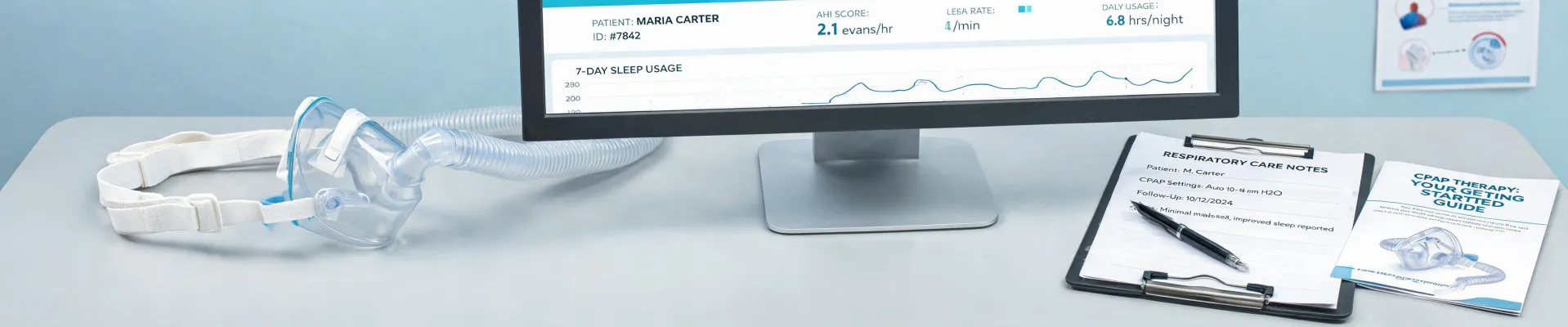
The second pattern was my own fault. In 2023, we activated remote patient monitoring through ResMed's AirView portal for most of our AirSense patients. We gave logins to the right people. We confirmed devices were transmitting. Then we waited for the value to appear on its own.
It didn't. For about two months, patient data flowed into the portal every night while almost nobody looked at it regularly. There was no assigned person, no daily check, no escalation list. So when a patient's adherence dropped or leak data looked bad, the information just sat there.
A pulmonology colleague described it perfectly: remote patient monitoring is like a medical imaging system. If a CT scanner saves images but no radiologist is assigned to read them, you've spent a lot of money on a system that doesn't improve patient care. The technology is only as good as the reading workflow around it.
The fix wasn't complicated. We now have one clinician assigned to review the remote monitoring dashboard for 15 minutes every morning. If a patient's usage drops below target, we call them within 48 hours. If leak data is high, we check whether the mask or cushion is the likely cause before blaming the device. Remote monitoring didn't reduce our workload by magic—it reduced it once we built a process that gave every alert an owner.
What is high flow oxygen? (And why it keeps coming up)
The third unexpected source of support tickets wasn't a device problem at all. It was confusion about different types of respiratory therapy. New clinic staff and patients asked the same question enough times that I finally added it to our training checklist: what is high flow oxygen, and is it the same as a CPAP machine?
High flow oxygen therapy is not CPAP. In simple terms, it delivers heated, humidified oxygen-enriched air through a nasal cannula at high flow rates—typically somewhere in the 20 to 60 liters per minute range. It's often used in hospital settings for patients with acute respiratory failure or other conditions where oxygen support is needed. CPAP, by contrast, delivers pressurized air through a sealed mask to keep the upper airway open during sleep.
When a patient asks whether they can use high flow oxygen instead of their CPAP, the honest answer is: those are different treatments for different problems, and a CPAP device won't deliver high flow oxygen therapy. I'm not a pulmonologist, so I won't pretend to cover the clinical nuances here. What I can tell you from an equipment coordination perspective is that this confusion shows up more often than you'd expect, and it's worth having a plain-language explanation ready before a patient asks.
When ResMed support is actually the right call
I don't want this post to sound like ResMed support calls are never legitimate. We've had real hardware issues in our logged data: a blower that failed after a power surge, a frame that cracked after being dropped, a magnetic headgear clip that stopped latching properly. Those were genuine defects, and official ResMed support was the correct path.
What I'd tell a new coordinator is this:
- Check the mask cushion first. If it's an AirTouch foam cushion and it's older than a month or has been washed, replace it before you blame the mask.
- Check the data before you call. Know whether you're seeing high leak, low adherence, or a device error. ResMed support is much more useful when you can say "AirView shows leak of 40 L/min with a 90-day-old AirTouch cushion" instead of "the mask doesn't work."
- Have the serial number and purchase info ready. It sounds obvious, but it's the difference between a ten-minute support call and a two-day email chain.
One caveat: this is the experience of one 14-bed, hospital-affiliated sleep center. If you're a home medical equipment supplier or a much larger institution, your numbers will probably look different. We had the advantage of a small team where workflow changes could happen quickly. The 46% reduction in our ticket volume won't translate perfectly to every clinic, and I wouldn't pretend otherwise.
But I do think the core lesson holds: a lot of what gets called a ResMed problem is actually a process problem. Once we started treating masks, data, and patient education as connected parts of one system—instead of separate blame targets—our equipment worked better, our patients slept better, and our support tickets finally made sense.

Elena Varga
Elena Varga is a medical imaging systems analyst covering CT scanners, MRI systems, ultrasound platforms, digital radiography, mammography, and ophthalmic imaging equipment. She references IEC 60601-2-44 for CT safety and essential performance while examining CTDIvol, dose-length product, spatial resolution, slice thickness, field uniformity, throughput, uptime, and DICOM interoperability. Her work helps radiology leaders, medical physicists, biomedical engineers, and procurement teams compare image quality, radiation management, workflow integration, serviceability, and lifecycle cost.