How a 48-Hour Rescue Changed Our Checklist for Refurbished ResMed CPAP Machines, Dental X-Rays, and Autoclaves
· Elena Varga
The Call at 6:43 a.m.
When the phone rang at 6:43 on a Tuesday morning in March 2024, I almost let it go to voicemail. I was on my second cup of coffee, mentally walking through a delivery schedule, and the number on the screen wasn't familiar.
Good thing I picked up.
It was Denise, a practice manager at a clinic that was supposed to open its doors to patients in two days. She'd been up since 5 a.m. doing a final dry run of every room. It wasn't going well.
"The autoclave failed its spore test," she said. "The dental x-ray machine won't even boot. And one of the refurbished ResMed CPAP machines we bought at auction just started throwing a high-pressure error."
A pause.
"We open Thursday."
In my role coordinating equipment for clinics and hospitals, I've handled more rush orders than I can count. Two hundred-plus, probably. Most are small; a few run into five figures. And a lot of them trace back to the same root cause: nobody checked before they had to fix.
This one was about to become a textbook example.
How the Mess Started
Denise's clinic wasn't a typical customer for us, at least not all at once. The practice had bought the inventory from a smaller clinic that closed down: one digital dental x-ray machine, a Class B autoclave, some dental laboratory equipment for the in-house lab, and two used ResMed machines to support sleep treatment consults.
The seller shipped everything in one load, with very little paperwork. Denise wasn't buying from us. But she asked us to commission and verify the equipment before opening, which is a normal request in this industry. Equipment brokers sell units as-is. Someone has to check the sensors, the software, the filters, the manuals.
We should have given that job a more rigorous checklist. Instead, we triaged by price: x-ray first, autoclave second, CPAP machines last. That ordering was a mistake. A $40 air filter and a missing PDF manual caused more chaos than a $15,000 imaging system.
How Does an Autoclave Work, Really?
By 8:30 a.m., Denise's dental assistant had asked me that question twice, and I could hear the panic in her voice.
Here's the short version. An autoclave uses pressurized steam to get hotter than boiling water. That wet heat denatures bacterial proteins and kills spores. But it's not enough to just blow steam into a chamber. The steam has to actually contact every surface, and the trapped air has to be removed first. That's what a Class B autoclave does well: it pulls a vacuum, then fills the chamber with steam.
So when our technician pulled the chamber cover, the answer was obvious. Mineral scale was caked onto the heating element and the temperature sensor. The old clinic had been using tap water instead of purified or distilled water. The scale confused the temperature readings, so the unit wasn't reaching the temperature it claimed. It thought it was sterilizing. It wasn't.
Nobody knew, because the maintenance manual didn't come with the unit.
The fix wasn't glamorous. We descaled the chamber, flushed the lines, replaced the door gasket, and ran a full empty-cycle test. Then we ran a Bowie-Dick test. Then we loaded a biological spore indicator into the chamber and waited.
That's the part of the story that still makes me twitch. A biological indicator takes time to grow. If the result had come back positive on Wednesday night, there was no plan B. The clinic's opening would have been delayed, and the dentist would have lost an entire day of booked procedures.
I didn't fully appreciate how much routine maintenance matters until that moment. All of it was preventable with distilled water and a monthly look at the manual.
The X-Ray Was Never Broken
Meanwhile, our imaging technician was staring at a dental x-ray machine that booted to a login screen and then stopped.
At first, we assumed hardware. It wasn't.
The previous clinic's software license was still locked to their old server. The seller had wiped the computer, but not properly transferred the software license or included the original installation media. The machine was fine. The paperwork was missing.
That took most of the day to sort out. We found the original serial number, tracked down the manufacturer, signed a transfer form, and waited for the license to be reactivated. It came through around 3 p.m. Then we ran test images, verified the image quality, and labeled the unit with its own asset tag so this would never happen again.
Honestly, the x-ray was the most expensive piece of equipment in the building and the easiest problem to solve. It just took time. And time was exactly what we didn't have.
The ResMed Lesson
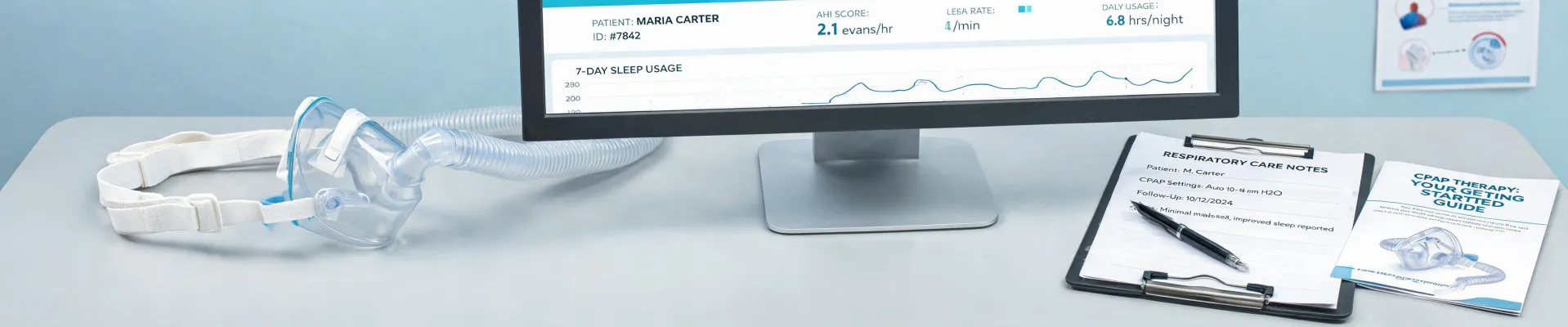
Then there was the refurbished ResMed AirCurve 10.
The error message made it sound like a major failure. High pressure. Motor fault. Replace machine.
But our respiratory tech opened the side compartment and found an air filter that looked like it had been pulled from a vacuum cleaner bag. The previous owner had stored the machine without a filter in place, or at least without changing it for a very long time. The airflow restriction was enough to trigger the alarm.
Here's where the "boring stuff" really matters: if someone had downloaded the ResMed AirCurve 10 manual PDF when the machine arrived, they would have found the filter replacement schedule in about two minutes. ResMed publishes the patient guide for free on their own website. It tells you exactly how often to replace the filter and what the error codes mean.
We replaced the filter, ran a pressure calibration test, and the machine behaved perfectly. No motor fault. No high-pressure error. Just a dirty filter that had been ignored because nobody had the manual.
A side note for anyone buying refurbished ResMed CPAP machines: don't judge the device by the model number alone. Judge it by whether the filters are clean, whether the humidifier chamber has been descaled, and whether the documentation actually comes with the unit. Those details tell you more about the previous owner than the hours counter ever will.
The 22-Hour Push
Tuesday was a blur. By early evening, we had the autoclave cycling again and the x-ray software license reactivated. The CPAP machine was running quietly in the corner with a clean filter and a fresh tube.
But we still had the biological spore test to wait on, and the dental board inspection was scheduled for Thursday morning.
We stayed late. At 10 p.m., we ran a full dress rehearsal: packaged instruments in the autoclave, a test image on the x-ray, and the ResMed machine set up exactly the way it would be for a patient consult. Everything passed.
Wednesday morning, the spore test came back negative. I honestly don't remember ever being so relieved to see a little colored dot in a plastic tube.
Denise called me at noon on Thursday. The inspection had gone well. The first patient was in the chair. She kept saying "I don't know how you did it," but I did know how. We didn't fix anything brilliant. We cleaned what should have been cleaned, found paperwork that should have been transferred, and replaced a part that should have been replaced before the machine was ever sold.
All of it was preventable.
Five minutes of verification beats five days of correction.
What I'd Do Differently
The March 2024 rescue changed how we handle every piece of used equipment that comes into our warehouse, regardless of who's selling it. Our intake checklist now starts with the boring questions:
- Where is the manual? Not the random PDF from a file-sharing site, but the actual manufacturer guide. For ResMed devices, that means the official ResMed AirCurve 10 manual PDF from the manufacturer's site.
- What water has been used in the autoclave? If there's any sign of mineral scale, the unit gets a full descale before it goes anywhere.
- Is the CPAP air filter clean? Open the compartment before you even plug the machine in.
- Does the dental x-ray system include a software license, installation media, and transfer documentation?
- When was the last real test cycle run, and what were the actual readings?
This checklist is not exciting. It's not a game-changer in the dramatic sense. But it would have saved Denise's clinic 22 hours of chaos, and it would have saved us a very stressful Tuesday.
Most buyers focus on whether the device is the newest model or whether they're getting a bargain. Those questions miss the point. The question everyone asks is, "How many hours are on it?" The question they should ask is, "What's been verified, and what documentation actually comes with it?"
People also assume that rush jobs cost extra because equipment dealers want to pad the invoice. That's backwards. Rush work costs extra because urgency has real costs: overnight freight, overtime, technicians pulled off other jobs, and no buffer for the next surprise. Preventing that urgency is usually cheaper than billing for it.
That's why our company policy now requires a 48-hour buffer on any used equipment delivery. We built that policy because of what happened in March 2024, not despite it.
The clinic opened on time. It almost didn't. And the fix wasn't newer equipment or better technology. It was the unglamorous habit of checking the basics before someone's business depends on them.
Trust me on this one. The boring checklist is the cheapest insurance you can buy.

Elena Varga
Elena Varga is a medical imaging systems analyst covering CT scanners, MRI systems, ultrasound platforms, digital radiography, mammography, and ophthalmic imaging equipment. She references IEC 60601-2-44 for CT safety and essential performance while examining CTDIvol, dose-length product, spatial resolution, slice thickness, field uniformity, throughput, uptime, and DICOM interoperability. Her work helps radiology leaders, medical physicists, biomedical engineers, and procurement teams compare image quality, radiation management, workflow integration, serviceability, and lifecycle cost.