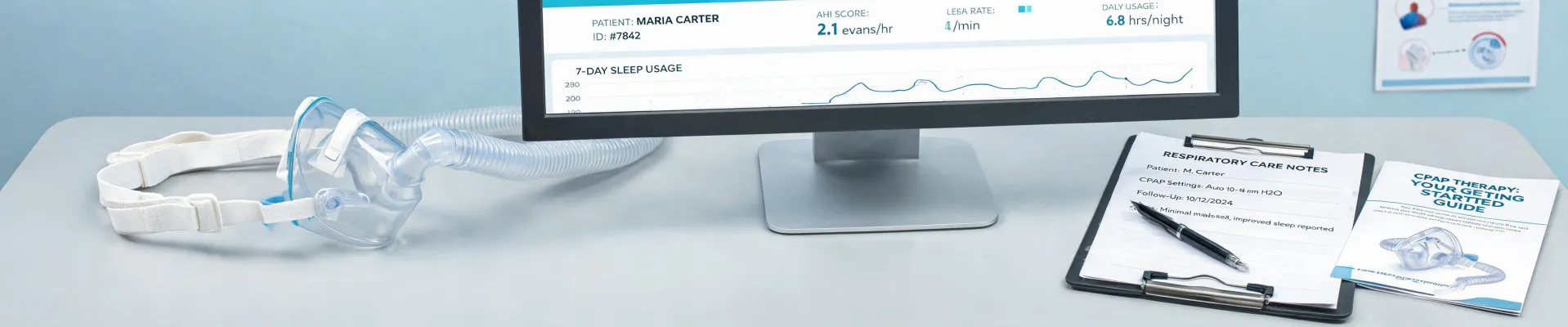
An $18,000 ResMed AirSense 11 Order Taught Me What Sleep Apnea Testing Really Involves
· Elena Varga
There’s a laminated checklist taped to the outside of our equipment storage room at the sleep center. Every new hire asks about it within their first week. Last month, one of our newer respiratory therapists asked me why it exists—so I told her the whole story. Now I’ll tell you too.
I Took Over Equipment Ordering With No Sleep Medicine Background
I handle equipment and supply purchasing for a mid-size sleep clinic in Ohio. We’re not a hospital system and we’re not a small private practice—somewhere in between. Four exam rooms, two sleep study beds, a compact CPAP dispensing area. I’ve been in this role for six years, but when I started, I knew almost nothing about sleep medicine.
My background is general medical procurement. I could compare ventilator specs or explain the difference between a pulse oximeter and a cardiac monitor at a basic level. But polysomnography? Sleep staging? Titration? I’d have failed the quiz.
In early 2022, our medical director decided we should bring CPAP dispensing in-house. We were diagnosing OSA every week and referring patients to three different DME suppliers. Patients complained about wait times. Compliance data was scattered across portals. The doctor wanted us to stock masks, dispense ResMed and other machines, and manage the critical first weeks of therapy ourselves.
The decision was right, and I still believe that. The problem was my execution.
The Order That Started the Trouble
I did what I always do when we buy equipment: compared specs, checked pricing, placed the order. Twenty ResMed AirSense 11 machines—the latest model, with built-in cellular connectivity so compliance data would flow to us automatically. That part of the decision was solid. The AirSense 11 is a dependable device and most of our patients do well on it.
The mistake was everything around the machine.
I ordered 100 masks to go with it. One style. One size range. A medium nasal pillow. No full-face options, no nasal masks, no fit packs, no sizing tools. In my defense, nobody on the clinical team had offered input on what to stock—but it was my job to ask. That was the first lesson, and it cost me the most.
I placed the PO in March 2022. Three weeks later, the whole thing started to unravel.
What Sleep Apnea Testing Actually Involves
The chaos taught me things I should have known before the order went through. Start with the most basic question: what is sleep apnea testing?
Diagnostic testing for sleep apnea—polysomnography, clinically—is an overnight study that monitors brain waves, eye movements, breathing effort, airflow, blood oxygen saturation, heart rhythm, and limb movements. The cardiac monitor component surprises a lot of patients, but it’s a standard part of the study. The AASM practice parameters require ECG monitoring in full polysomnography, partly because OSA and cardiovascular disease are so intertwined. A lot of patients discover underlying arrhythmias or blood pressure issues during a sleep study. The AASM estimates that roughly 30 million US adults live with sleep apnea, and the majority remain undiagnosed.
The output is a set of scores—AHI, oxygen nadir, sleep architecture breakdown—and those scores determine whether a patient needs treatment, at what pressure, and how urgently. If the diagnostic study shows OSA, many patients come back for a titration study, where the CPAP pressure is fine-tuned while the same monitoring continues.
Here’s the thing I missed completely: none of those measurements tell you which mask a patient will tolerate at 12 cmH₂O for seven hours. Mask fit is a clinical individualization problem, not a SKU-counting problem. I didn’t know that in March 2022. I treated CPAP dispensing like stockpiling blood pressure cuffs. It is not that.
The Patient Who Broke the System
Our first visible failure came about three weeks after launch. Dana, our lead respiratory therapist, had a patient—I’ll call him Mr. H. A 58-year-old with severe OSA, oxygen desaturating into the high 60s in REM sleep. He was also recovering from a knee replacement with limited mobility. For his study, he needed a bariatric bed, and transferring him from his wheelchair into the bed required a patient lift. We didn’t have one on site.
Dana spent the afternoon arranging a rental. It worked out, thankfully, and the study was completed. But the dominoes were already falling.
Mr. H’s study showed severe supine-predominant OSA. He needed CPAP at 14 cmH₂O. The next morning, Dana tried to fit him with the nasal pillow mask I’d bought 100 of. It was wrong for his face. The pillows pressed too hard at his nostrils, the headgear length was tight, and he was anxious about the whole experience. Every adjustment made it worse.
Dana pulled a full-face mask from a vendor sample kit we’d almost thrown away (should mention: never discard those sample kits—they kept us alive during that period). That got Mr. H through his first night. But he left with the same uncertainty he came in with, and he asked Dana a question I still think about: “Is it always going to feel this hard?”
No patient should leave their first CPAP fitting feeling like that.
Fixing It—Slowly and Systematically
I authorized a rush order for a proper mask inventory: nasal pillows in multiple sizes, nasal masks, full-face masks, and the fitting tools that go with them. And we switched our supply purchasing from the local distributor to the ResMed shop portal—or rather, our office manager made that switch after seeing that the portal had product bundles and fitting resources our distributor had never mentioned. The portal gave us better visibility into what a standard patient setup should include. That was the first real efficiency gain.
But the deeper problem wasn’t the ordering channel. It was the workflow—or the absence of one.
Starting in May 2022, I documented every error that came out of that launch. Six significant mistakes, roughly $18,000 in wasted inventory and expedite fees by the end of Q2. Some stock was traded to a neighboring clinic, but the harm to a few patients’ therapy starts couldn’t be reversed with a transfer order.
The documentation turned into a two-page checklist. New staff members get it on day one. The items that matter most:
- Match the mask to the patient’s anatomy, pressure needs, and breathing style—not to whatever is cheapest in the catalog.
- Confirm the humidifier and heated tube setup before dispensing, especially in our climate.
- Activate the device’s cellular module on the ResMed portal before the patient walks out the door.
- Schedule a two-week data review call. Early mask leak correction is what keeps compliance rates alive.
As of January 2025, this checklist has caught 47 potential errors. That’s 47 appointments, fittings, and therapy starts that did not get wasted. In a clinic our size, that’s a number worth more than the $18,000 I burned through in that first quarter.
What I’d Do Differently—and What I’d Tell You
It took me about 18 months and well over a hundred follow-up calls with patients to understand something that sounds obvious in hindsight: the CPAP machine is the easy part. The AirSense 11 is a good device, and we use it as our primary dispensing model. But therapy success comes from the ecosystem around the machine—mask fit, humidification, education, early troubleshooting, data review. The device enables the therapy. The system delivers it.
I should add a caveat: this worked for us because we’re a mid-size clinic with two respiratory therapists who can block 45 minutes for an initial fitting. If you’re a solo sleep specialist without that capacity, your program will need to look different. The principle—understand the clinical workflow before you buy the inventory—holds regardless. But the details will vary.
If you’re setting up a CPAP program or ordering ResMed equipment for the first time, do me a favor: sit down with the people who will fit the masks and review the data before you write the PO. Their input matters more than any spec sheet or forum thread.
And to the therapist who asked about the laminated checklist last week: I’m glad I wrote it all down. I felt kinda embarrassed documenting my own mistakes at first. But if I hadn’t, the next person in my chair would have repeated every one of them. That’s the mistake I refuse to make twice.

Elena Varga
Elena Varga is a medical imaging systems analyst covering CT scanners, MRI systems, ultrasound platforms, digital radiography, mammography, and ophthalmic imaging equipment. She references IEC 60601-2-44 for CT safety and essential performance while examining CTDIvol, dose-length product, spatial resolution, slice thickness, field uniformity, throughput, uptime, and DICOM interoperability. Her work helps radiology leaders, medical physicists, biomedical engineers, and procurement teams compare image quality, radiation management, workflow integration, serviceability, and lifecycle cost.