Why Your Medical Device Budget Is Over Running: A Procurement Manager's $8,400 Lesson
· Elena Varga
The Budget Trap I Fell Into
In my first year managing procurement for a 40-person sleep and diagnostics clinic, I made the classic mistake: I kept vendor quotes in one spreadsheet and purchase orders in another. You can guess how that ended. By Q3, we were over budget across three categories—CPAP equipment, lab supplies, and even basic diagnostic tools like blood pressure monitors.
I remember staring at the numbers and thinking, How? I negotiated great prices. That was exactly the problem. The prices were great. The total costs weren't.
The Purchase Price Is Just the Entry Ticket
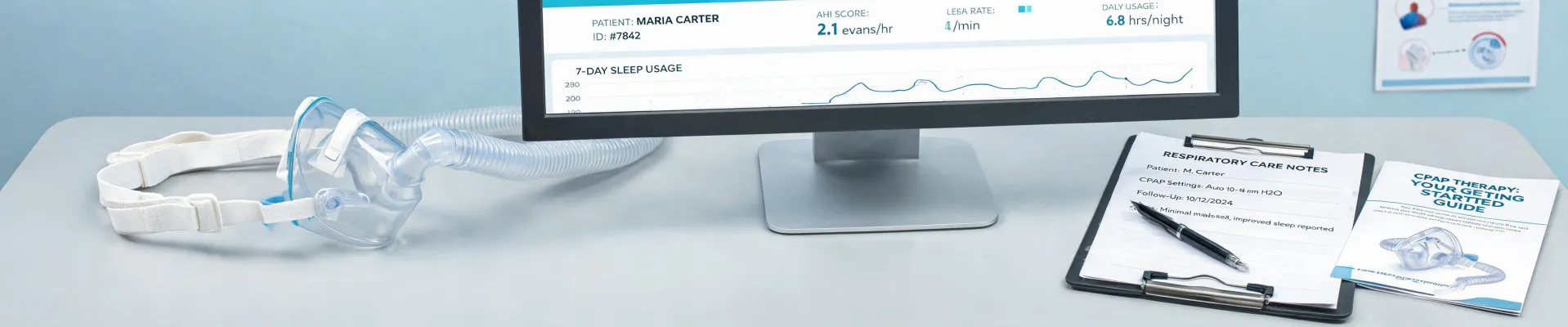
Let's start with the example I know best: ResMed CPAP machines. If you've ever evaluated one for a sleep center or home care program, you've seen the quote: the device itself, a starter mask, the tubing. The number looks reasonable.
What doesn't show up on that quote are the things that keep the device working over time. Masks need replacing every three to six months. Filters need changing. The humidifier water chamber wears out. And if you're considering the ResMed AirView platform for remote patient monitoring—which, honestly, is a game changer for compliance tracking—that's a separate subscription cost that never appears on the equipment invoice.
Everything I'd read about CPAP procurement said compare device prices. In practice, comparing only device prices is like buying a printer without considering the ink. And I learned that the expensive way.
My "Cheap" Blood Analyzer Wasn't Cheap
In 2022, I approved a blood analyzer for the lab based purely on the upfront quote. It was $3,200 less than the competitor's model. My finance director actually congratulated me.
Six months later, I ran a real cost analysis. The "cheaper" analyzer required proprietary reagent packs that cost about 8% more per test. Calibration standards had to be ordered monthly, and every order carried shipping fees. Staff training took twice as long because the interface wasn't intuitive. Total extra operating cost for one year: roughly $2,400. Plus the training hours I hadn't budgeted for.
They warn you about hidden fees in lab equipment procurement. I didn't listen. Then I ate an $800 mistake in calibration costs alone when I discovered the pipettes hadn't been verified on schedule. Electronic pipettes need regular calibration checks—especially in a regulated diagnostics setting. A $500 pipette carries $120 to $150 per year in calibration and maintenance costs. Nobody puts that on the quote either.
The "Simple" Devices Are Never Simple
You'd think a blood pressure monitor is a low-effort procurement. It is—until you need three different cuff sizes for your patient population. Until staff need training on how to use a blood pressure monitor correctly per protocol: proper cuff placement, patient seated for five minutes, feet flat on the floor, no talking. Until one monitor gets dropped and starts producing readings that are 15 mmHg off. Now you're in accuracy-verification territory. That's a cost.
One of the most common questions my team gets from patients: "Can I use reverse osmosis water in my ResMed CPAP?" It sounds like a minor maintenance detail, but it's exactly the kind of small decision that determines long-term equipment cost. ResMed's official guidance for its humidifier chambers recommends distilled water. RO water that is properly filtered is, in practice, just as mineral-free. But if a patient assumes tap water is fine, you get scale buildup, a shortened water chamber life, and premature replacement costs. Get the answer right, and you save real money over the machine's lifetime. Ignore it, and you're signing up for avoidable replacement purchases.
The 25–40% Tax on Every Equipment Purchase
After six years of tracking every invoice, I found a pattern. Budget overruns weren't caused by one big purchase. They were driven by dozens of small recurring costs that never appeared on the original quote:
- Reagents and consumables for blood analyzers
- Calibration services and standards for electronic pipettes
- Replacement masks, tubing, chambers, and filters for ResMed CPAP devices
- Training and retraining on devices like blood pressure monitors
- Subscription fees for platforms like AirView
- Shipping and handling on every consumables reorder—which adds up faster than you'd think
I don't have hard data on industry-wide numbers, but based on roughly 200 purchase orders in our own system, I'd estimate that 25–40% of a medical device's total annual cost comes after the initial purchase. For CPAP machines, the mask and accessory replacement cycle alone often consumes a significant chunk of the device's lifetime cost. And when a sales rep says "the device pays for itself," they're technically right. They just don't mention you'll be paying for it again in small transactions all year long.
You can't control what you don't measure. Start measuring the post-purchase costs.
The Fix: A Simple TCO Framework
After the blood analyzer fiasco, I built a total cost of ownership spreadsheet. It's not impressive. It's a Google Sheet. But it completely changed how we evaluate vendors.
Here's the calculation we use for every device:
Total Cost of Ownership = Initial Price + Annual Consumables + Calibration & Maintenance + Training + Replacement Rate × Expected Lifespan
For ResMed CPAP machines, we now include mask replacement costs (2–3 masks per patient per year), filter costs, humidifier chamber replacement, and any AirView subscription fees. For lab equipment, we factor in reagent cost per test—not just the analyzer price. For pipettes, we budget calibration service contracts. For blood pressure monitors, we include replacement cuffs and an annual accuracy check.
We also changed the vendor evaluation process. Now, before shortlisting anyone, we ask for a post-purchase cost list: consumables pricing, maintenance schedules, calibration fees, training expectations. You'd be surprised how many vendors hesitate at that request. The ones who answer transparently tend to win our business—even when their upfront price is slightly higher.
That said, I don't want to sound like the old way was all wrong. We used to buy from one trusted distributor and call it a day, and that relationship had real value. I'm not saying you should abandon long-tenured vendors. I'm saying bring them into the TCO conversation. Good vendors will help you build the model. The ones who won't probably have reasons to stay quiet.
What This Saved Us
After implementing this approach, we cut annual per-device operating costs by about 17%—roughly $8,400 across all categories in our 2024 fiscal year. The biggest wins came from: giving our technicians a maintenance calendar so pipettes got calibrated when they were supposed to, switching to a reagent vendor with better per-test pricing even though their analyzer wasn't the cheapest upfront, and standardizing our CPAP accessory ordering so we weren't paying rush shipping on masks every other week.
But here's the part I want to emphasize: the savings didn't come from squeezing vendors. They came from actually seeing where the money was going. Before, it was scattered across dozens of small invoices. Now it's visible in one place.
So, About That RO Water Question
You might wonder why a cost controller spends so much time on a question like reverse osmosis water in a ResMed CPAP humidifier. Here's why: it's the perfect example of how small decisions create cost consequences.
Distilled water costs about $1.29 a gallon. Properly filtered RO water is essentially free if you already have the system. Tap water is free, too—until you account for the mineral deposits that shorten the water chamber's lifespan. That's a $25–$35 replacement, a few times a year, instead of once every two years. Not a catastrophe. Just an unnecessary bleed.
And there are a hundred small bleeds like this in every medical device category. The trick is to spot them before they become a flood.
So yes, you can use reverse osmosis water in your ResMed CPAP—as long as it's properly filtered and mineral-free. If you're ever unsure, stick with distilled water as ResMed recommends. And while you're at it, look at your maintenance budget. You might just find the hidden costs I found in mine.

Elena Varga
Elena Varga is a medical imaging systems analyst covering CT scanners, MRI systems, ultrasound platforms, digital radiography, mammography, and ophthalmic imaging equipment. She references IEC 60601-2-44 for CT safety and essential performance while examining CTDIvol, dose-length product, spatial resolution, slice thickness, field uniformity, throughput, uptime, and DICOM interoperability. Her work helps radiology leaders, medical physicists, biomedical engineers, and procurement teams compare image quality, radiation management, workflow integration, serviceability, and lifecycle cost.