ResMed Under-Nose Masks and CPAP Machines: Answers From 200+ Urgent Setups
· Elena Varga
-
1. Which ResMed machine should I choose for sleep apnea?
-
2. What's the best ResMed under-nose mask?
-
3. How fast can I actually get a ResMed machine after diagnosis?
-
4. What kind of patient monitoring does ResMed offer?
-
5. Do I need fluoroscopy or other medical imaging for sleep apnea?
-
6. What do I do if my ResMed machine stops working?
-
7. Can I use ResMed masks with other CPAP brands?
If you've landed here, you probably just got a sleep apnea diagnosis—or someone close to you did. Now the questions are piling up: which ResMed machine is right, which under-nose mask actually fits, how fast can you get everything? I coordinate equipment delivery at a durable medical company. I've handled 200+ rush orders in five years, including same-day turnarounds for patients who woke up with no machine and went to bed with therapy. These are the questions I answer most.
1. Which ResMed machine should I choose for sleep apnea?
For most adults, start with the AirSense 11 AutoSet. It's ResMed's current flagship—the AirSense 10 was the workhorse from 2014 until the 11 came along—and it adjusts pressure through the night as your breathing patterns change. The fixed-pressure Elite is cheaper, but honestly, fewer than 20% of our patients choose it.
I don't have hard data on the exact split, but based on five years of orders, my sense is about 4 out of 5 people go AutoSet, and most are happy with it. The auto-adjusting pressure really matters if your OSA changes with sleep position, weight, or alcohol. One caveat: if you travel a bunch, the AirMini is smaller, but you give up the built-in humidifier.
And remember, your prescription isn't a verdict. ResMed publishes the clinical data behind its therapy claims—which matters, because FTC advertising guidelines require health claims to be substantiated. If a brand can't show you its own outcome numbers, walk away.
2. What's the best ResMed under-nose mask?
"Under-nose" is misleading, because ResMed sells two very different styles that both sit below your nose. The AirFit P10 uses nasal pillows—little silicone cones that seat at your nostrils. The AirFit N30 and N30i use a nasal cushion that rests on the underside of your nose without going inside. The N30i routes the tube over the top of your head, which is a game changer for side sleepers.
I've fitted all three more times than I can count. The P10 is quieter and more secure if you toss and turn. The N30/N30i is better for people who find pillow tips irritating. But here's the truth: many patients try one, then switch within their 30-day trial window, and that's fine. Take advantage of the trial period—insurance usually covers a replacement within the first month anyway.
3. How fast can I actually get a ResMed machine after diagnosis?
Faster than you think, if you know what to ask. Standard shipping through USPS or UPS sits around 3-7 business days. But rush setups? I've gotten patients up and running within 24 hours, more than once.
March 2024, a sales exec got his sleep study results at noon. Severe OSA—AHI of 42. Insurance approved at 2:40 PM. Our warehouse packed an AirSense 11, mask, and heated tubing, and I paid $80 in courier fees to get everything to his hotel by 7 PM. He was flying to Paris at 6 AM. Skipping that delivery would've meant two more weeks of untreated OSA—waking up gasping in a hotel room at 3 AM, running on fumes at client meetings, and that's if nothing worse went wrong first.
So here's what I tell every patient: call your supplier and ask two questions before you pay anything. Is the machine in stock? Do you offer same-day or next-day delivery? If the answer to either is no, find another supplier. When your therapy is on the line, the extra $40-80 for expedited delivery buys certainty, not just speed.
4. What kind of patient monitoring does ResMed offer?
Let's clear up the "types of patient monitoring" confusion. Healthcare monitoring spans a spectrum—spot checks like home blood pressure, retrospective tracking like a glucose log, and continuous real-time vitals like ICU bedside monitors. ResMed's AirView sits firmly in the retrospective tracking camp.
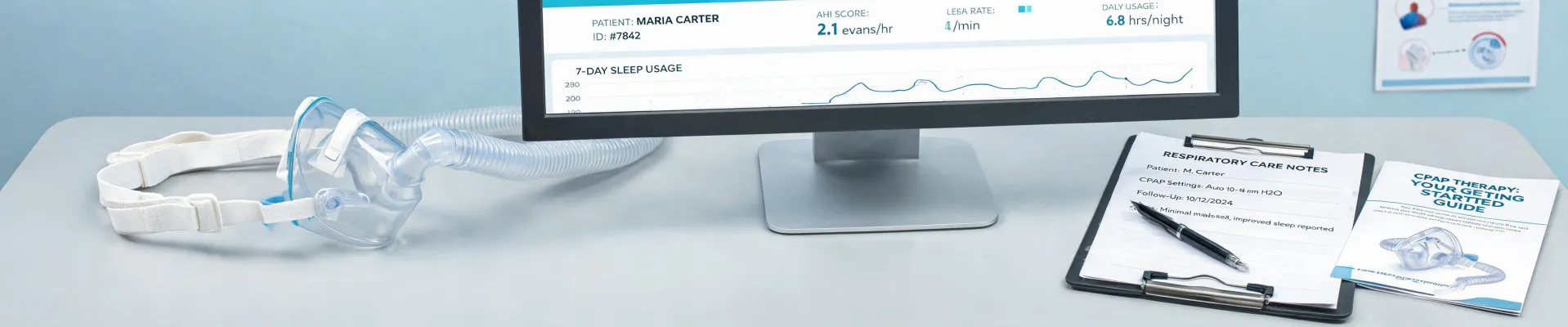
AirView is a cloud platform that your CPAP machine reports to overnight. It tracks hours of use, AHI, leak rate, and mask fit. Your physician gets a dashboard—no SD card to bring to a follow-up appointment. The patient app, myAir, gives you a morning score and simple coaching tips.
The important boundary: AirView won't alert anyone if you stop breathing tonight. It's not an emergency monitoring system. For routine OSA, that's absolutely fine. But if you have central sleep apnea or a complex condition, your neurologist or pulmonologist will likely want something more advanced.
5. Do I need fluoroscopy or other medical imaging for sleep apnea?
This surprises everyone. Patients constantly ask if their chest X-ray or head CT relates to OSA. It usually doesn't. Diagnosis is built on a sleep study, not imaging.
That said, imaging has a role in specific situations. A fluoroscopy system—a medical imaging system that records real-time moving X-ray—can help a specialist see dynamic airway collapse that a static MRI wouldn't catch. It's sometimes used in complex sleep centers to plan surgery or investigate unusual obstruction.
But here's the red flag: if someone orders imaging for routine OSA workup, ask what decision it will change. If it's not planning a surgery or ruling out a structural abnormality, it's probably unnecessary. You have every right to ask that question.
6. What do I do if my ResMed machine stops working?
First, don't panic and don't buy a new machine. The most common "it's broken" call I get turns out to be a dead power adapter or a clogged air filter. Check the filter, then the power cord, before you touch your wallet.
If the device is truly dead, check the warranty. ResMed covers five years. The catch: repairs take 2-4 weeks, and you need therapy tonight. So ask your DME supplier about a loaner. Most keep a few spares. If they won't lend one, rent a machine locally—$50-80 a month is a fraction of the cost of untreated severe OSA.
The underlying lesson matches what I've learned from 200+ rush jobs: certainty matters more than price. Know your supplier's after-hours policy before you need it. Keep a spare mask and tubing. Never let a broken machine turn into weeks of untreated apnea.
7. Can I use ResMed masks with other CPAP brands?
In most cases, yes. The standard 22mm hose connection is universal. A ResMed AirFit P10 fits a Philips machine, and a Fisher & Paykel full-face works on an AirSense. The "you must stay in one brand" rule comes from the 1990s, when every manufacturer used proprietary connectors. That's changed.
Two exceptions. Heated tubing is still proprietary—a ResMed ClimateLine won't run on a Philips machine. And the mask-fit detection algorithm performs best with the same brand's mask. Mixing brands means losing that smart measurement.
Practical advice: pick a mask based on fit, not brand. But stick with the same brand's heated tube if you want the full experience. And whatever you do, set the correct mask type in the machine settings, or your pressure readings will be off.

Elena Varga
Elena Varga is a medical imaging systems analyst covering CT scanners, MRI systems, ultrasound platforms, digital radiography, mammography, and ophthalmic imaging equipment. She references IEC 60601-2-44 for CT safety and essential performance while examining CTDIvol, dose-length product, spatial resolution, slice thickness, field uniformity, throughput, uptime, and DICOM interoperability. Her work helps radiology leaders, medical physicists, biomedical engineers, and procurement teams compare image quality, radiation management, workflow integration, serviceability, and lifecycle cost.