Most Equipment Failures Are Self-Inflicted: Why I Verify Before I Buy
· Elena Varga
Most equipment failures in a medical facility are self-inflicted. That sounds harsh, but after six years of managing equipment and supply orders for a 38-bed sleep and respiratory clinic, I'm convinced. We don't lose money because vendors overcharge or budgets are too tight. We lose money because we skip the verification step that would've caught the problem before the repair invoice arrived. Five minutes of checking beats five days of fixing. Every time.
I'm an administrative buyer. My job covers everything from ResMed AirSense 10 Auto CPAP machine orders for the sleep lab to the gloves in the exam rooms—roughly $200,000 a year in purchases across eight vendors. I report to both operations and finance, which is code for "one boss wants it cheaper, the other wants it better."
The $3,800 Order That Taught Me Compatibility Matters
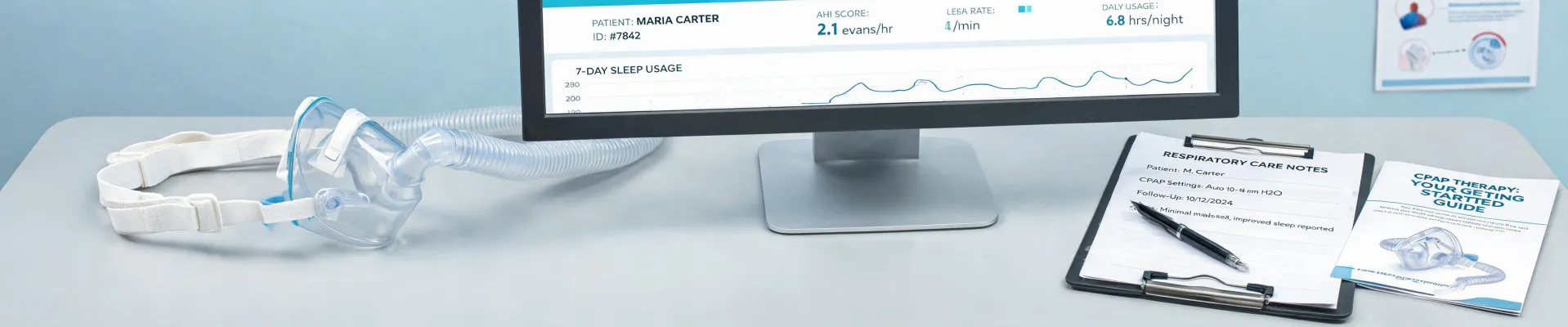
When I took over purchasing in 2020, my first big order was six ResMed AirSense 10 Auto CPAP machines for a new sleep study room. The device itself is solid—according to the FDA 510(k) database (accessdata.fda.gov), it's cleared to treat obstructive sleep apnea in adults. But CPAP therapy isn't just the machine. It's the mask, the tubing, the humidifier, the data module. What I didn't verify: the heated humidifier in the AirSense 10 is designed to be paired with ClimateLineAir heated tubing. Without it, warm humidified air hitting standard tubing creates condensation—rainout, in sleep-lab slang—and patients wake up with water droplets in their masks. We had a shelf full of standard, non-heated tubing from the previous room setup. So the new machines sat unopened while I placed a rushed second order for the heated tubes, plus expedited shipping. Extra cost: about $680 in freight and a week of scheduling delays.
The worst part isn't the money. It's that a 30-minute read of the spec sheet would've prevented the whole thing. In hindsight, ordering the heated tubing upfront was a no-brainer. I've now got a compatibility checklist for every product line: device model, mask type, tubing standard, humidifier settings, software version. It felt like overkill at first. It's saved me from a fourth emergency order more times than I can count.
The Small Consumables Trap
Here's the thing about running a CPAP clinic: hygiene protocols aren't optional. Every mask that goes near a patient's face gets wiped down first, and the wipe matters. Regular disinfectant wipes leave residues that can irritate skin—and if a patient gets a rash around their nose, they stop using the machine. Therapy fails. The referring physician gets a call. The clinic looks careless.
In Q3 2023, we ran out of resmed mask wipes mid-week. My reorder had been sitting in a virtual cart while I dealt with "more important" purchase orders. The respiratory therapists, being pragmatic people, grabbed the hospital-grade disinfectant wipes from the supply closet instead. Two patients developed skin irritation. One canceled her next appointment.
It took me 10 minutes after that to set up a recurring order with a minimum-stock alert. Ten minutes. The cure cost us patient trust; the prevention cost a coffee break.
The Endoscope That Changed My Perspective
I'm going to talk about a department I know nothing about: GI.
Our endoscopy unit shares the same supply budget as sleep and respiratory, so their nurse manager asked me to help justify a new storage cabinet. I looked at their procedure manual to understand the request. That's when I learned how to store endoscopes properly: according to SGNA's standards of practice (sgna.org), scopes must be hung vertically in a vented, dry storage cabinet—not coiled in a transport case or left in a drawer.
Why? Because residual moisture inside the instrument channels breeds biofilm. Biofilm leads to reprocessing failures, which is a patient safety issue and a financial one. The year before, one scope had to go out for repair after repeated reprocessing issues. The bill: $4,200. A proper storage cabinet: about $1,500. Hanging a scope vertically instead of setting it down "for just a second": free.
The upside of skipping the routine is 30 seconds saved. The risk is a contaminated or damaged scope. I kept asking myself: is 30 seconds worth potentially compromising a sterile instrument? The answer seems obvious—yet we'd paid $4,200 for that particular 30-second shortcut.
The same logic shows up in equipment I'll never fully understand. Our CT scanner's OEM preventive maintenance contract runs about $24,000 a year (per our 2024 contract; verify current pricing with your vendor). That sounds like a lot until you price a replacement tube—around $70,000. The manufacturer priced the checkup to be cheaper than the funeral. And the hematology analyzer in the lab requires daily quality control runs per CLIA regulations. The field engineer once told me, flat out:
"Every calibration failure I've seen here traces back to somebody skipping the daily QC log. Every single one."
It's tempting to think buying medical equipment is just about comparing prices. But identical specs from different vendors, or a lower-priced device without the right supporting components, can produce wildly different outcomes. The purchase price isn't the cost.
"But What If You Only Have Five Minutes?"
Here's the objection I get whenever I argue for more verification: "Easy for you to say. You're not the one making the call in a five-minute window."
Fair. I've made decisions in worse windows. Two months ago, a pulmonologist asked me to source a specific mask size same-day for a patient about to travel. I skipped my usual verification routine and went with the first vendor that showed stock. Wrong size. Restocking fee plus a disrupted travel plan—both avoidable. I'd like to say I'll never do it again, but the pressure to say "yes" fast isn't going anywhere.
What changed is the system around the decision. I keep a pre-approved supplier list, a cross-reference for every product we stock, and reorder points for consumables. So a fast decision doesn't have to be a risky one. Speed becomes "choose from the approved list," not "trust the first Google result."
It took me three years and more than 100 orders to understand that verification isn't a bureaucratic step. It's the actual job.
Bottom Line
I do not believe in cutting corners to save time, because I've watched the math work out the wrong way too many times. Five minutes of checking compatibility beats five days of returns and rescheduling. A $1,500 storage cabinet beats a $4,200 repair. A 10-minute reorder alert beats a week of improvising with the wrong wipes.
Will I make more mistakes? Absolutely. I made one two months ago, and I'll probably make another next quarter. But I've stopped treating mistakes as bad luck and started treating them as missed verification steps. That shift—more than any checklist—is what made me a better buyer.
Prevention over repair isn't corporate wisdom I'm repeating. It's a rule I learned by paying the stupid tax, and I'd rather you learn it for less.

Elena Varga
Elena Varga is a medical imaging systems analyst covering CT scanners, MRI systems, ultrasound platforms, digital radiography, mammography, and ophthalmic imaging equipment. She references IEC 60601-2-44 for CT safety and essential performance while examining CTDIvol, dose-length product, spatial resolution, slice thickness, field uniformity, throughput, uptime, and DICOM interoperability. Her work helps radiology leaders, medical physicists, biomedical engineers, and procurement teams compare image quality, radiation management, workflow integration, serviceability, and lifecycle cost.