Medical Devices Are Finally Designed for Humans—Here's Why That Matters
· Elena Varga
I'll say it plainly: medical devices were designed for no one in particular for too long. They worked, sure. But they didn't consider the actual human who had to use them. That's changed over the last five years, and in my opinion, it's the single biggest improvement in modern healthcare.
In my role coordinating emergency equipment for a regional hospital network, I've handled 200+ rush orders over six years—some with same-day turnarounds. When I first started, I assumed the clunky, intimidating machines were just how healthcare had to be. Three years of watching patients abandon life-changing therapy because their equipment was uncomfortable taught me otherwise.
The mask that changed my mind
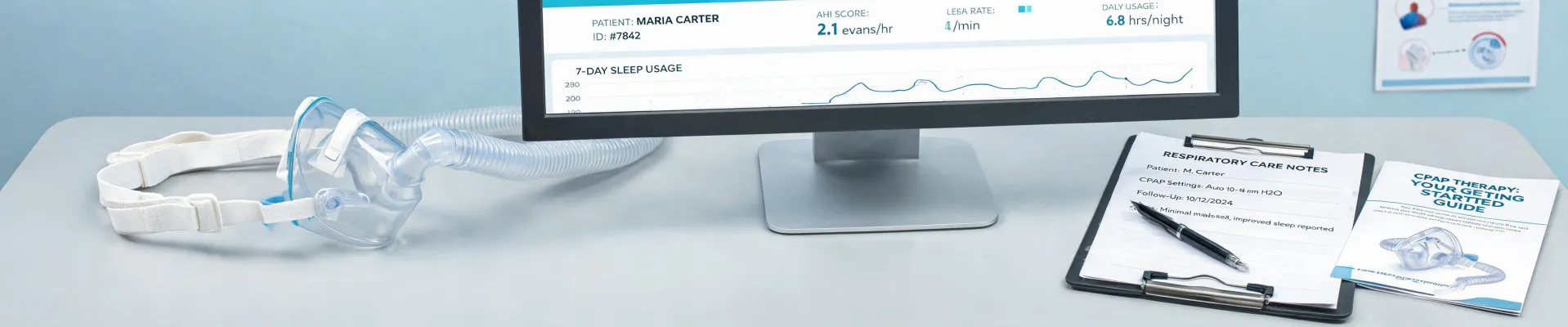
A patient came in and told me they'd stopped using their CPAP machine after two weeks. Not because the therapy wasn't working—because the mask was unbearable. Leaks, red marks, claustrophobia. We had a drawer full of abandoned masks from people who'd given up.
Then we ordered the ResMed AirTouch N30i. I remember thinking, seriously, this is it? It felt way more lightweight than the old models—almost like a camping headlamp. And it made a real difference. Patients actually kept using it. The same applies to the AirFit F40 full face CPAP mask. If you scroll through the ResMed reviews for that mask, the recurring words are seal and comfort. That's not just marketing. That's the difference between a patient who tolerates therapy and one who abandons it.
It's not just sleep therapy—the basics are changing too
Consider the manual resuscitator. For years, it was a bag, a valve, and a mask, and that was it. You needed serious training to use it effectively, especially with one person. But newer models include pressure gauges and audible feedback, which help even experienced clinicians avoid hyperventilation. The fundamentals haven't changed—you still need a skilled hand—but the device now works with you instead of against you.
The power wheelchair is another example. It's tempting to think a wheelchair just needs to move. But when you're talking about someone's daily independence, small design choices—like the sensitivity of the joystick or the smoothness of turns—are a huge deal. Good design doesn't make the chair smart for its own sake; it makes the user feel capable.
I also get asked all the time: how does a blood analyzer work? A few years back, in a real emergency, our central lab machine went down. We had to rely on a portable blood analyzer to get results while a patient was crashing. That portable unit was a game-changer. It ran a full panel on a tiny sample in minutes. It worked because it was designed for that exact scenario: fast, simple, and reliable at the point of care.
The pushback and the bottom line
I hear the skeptics. These devices are over-designed. The function is what matters. To some extent, they're right. A manual resuscitator without a proper seal is useless, no matter how many gauges it has. But this isn't about replacing fundamentals with frills—it's about removing friction between the device and the person using it.
And I want to be careful here. The industry has a long history of marketing over substance. That's why we need regulations like the FTC guidelines (ftc.gov), which require that health claims be truthful and substantiated. If a company says a new design improves compliance, they should be able to prove it. That kind of scrutiny is good for everyone.
Does all this evolution cost more? Sometimes. But untreated sleep apnea leads to cardiovascular problems, emergency department visits, and lost productivity. A wheelchair that's difficult to maneuver doesn't just inconvenience the user—it makes them dependent. A cumbersome mask doesn't just annoy a patient—it ends their therapy. When I think about the true cost of bad design, the upgrade is a no-brainer.
In my opinion, the healthcare industry has finally started designing for humans. It's not about making things look pretty; it's about making things that people can actually live with. That's the kind of progress we should all demand.

Elena Varga
Elena Varga is a medical imaging systems analyst covering CT scanners, MRI systems, ultrasound platforms, digital radiography, mammography, and ophthalmic imaging equipment. She references IEC 60601-2-44 for CT safety and essential performance while examining CTDIvol, dose-length product, spatial resolution, slice thickness, field uniformity, throughput, uptime, and DICOM interoperability. Her work helps radiology leaders, medical physicists, biomedical engineers, and procurement teams compare image quality, radiation management, workflow integration, serviceability, and lifecycle cost.