Medical Device Quality Isn't One Checklist: A Triage Guide for ResMed CPAP, Hybrid Masks, and More
· Elena Varga
Look, I'll admit something. When I first started as a quality inspector in a medical device company, I assumed the safest choice was always the strictest spec. I thought a 50-point inspection was better than a 10-point inspection, and I thought “passes everything” meant “will work in the field.” Four years later, I do not believe that at all.
I review roughly 300 products a year before they reach customers. In our Q1 2024 quality audit, I rejected about 8% of first deliveries. The reasons weren't cosmetic. They were mismatches between what the product was designed to do and what it actually did in real conditions.
Here's the thing: there's no universal quality checklist for medical devices. A CPAP hybrid mask from ResMed and a biosafety cabinet have almost nothing in common except the word “medical.” So before I approve anything, I sort it into one of three scenarios.
Scenario 1: Patient-Contact Consumables (CPAP Hybrid Masks, Syringes)
If the product touches the patient directly, the failure mode is fit and material. You can't inspect “comfort” in a lab, but you can inspect the specs that predict it.
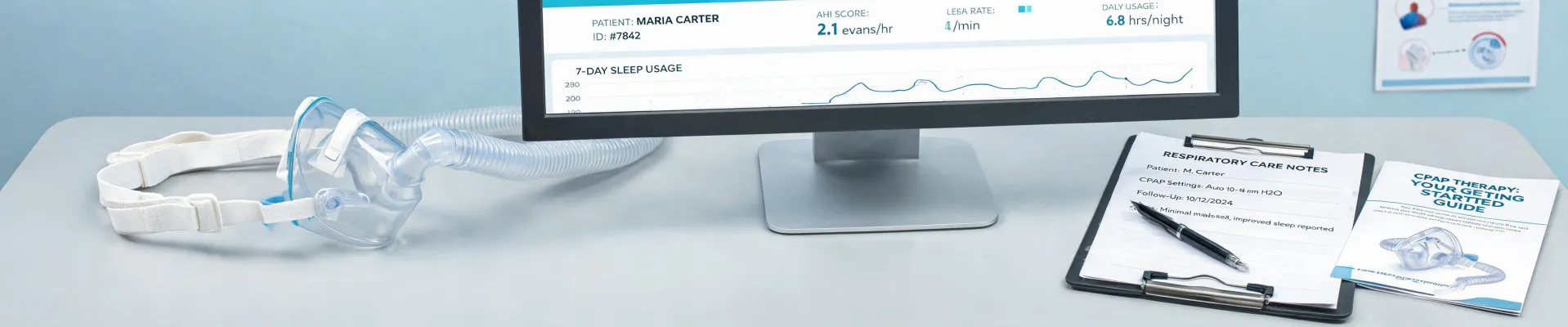
For a ResMed CPAP hybrid mask like the AirFit F30 or F30i, the first thing I ask about is the sealing cushion geometry. Hybrid masks look like nasal masks, but they cover both the nose and mouth. That changes the seal pressure and the exhalation vent flow. If a supplier can't tell me how those specs compare to a standard nasal pillow, I don't approve the product.
Syringes are the same story. I always ask which type we're talking about: Luer-Lok vs slip tip, two-part vs three-part, sterile vs non-sterile. Those are not interchangeable. I've rejected batches because the graduation lines were unevenly spaced. In a 10,000-unit order, that's not cosmetic—it's a dosing error waiting to happen.
One rule I will not drop: if a vendor says “medical-grade” and can't show a material datasheet, that's a red flag. Per FTC advertising guidelines (ftc.gov), health and safety claims need substantiation. I don't treat that as a legal nicety. I treat it as the starting point.
Scenario 2: Active Therapy Devices (ResMed CPAP Machines, Surgical Energy Devices)
Active devices are where the checklist changes the most. The device can look perfect on the outside and still fail the moment it has to do work.
Take the complaint “ResMed CPAP not blowing air.” This is a symptom, not a diagnosis. In our service logs, the most common causes are not a dead blower. The air filter is clogged, the tubing is kinked, or water has collected in the humidifier and partially blocked the air path. All three can look like the same issue, but they are not the same scenario.
Here's a quick triage:
- No LED, no motor sound: likely a power supply or battery issue.
- Motor runs, but no air at the mask: check the filter and tubing first.
- Weak but present airflow: check the humidifier seal and mask vent openings.
In Q1 2024, we received a returned device labeled “not blowing air.” The filter was so covered in dust that the motor couldn't pull enough air through it. The machine itself was fine. That return cost us shipping, labor, and two weeks of downtime for a user who could have been back on therapy sooner.
For surgical energy devices, the failure mode is different but the mindset is the same. I don't look for airflow—I look for waveform compatibility and insulation integrity. If a vendor says “compatible with most generators,” that's not a spec. I need the exact connector and output parameters for the generator model in your facility. Unexpected arcing can be a broken wire, a stripped connector, or a signal mismatch. Those are different root causes, and they need different responses.
Scenario 3: Containment and Environmental Protection (Biosafety Cabinets)
Biosafety cabinets don't touch patients, but they protect them and the lab staff from airborne particles. The quality check starts with certification, not with “looks clean.”
I want the latest cabinet certification before the unit moves into a lab. I check the filter leak test date, the downflow velocity, and the particle count record. If the cabinet has been moved after certification, the certificate is no longer valid. It needs recertification before approval.
It's tempting to think a cabinet with a HEPA filter is automatically safe. But if the intake and downflow balance is off, the HEPA filter can't compensate. (Note to self: never let anyone skip the smoke test.) A cheap cabinet that is certified and maintained is safer than an expensive one that isn't.
How to Tell Which Scenario You're In
Ask three questions:
- Does it touch the patient during use? Focus on material, fit, and tolerances.
- Does it actively deliver pressure, energy, or heat? Focus on power, flow, and component compatibility.
- Does it provide containment or environmental protection? Focus on certification, airflow, and cabinet integrity.
Some products cross lines. A CPAP with a humidifier is both active and patient-contact, so you check both. That's fine. The goal isn't to put devices in neat boxes—it's to make sure you're testing the failure mode that matters.
The next time someone asks me, “Is this any good?”, I usually answer: “What's it supposed to do, and what happens when it fails?” That sounds odd, but it's the most useful quality question I know. For a hybrid mask, failure means poor seal. For a CPAP, failure means no therapy. For a surgical energy device, failure means injury. For a biosafety cabinet, failure means contamination.
No single checklist covers all of that. A good inspector doesn't memorize one. They sort, then check.

Elena Varga
Elena Varga is a medical imaging systems analyst covering CT scanners, MRI systems, ultrasound platforms, digital radiography, mammography, and ophthalmic imaging equipment. She references IEC 60601-2-44 for CT safety and essential performance while examining CTDIvol, dose-length product, spatial resolution, slice thickness, field uniformity, throughput, uptime, and DICOM interoperability. Her work helps radiology leaders, medical physicists, biomedical engineers, and procurement teams compare image quality, radiation management, workflow integration, serviceability, and lifecycle cost.