Medical Device QA: ResMed N20 Mask, AirSense 11 Outlet Adapter, ICU Monitors, C-Arms & Centrifuges
· Elena Varga
There's No One-Size-Fits-All Receiving Inspection
If you've ever signed for a pallet of medical supplies and later found a cracked mask port, you know that sinking feeling. I'm a quality and brand compliance manager at a medical device company, and I review every delivery before it reaches customers—roughly 200+ unique items a year. In our Q1 2024 quality audit, we rejected 9% of first deliveries because of spec deviations. Not because our vendors are sloppy, but because the receiving checklist didn't match the product.
That's the core mistake: people treat a CPAP mask, an ICU monitor, a C-arm system, and a centrifuge like they all need the same inspection. They don't. The right approach depends on what you're receiving, how it's used, and which failure mode would cost you the most. A visual check is never enough for patient-contact items. A power-on check is never enough for imaging equipment. And a balance check is never enough for a centrifuge.
Per FTC guidelines (ftc.gov), any claim about device compatibility or performance has to be substantiated. I treat supplier claims the same way: I verify. Here are the scenarios I've built over four years of reviewing these products.
Four Scenarios, Four Different Checkpoints
Before diving in, here's a simple way to classify what you're looking at:
- Patient-contact consumables (masks, cushions, tubing): focus on material, geometry, and leak.
- Connectable components (adapters, ports): focus on fit and mechanical lock.
- Active medical electronics (ICU monitors, C-arm systems): focus on electrical safety, firmware, and calibration.
- Mechanical/lab equipment (centrifuges): focus on balance, rotation, and safety interlocks.
It isn't a perfect taxonomy, but it helps you see why a single checklist would be a no-brainer in theory and a disaster in practice.
Scenario A: ResMed mask N20
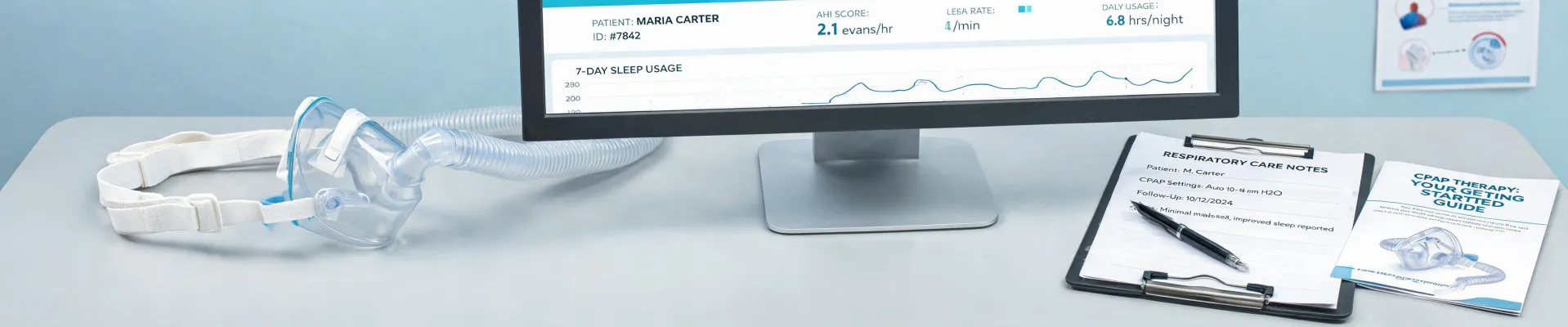
The ResMed mask N20 is one of the most common CPAP masks we ship, and it's also one of the easiest to inspect incorrectly. People see a soft silicone cushion, an unobtrusive frame, and assume it's fine. But the N20's seal depends on a specific cushion geometry, frame angle, and headgear clip tension. Any one of those three things can be off-spec and still look normal to the eye.
We received a batch where the nose bridge angle was off by about 1.2 mm from our spec. It looked fine. It sealed fine at low pressure. But at therapeutic pressure, the leak was loud enough to wake a patient. The vendor claimed it was within industry standard. We measured it, rejected the batch, and they redid it at their cost. Now every contract includes a geometry check on a sample and a 24-hour leak test.
I still kick myself for not measuring that angle earlier. If I'd run the test at the dock, we'd have caught it before the masks reached the sleep lab. So glad we added the 24-hour leak test to our ResMed mask N20 protocol—we almost accepted the next shipment based on visual inspection alone (this was back in 2024, at least). The lesson: when a mask touches a patient's face, your eyes are not the right measurement tool.
Scenario B: ResMed AirSense 11 air outlet adapter
The ResMed AirSense 11 air outlet adapter is a small plastic component that connects the device's air outlet to the tubing. It doesn't look like a critical part. But if the snap-fit is loose, the tube can pop off in the middle of the night. If the locking tab doesn't travel far enough, the mask seal fails and the leak alarm goes off. For a patient who relies on CPAP, that's not an inconvenience—it's a bad night and a frustrated call to your support line.
Here's what I learned the hard way: we once accepted a shipment of adapters based on visual inspection. The adapters looked identical to the previous lot. But when a technician attached a heated tube, the tube rotated freely and the leak alarm went off. We ended up replacing 800 units (ugh). The root cause? The internal diameter of the outlet adapter was 0.3 mm larger than spec. That's not visible to the eye, but it's a deal-breaker for a pressure-facing component.
For any ResMed AirSense 11 air outlet adapter order, we now do a three-step check: push the tube in until it clicks, pull gently to confirm the lock, and run a pressure test on a sample. The whole process takes about 15 minutes for a batch. 5 minutes of verification beats 5 days of correction.
Scenario C: ICU monitor
An ICU monitor is a different animal. You're not worried about cushion geometry or adapter fit; you're worried about whether the alarms are trustworthy. Our acceptance protocol includes a functional test with a patient simulator, verifying that the ECG and SpO2 waveforms match the input signal, and confirming the firmware version matches the manual. If the vendor says the device is FDA-cleared but the manual doesn't match the software build, that's a red flag.
One thing that surprised us: electrical safety checks can't be skipped even on a brand-new unit. We had a monitor that passed all functional tests but failed the earth-leakage test. It came from a reputable manufacturer, but the power supply had a hairline crack (thankfully, caught in time).
Also check the things that are easy to ignore in an ICU monitor: the alarm volume, the visual alarm indicators, the battery backup, and the network connection. A monitor that disappears from the central station is a failure that no one notices until a patient's vitals change. If you're thinking this is overkill, consider what a false alarm—or a missed alarm—can cost. That's not a risk I'm willing to take.
Scenario D: C-arm system
C-arm systems are the most expensive items on this list, and the inspection is as much mechanical as it is electronic. The image quality matters, but don't forget the movement: the C-arm has to lock in multiple positions, and the brake mechanism is a common failure point.
Our biggest regret was not verifying the brake on a mobile C-arm before it went to the OR suite. The unit looked perfect, the software booted, the X-ray image was crisp. But the lateral motion didn't lock properly. A surgeon noticed during the first case, and the case had to be rescheduled. That quality issue cost us a $22,000 redo and delayed our launch.
Now every C-arm system acceptance includes a full range-of-motion test, brake check at every joint, and a 30-minute continuous operation test. We also verify the radiation safety features, such as the collimation and the dose display. If you're in a smaller imaging center, your workflow might be different, but the principle is the same: a C-arm isn't ready just because it powers on.
Scenario E: Centrifuge
And if you're here because you typed 'how does a centrifuge work' into a search engine, here's the short answer: it separates fluids by density using high-speed rotation. Heavy particles sink to the bottom of the tube while lighter liquid stays on top. But from a QA perspective, the most important part is balance.
A rotor that's even 1 gram off creates a vibration that can damage the drive shaft and ruin samples. We once accepted a centrifuge that looked pristine but had a failing imbalance sensor. The first run shut itself down, and we had to wait three weeks for a replacement sensor. So now we check the rotor swing, the lid interlock, and the imbalance sensor on every acceptance.
If you're asking how does a centrifuge work because you're evaluating one for the first time, use this checklist: rotor balance, tube compatibility, speed accuracy, and safety interlocks. Those four items cover 95% of the problems we've seen. The rest is about cleaning, because a centrifuge with dried sample residue is also a QC failure—just a slower one.
How to Tell Which Scenario You're In
If you're not sure which checklist applies, ask three questions:
- Does this item touch a patient? If yes, geometry and hygiene come first.
- Does this item plug in and communicate? If yes, firmware and electrical safety come first.
- Does this item move or rotate? If yes, balance and interlocks come first.
Patient contact means geometry and hygiene. Electronics means calibration and safety. Motion means balance and interlocks. If you're still on the fence, start with the shortest checklist and work your way up. You'll often find that the item itself tells you which scenario it belongs to.
One caveat: our workflow works for a mid-size medical device company with predictable ordering patterns. If you're a solo sleep clinic or a large hospital network, the calculus might be different. I can only speak to my context—but the mindset is universal: prevention over cure.
The cheapest insurance is a written spec, a sample test, and the courage to reject a batch that doesn't meet it.
Bottom line: 5 minutes of verification beats 5 days of correction. Trust me on this one.

Elena Varga
Elena Varga is a medical imaging systems analyst covering CT scanners, MRI systems, ultrasound platforms, digital radiography, mammography, and ophthalmic imaging equipment. She references IEC 60601-2-44 for CT safety and essential performance while examining CTDIvol, dose-length product, spatial resolution, slice thickness, field uniformity, throughput, uptime, and DICOM interoperability. Her work helps radiology leaders, medical physicists, biomedical engineers, and procurement teams compare image quality, radiation management, workflow integration, serviceability, and lifecycle cost.