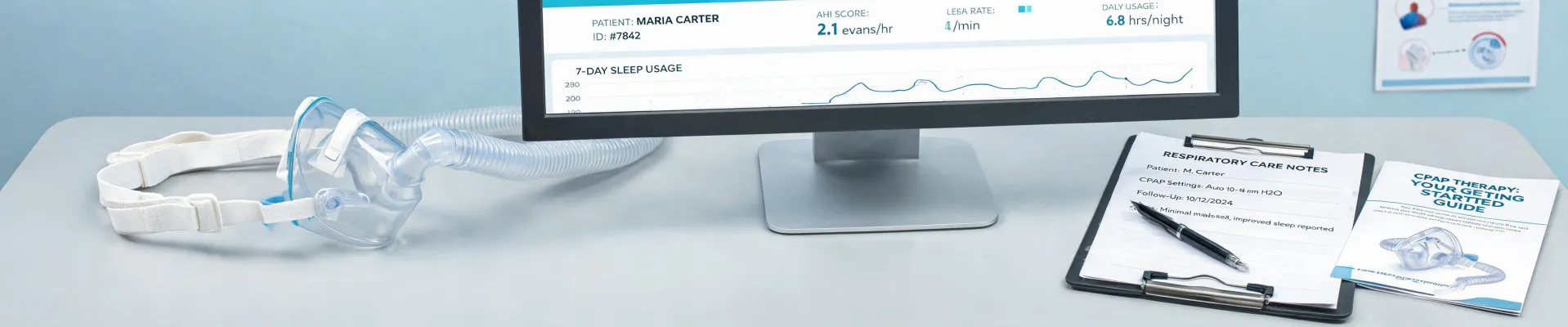
The Procurement Checklist for ResMed CPAP Masks and Respiratory Equipment: 8 Mistakes I've Made
· Elena Varga
-
Step 1: Verify device compatibility before you think about price
-
Step 2: Match the interface to the therapy, not to the sales rep
-
Step 3: Ask what the patient monitoring system will actually do
-
Step 4: Don't order the ResMed CPAP mask N30i without writing down sizes
-
Step 5: Run the total cost of ownership before comparing vendors
-
Step 6: List the scope of supply for every order
-
Step 7: Check shelf life, warranty, and return policy before stock arrives
-
Step 8: Build a buffer for the human parts
-
What I still get wrong
Here's the checklist I wish I had in 2017.
I've been handling respiratory and sleep equipment orders for a regional hospital group for about seven years. In that time, I've personally made and documented 12 significant buying mistakes—totaling roughly $68,000 in wasted budget. As of January 2025, this list is still the first thing I hand to a new buyer.
This list is for anyone who orders CPAP machines, masks, high flow nasal cannula setups, or patient monitoring systems for a hospital, sleep lab, or home medical equipment company. It's eight steps, in the order I wish I'd followed. No magic. Just stuff to check before you hit approve.
Step 1: Verify device compatibility before you think about price
This sounds obvious, but it took me a year to stop trusting product titles. What I mean is: when someone asks for a ResMed AirSense 10 CPAP mask, I now ask back—which mask style? which frame? which cushion size? which tubing? Because 'AirSense 10 compatible' isn't a single SKU.
In 2022, we ordered 60 CPAP masks based on a product page that said 'fits AirSense 10.' It mostly did, but the heated tubing connector didn't click with 14 of them. We had to buy 14 adapter kits at $45 each. That's $630 I can't get back, plus a week of patient rescheduling. Now the first field on our order form is the exact device model, not the price.
Step 2: Match the interface to the therapy, not to the sales rep
A CPAP mask and a high flow nasal cannula are not the same kind of animal. CPAP is continuous pressure. High flow nasal cannula is high-flow, humidified oxygen or room air. They use different circuits, different humidifiers, and different patient interfaces.
I once had a new staff member try to substitute a CPAP circuit for a high flow nasal cannula setup because 'both go to the nose.' It didn't work—the patient's CO2 and flow settings were wrong. The nurse caught it before anything bad happened, but the patient's therapy was delayed by three hours. That cost time and trust.
Check the order: CPAP or HFNC? Check the device: can it actually deliver the prescribed flow? Check the interface: is it a sealed mask or an open cannula? These are not interchangeable.
Step 3: Ask what the patient monitoring system will actually do
I love a connected device. But I hate finding out after purchase that the patient monitoring system doesn't talk to our EMR.
We bought ResMed devices for the sleep lab and assumed their remote monitoring platform would feed directly into our system. We assumed wrong. Our IT team needed six weeks to build the interface, and we paid a consultant $2,500 to make the data export work. The monitoring software itself was fine. The missing piece was integration.
Before you buy any patient monitoring system, ask: What fields does it capture? Does it send data in real time or once a day? Can our EMR receive it? Who gets alerts? Are there recurring fees after the first year? Include all of that in your TCO calculation.
Step 4: Don't order the ResMed CPAP mask N30i without writing down sizes
The ResMed CPAP mask N30i is one of the masks we reorder most. It's the nasal pillow style with the tube on top, and patients like it because it keeps the hose out of the way. But it has different cushion sizes and frame sizes.
In 2023, I ordered 40 N30i masks from memory. I specified the mask name but not the frame and cushion sizes. We received 40 medium/standard sets. Three patients needed wide frames, two needed small cushions. Those five unopened masks sat in inventory for a month before we could return them. $620 wasted, and the clinic manager gave me a look I still remember.
Now I put the full line on the order: ResMed CPAP mask N30i, frame Standard or Wide, cushion S/M/L, quantity. If it doesn't have the size fields filled, I don't process it.
Step 5: Run the total cost of ownership before comparing vendors
Personally, I'd rather pay more upfront for a device that works than pay less and bleed money on adapters, service calls, and missed follow-up visits.
This lesson did not come from CPAP masks. It came from lab equipment. Someone in the group was comparing a clinical chemistry analyzer with an immunoassay analyzer. The clinical chemistry analyzer had a lower list price, so they thought they could 'skip the expensive one.' But you can't compare clinical chemistry vs immunoassay platforms on sticker price alone. Reagents, calibrators, maintenance, random-access capacity, turnaround time—completely different.
Same for respiratory equipment. A ResMed AirSense 10 CPAP mask may cost more than a third-party bundle. But if the third-party mask leaks, causes skin irritation, or isn't compatible with the comfort features your patient needs, you end up with returns and extra calls. That's real money.
My TCO sheet has seven lines: purchase price, freight, installation, training, consumables, integration, and expected support. It takes me about 15 minutes to fill out. I've caught over 30 potential errors in the last 18 months using it. Maybe 30, I should count again.
Step 6: List the scope of supply for every order
Most people ignore this one. I know I did.
In 2021, we bought 25 ResMed AirSense 10 devices and assumed the heated tubing was included. It wasn't. The order said 'device only.' We found out on delivery day. The units were useless until we paid $975 for tubing and then waited another week.
Now every PO has a line-by-line list: device, power cord, hose, filter, mask, cushion, frame, SD card, manual, remote monitoring codes. If a rep can't tell me what's included, that's a red flag. This one habit has saved us a ton of headache.
Step 7: Check shelf life, warranty, and return policy before stock arrives
Masks have a finite, printed shelf life. CPAP devices have warranties that start from the date of the invoice, not the date of patient assignment. If you stockpile, you can burn a year of warranty before a device ever touches a patient.
We once had a patient monitoring system module that failed at month 13. The warranty had started when the module was ordered, not when it was installed. Nobody had the change-order paperwork, so we paid $440 to replace it. To be fair, the vendor's policy was in the fine print—I just hadn't read it.
Step 8: Build a buffer for the human parts
I went back and forth for a long time between standardized inventory and patient-specific mask ordering. Standardized inventory is simpler and looks efficient. Patient-specific ordering fits better and leads to fewer returns. Honestly, I'm not sure there's a perfect answer. My best guess is a hybrid works best: keep a standard stock of the most common frame and cushion combos, but set a fast lane for special sizes.
And leave room for human error. A clinician sees an N30i on the patient's profile and doesn't check the cushion size. I catch it now because the mask order won't process without a size field. Make your system do the checking, because memory is overrated.
What I still get wrong
The most frustrating part of this work: even with a checklist, the same small mistakes keep sneaking back.
I get why people skip the comfortable steps. They think one mask is like another. They think the rep already checked. They think the extra integration fee is next year's problem. Then next year comes and the budget is gone.
If you take one thing from this: start with the TCO, not the tag. The cheapest quote in the catalog is usually the expensive one once returns, delays, and integrations are counted. That's my opinion, but it's based on $68,000—no, about $71,000 now, I mixed it up with the lab project. Seriously, run the numbers. Bottom line: the checklist is boring. It isn't a game-changer. It just stops the bleeding.

Elena Varga
Elena Varga is a medical imaging systems analyst covering CT scanners, MRI systems, ultrasound platforms, digital radiography, mammography, and ophthalmic imaging equipment. She references IEC 60601-2-44 for CT safety and essential performance while examining CTDIvol, dose-length product, spatial resolution, slice thickness, field uniformity, throughput, uptime, and DICOM interoperability. Her work helps radiology leaders, medical physicists, biomedical engineers, and procurement teams compare image quality, radiation management, workflow integration, serviceability, and lifecycle cost.