Why Your ResMed AirTouch Mask Leaks at Home but Passes the Fit Test in the Clinic
· Elena Varga
I'm a respiratory therapist who has managed CPAP equipment and mask fittings for seven years. I've made and documented 22 significant equipment mistakes—wrong interfaces, wrong sizing calls, missed compatibility checks—totaling roughly $4,000 in wasted supply budget. This is the most embarrassing one, because the fix was twelve dollars.
The Patient Who Nearly Quit Over a Leak That Didn't Exist
Fourteen days into CPAP therapy, she was done.
"I've tried everything," she said, setting the ResMed AirTouch F20 on my desk. "It leaks all night. Every night. I'm more exhausted than I was before I started."
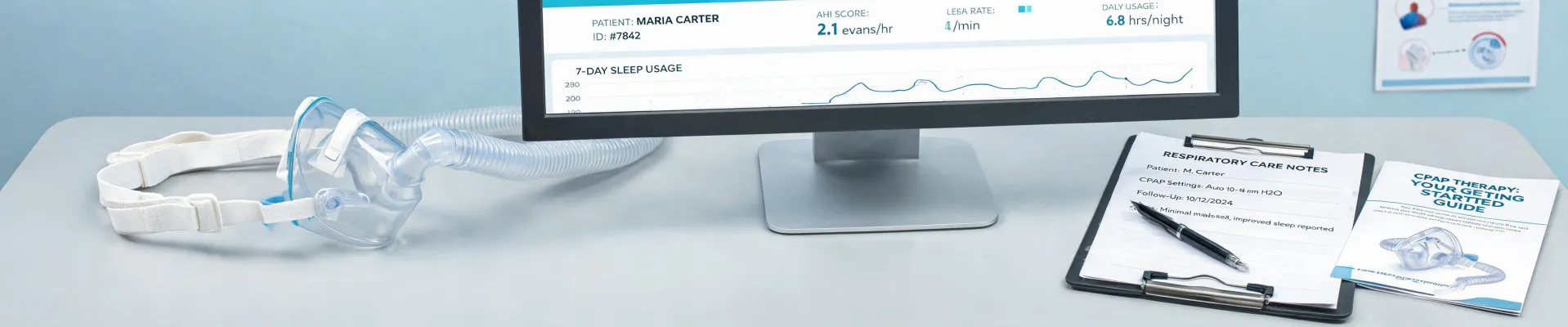
Her MyAir data backed her up: average leak 30 L/min, flagged red most nights. But here's what threw us: she'd passed the mask-fit test in our clinic. The cushion was the right size. The headgear looked right. She was using the machine seven-plus hours a night. This wasn't a compliance problem. It looked like a mask problem.
So I did what equipment coordinators do: I replaced the cushion ($89). When that didn't help, I ordered a complete replacement mask ($159). Two weeks later she was back, same leak, same frustration, more self-doubt.
The third visit, I stopped looking at the mask and started tracing the whole circuit. AirSense 10 outlet. Adapter. Standard 22mm tubing. Mask elbow. Cushion.
The adapter connecting her standard tube to the AirSense 10 outlet was cracked. A $12 part. At 10 cmH2O it hissed air onto the nightstand all night long. The mask had never leaked. The connection did.
The mask wasn't the problem. The connection was.
Why We Blamed the Mask (and What the Leak Reading Actually Means)
The frustrating part is that this wasn't a one-off. In our 2023 equipment audit, 12 out of 41 masks returned as "leaking" had intact cushions and good face seals. The leak was elsewhere in the circuit: a cracked adapter, a stretched tube connector, a mismatched elbow, or a device menu set to "nasal" while the patient wore a full face mask.
Here's the thing that everyone misses: when the AirSense 10 reports a leak, it's reporting total system leak. The device measures air leaving the circuit where it shouldn't. It has no idea whether it's escaping at the cushion, the elbow swivel, the tube junction, or the outlet adapter. Clinicians see a leak flag and think "mask fit." But the machine is saying "something in the circuit is open." Those are different problems with different fixes.
It's tempting to think leak equals mask. But identical specs at the face can produce wildly different numbers once you add a three-year-old tube, a third-party adapter, and a patient who turns over at night.
The AirTouch foam cushion sets its own trap
To be fair to the AirTouch: the foam cushion is genuinely comfortable. Many patients prefer it to silicone. But the foam doesn't tolerate the universal first response to a leak—tightening the headgear. With silicone, extra tension can reseat the seal. With foam, extra tension compresses the cushion away from the face. The seal gets worse, so the patient tightens more, which compresses it further. A lot of the AirTouch returns in our clinic had been over-tightened into failure. That's a real mask problem, but it starts with a perceived leak, and the perceived leak is usually the interface, not the cushion.
The mask-fit test's blind spot
The mask-fit test on the AirSense 10 is useful, but only for one thing: testing the mask. It pressurizes the circuit for a few seconds and checks whether total leak stays below threshold. It's a snapshot. It won't catch a hairline crack that opens when the patient shifts at 2 a.m. It won't flag a tube that's lost its snap-fit after a few hundred insertions. And if the leak is small, the test can pass and still lose 20 L/min over a night.
The connector standard that isn't standard
This is where my own training got in the way. In respiratory therapy school, the connector standard is drilled into you: manual resuscitators, ventilator circuits, and CPAP masks use the same 22 mm outer / 15 mm inner patient connection, per ISO 5356-1. It's universal. Knowing that, you get complacent.
But ResMed's mask elbows and the AirSense 10 outlet sit on top of that standard, with their own clips and fittings. If you're using a standard 22mm tube, you need the specific air outlet adapter for the AirSense 10—and "compatible" third-party versions vary in quality. The crack we missed was exactly where the tube's weight stressed the adapter. Not at the face.
The interface confusion shows up in other questions too. Every few months, a patient asks about connecting the machine to an external air source—a portable concentrator, a tank, once a dental air compressor from a home workshop. For the record: no. The air outlet adapter is for low-pressure breathing circuits, not compressed air supplies. A dental air compressor powers dental tools; it isn't a medical-grade breathing air source. Feeding compressor pressure into a CPAP would overwhelm the machine's pressure control, and that's a barotrauma risk, not a hack.
The Real Cost of Blaming the Mask
Let me put numbers on the cascade, because the $12 adapter is only the beginning.
The patient above: $89 cushion, $159 mask, two extra clinic visits. Roughly $320 in direct waste, documented.
Then there's the cost I can't easily itemize. A similar patient, same pattern—we blamed his mask, he quit therapy entirely. Eight months untreated, AHI of 34, and a hypertensive crisis that put him in the emergency department. I'm not going to claim the untreated apnea caused it; I can't prove that for an individual. But the cardiovascular risks of untreated obstructive sleep apnea are not subtle. And the ED visit alone cost around $2,800 with insurance applied. I might be misremembering the exact figure, but it was more than the adapter either way.
At the clinic level: over 18 months, we traced about $4,000 in equipment replacements, returns, and re-fittings directly to interface mistakes. Maybe $4,100, depending on what you count—some got absorbed into larger supply orders. All of it was avoidable.
The cost that matters most isn't in the budget. It's the patient who concludes CPAP doesn't work because we kept replacing the wrong part. That patient doesn't come back. They just move the machine off the nightstand.
The Pre-Flight Checklist We Use Before Any Replacement
Here's the one-page checklist I now attach to every AirTouch fitting and every leak complaint. It saves our clinic roughly $1,000 a quarter.
- Check the mask type in the clinical menu. Full face, nasal, or nasal pillow. If the setting doesn't match the mask, the leak algorithm misreads the data.
- Inspect the circuit before the cushion. Outlet adapter, tube ends, elbow swivel. Hairline cracks hide where the tube's weight stresses the plastic. Run a fingernail across the surface—cracks catch.
- Verify the elbow size matches the tube. A 15mm elbow forced onto a 22mm connection is a $10 replacement, not a $159 mask replacement.
- Test at the patient's pressure, not the default. Someone on 14 cmH2O needs to know how it seals at 14 cmH2O, not just at the fit-test pressure.
- Date the cushion. Write the replacement date on the frame. AirTouch foam: 2 to 4 weeks, depending on skin oils and humidity. Silicone: closer to 3 months. A worn cushion can leak—but it's the last thing on this list, not the first.
The sixth step isn't technical, but it belongs here anyway: say the recurring costs out loud. "Mask included" reads well on an invoice, but when an AirTouch foam cushion wears out after a month, the patient needs to have known that before walking out with the box. Same logic applies on the supply side—I've learned to ask "what's NOT included" before "what's the price." The vendor who lists everything upfront, even if the total looks higher, usually costs less in the end.
There's something satisfying about a patient coming back a month later saying the leak is gone. After the stress of the first failed fitting, the $320 in wasted parts, and the near-miss on her trust—that's the payoff.
The cracked adapter is still on my desk. It's a reminder that "what's wrong with this mask?" is almost always the wrong question. The right question is: "where is this leak actually coming from?"

Elena Varga
Elena Varga is a medical imaging systems analyst covering CT scanners, MRI systems, ultrasound platforms, digital radiography, mammography, and ophthalmic imaging equipment. She references IEC 60601-2-44 for CT safety and essential performance while examining CTDIvol, dose-length product, spatial resolution, slice thickness, field uniformity, throughput, uptime, and DICOM interoperability. Her work helps radiology leaders, medical physicists, biomedical engineers, and procurement teams compare image quality, radiation management, workflow integration, serviceability, and lifecycle cost.