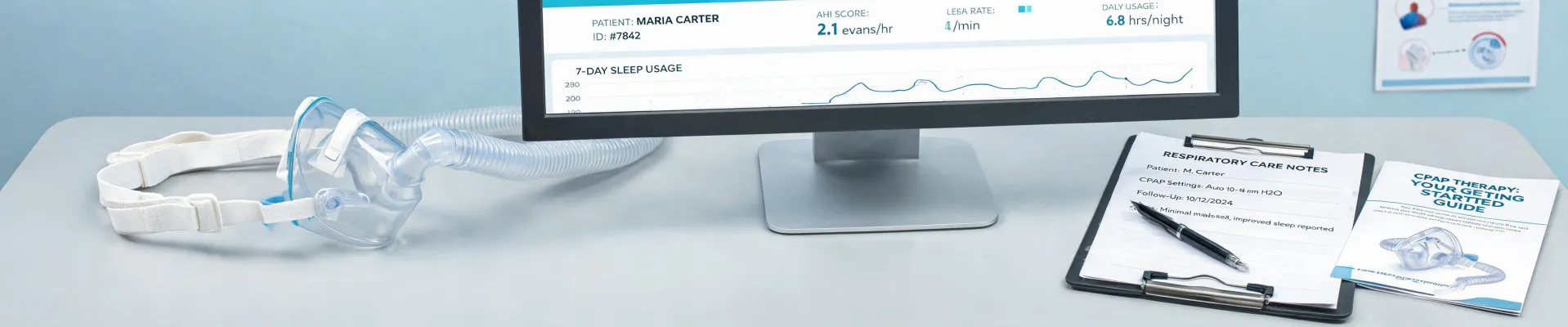
We Almost Ditched ResMed for 29%-Cheaper CPAP Masks. The Spreadsheet Said No.
· Elena Varga
The folder landed on my desk in late April
Dr. Calloway, our sleep lab director, dropped a folder in front of me and said, “We need to replace the old sleep diagnostic device, refresh the entire mask stock, and add a patient transfer device for EMS. Same budget. Fiscal-year close.”
I’m the procurement manager at a 300-bed regional hospital in Ohio. I’ve managed our pulmonary and sleep equipment budget—$180,000 a year—for six years, and I log every order in our cost tracking system. I’ve negotiated with more than 40 vendors in that time. I know the difference between a price and a cost.
This contract almost taught me that lesson the hard way.
Three quotes, one obvious winner
I sent requests to three suppliers: our ResMed-authorized distributor, a national wholesaler that sells compatible masks at a discount, and a refurbished equipment dealer. The responses came back within a week (all quotes valid as of April 2024; verify current pricing).
The ResMed distributor quoted $14,200 for the annual mask stock—the full AirFit lineup, from nasal pillows to full-face. The national wholesaler quoted $10,100 for “compatible” masks. Same styles. Same silicone. 29% less on paper.
The refurbished dealer went after a separate line item: $6,800 for a used sleep diagnostic device with a 90-day warranty. No clinical support. I set that bid aside and focused on the $4,100 gap in front of me.
My first instinct was to flag the file: “Wholesaler likely.”
Then I started digging.
The hidden line items
I spent a weekend mapping our patient population to the ResMed sleep apnea mask lineup—the AirFit P10 for nasal-pillow patients, the F20 for full-face, the N30i for side sleepers. The lineup is broad, which is partly why the quote was higher.
But here’s the thing about “compatible” masks: they fit the patient’s face, but they don’t fit your workflow.
ResMed masks have QR codes on the frame. Scan one, and it pulls up a setup video and registers the mask in the myAir app. Patients self-serve the basics: “Why is it leaking?” “Is the cushion right?” “How do I clean this?” Our RTs get fewer of those calls.
The wholesale masks have none of that. No QR. No app. No dashboard.
Mask leaks also nudge compliance numbers. According to CMS (cms.gov), CPAP coverage requires use for at least 4 hours per night on 70% of nights. A poorly sealed mask means more leak alerts, more low-adherence flags, and more RT time chasing down why a patient’s numbers dropped. One of our senior therapists estimated the extra work at fifteen minutes per patient per month—180 hours a year of phone calls, refits, and chart notes. At our loaded RT rate of $42 an hour, that’s roughly $7,500 a year.
Then there were returns. The wholesaler’s own product data listed a 13% return rate on compatible masks—mostly leaks and sizing misses. Our ResMed history sits around 4%. On 200 masks a year, that’s 18 extra returns. Processing plus replacement, about $1,000 a year.
And training. The respiratory team could work with the wholesale masks, but they wanted a half-day session on sizing and troubleshooting. $1,300, one time.
I ran the totals. The $4,100 discount looked like a bargain until it became a $5,700 loss in year one. And about $4,400 extra every year after.
I went back and forth for a week and a half. The wholesaler’s price was a hard number, right there on the quote. The workflow costs were assumptions—educated ones, but assumptions. On paper, the cheap bid made sense. My gut said the integration wasn’t a luxury. I re-ran the spreadsheet four times.
The clock made it worse. Fiscal-year close was ten days out, and the EMS contract renewal for the patient transfer device was riding on the same budget review. Normally I’d run a four-week pilot before committing. There was no time.
Then during training prep, one of our therapists asked how to use a nebulizer with these masks. I didn’t know. I called the ResMed distributor’s clinical support line, and a human being walked me through it: the inline nebulizer adapter, which masks it works with, and how to keep the CPAP pressure stable during a treatment. They sent a one-page clinician guide we still use.
Try getting that from a national wholesaler’s customer service queue.
What happened after
Eight weeks after the folder landed on my desk, we signed with the ResMed distributor. The final order covered the annual mask stock, a replacement sleep diagnostic device for home studies, and the patient transfer device—a ResMed Astral for inter-facility transports. Total PO: $46,800, about 26% of my annual budget.
My CFO asked if I was leaving money on the table. I told her yes, deliberately. Then I showed her the spreadsheet.
By Q1 2025, the outcome was clear. Mask adherence in our clinic hit 84%, up from 71% in the same quarter last year. Not because the masks are magic—because our RTs were spending their time on patients who needed follow-up, not chasing fit issues.
The part I still tell my finance director
Here’s the honest part. ResMed wasn’t the right answer for everything. We still keep a small stock of masks from another brand for patients who need a fit the AirFit line doesn’t cover well—certain facial anatomies, helmet interfaces. And if we were building a sleep program from scratch, with no existing ResMed devices, no myAir workflow, and no RTs already trained on the system, I might have signed the wholesaler’s bid and banked the $4,100. That’s a real saving. The cheaper masks are fine for a clinic that isn’t invested in an ecosystem.
At this point, the question wasn’t “CPAP mask: ResMed or compatible?” It was whether the discount covered the workflow gap.
The conventional wisdom in procurement is: define the spec, compare like for like, take the lowest bid. My experience with this contract says otherwise. Compatibility is a line item. Human time is a line item. Patient behavior is a line item. They just don’t show up on the invoice.
Six months later, I still think the decision was right, but it was closer than our CFO wants to admit. The wholesaler’s quote is still in the file. If our patient population changes—or if someone builds a compatible mask that integrates as well as ResMed’s—I’ll re-run the math. That’s the job.

Elena Varga
Elena Varga is a medical imaging systems analyst covering CT scanners, MRI systems, ultrasound platforms, digital radiography, mammography, and ophthalmic imaging equipment. She references IEC 60601-2-44 for CT safety and essential performance while examining CTDIvol, dose-length product, spatial resolution, slice thickness, field uniformity, throughput, uptime, and DICOM interoperability. Her work helps radiology leaders, medical physicists, biomedical engineers, and procurement teams compare image quality, radiation management, workflow integration, serviceability, and lifecycle cost.