Is the ResMed AirSense 11 Dual Voltage? A Clinic Buyer Answers 5 Common Equipment Questions
· Elena Varga
I'm the office administrator for a 40-person sleep medicine practice. I manage all equipment and supply ordering—roughly $300,000 a year across 12 vendors—and I report to both operations and finance, which means I see both sides of every purchasing argument. When our physicians ask about a device, or our finance director wants to know why a product is worth the spend, I'm the one who does the homework.
The questions I get asked most, in no particular order:
- Is the AirSense 11 dual voltage?
- What is the HumidiX Plus, and should we be using it?
- What should a patient monitoring system include?
- Does a sleep clinic need cardiac monitors?
- How do you use a patient lift safely?
Here are my honest answers, based on several years of purchasing decisions (and more than a few expensive lessons).
1. Is the ResMed AirSense 11 dual voltage?
Yes. The AirSense 11 comes with a built-in universal power supply that accepts 100–240V AC, 50/60Hz. Patients can use it in most countries with just a plug adapter—no external transformer is needed.
This is a feature we verify now, but learned the hard way. In 2022, one of our physicians took an older machine to a conference in Europe and plugged it into a 220V outlet without checking the voltage rating. The power supply was destroyed. That was a roughly $1,200 repair bill, plus the cost of a loaner device while it was out of service. When we evaluated the AirSense 11 in 2024, dual voltage capability was one of the first things I confirmed. (Source: ResMed AirSense 11 user guide; verify current specifications for your region.)
2. What is the ResMed HumidiX Plus, and should we standardize on it?
The HumidiX Plus is a single-use heat and moisture exchanger (HME) for compatible ResMed masks. It sits between the mask and the breathing circuit, capturing warmth and humidity from the patient's exhaled breath and returning them on the next inhale. No water chamber, no power supply—it's fully passive.
The thing I'd push back on is treating it as an alternative to a heated humidifier. It is not a replacement for that. In our clinic, we use it in specific scenarios:
- Patients who travel and want a lightweight setup
- Short-term CPAP users who haven't committed to a permanent setup
- Hospital or skilled nursing stays where power access is limited
For routine home use, patients with chronic nasal congestion or dry mouth generally do better with the heated humidifier that comes with the AirSense 11. We ran a small trial in early 2024, and patients reported noticeably more dry-air discomfort on the HumidiX Plus. It's a niche product that works well in the right context—but I wouldn't standardize on it as a cost-saving measure. (Single-use HME disposables are roughly $8–10 per unit based on January 2025 quotes; verify current pricing.)
3. What should we look for in a patient monitoring system?
For sleep therapy, compliance data is the main event. According to CMS, continued CPAP coverage typically requires documented use of at least 4 hours per night for 70% of nights over a 30-day period. If your monitoring system doesn't track that accurately, you're likely to lose reimbursements—and, more importantly, patients quietly stop using their devices without anyone noticing.
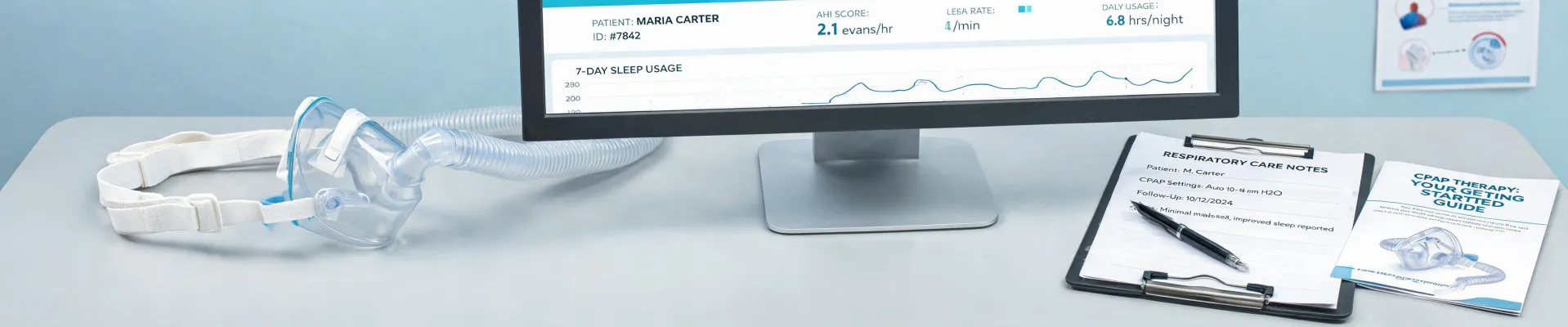
We use ResMed AirView for remote monitoring. It gives us usage hours, leak rates, residual apnea events, and device status in one cloud dashboard. It flags at-risk patients before the 30-day compliance window closes, which noticeably reduced the manual follow-up calls our nurses used to make. That last part matters more than you'd think.
If you're evaluating any patient monitoring system, ask these questions:
- Does it integrate with your EMR? Demand a live test run, not a sales demo.
- Can multiple clinicians access the dashboard without paying for duplicate licenses?
- Does the system alert on non-compliance early enough to intervene?
- What is the per-device annual cost?
I made the mistake in 2021 of choosing a platform based on price. The EMR integration turned out to be incomplete, and our nurses spent six to eight hours per week manually re-entering compliance data. Looking back, I should have asked the vendor to walk through a real patient scenario in a test environment before signing. It would have exposed the problem in an afternoon instead of a year.
4. Should our clinic invest in cardiac monitors?
This question came up more than I expected, and I understand why: untreated sleep apnea is associated with cardiovascular conditions, especially atrial fibrillation (Source: American Heart Association, 2023). Some sleep clinics now offer co-located cardiac screening, which sounds like a natural expansion.
The numbers said we could generate $40,000–$50,000 in net new revenue in year one. But my gut said our workflow wasn't ready. We have no nurse with cardiology experience, no escalation protocol for abnormal rhythms, and a complicated history with EMR integration. Buying a monitor doesn't solve any of those gaps.
We ended up referring high-risk patients to cardiology instead. In my experience, the equipment is the cheapest and easiest part of adding a new clinical capability. The expensive parts are training, protocols, and ongoing oversight. If you're considering cardiac monitors, start with the workflow—not the device.
5. How to use a patient lift properly (and what to check before buying one)
Off-topic for a ResMed article, I know, but clinic administrators often handle equipment purchases across multiple departments. I've learned more about patient lifts than I expected.
The core procedure: position the sling correctly under the patient (usually with a log-roll for bed transfers), attach all connection points to the lift arms, verify the patient's weight is below both the sling and lift rated capacity, and lift and move smoothly. Lowering is where patient confidence gets built—or lost—so controlling the descent is just as important as the lift itself.
Three buying lessons from our process:
- Respect weight capacity. We initially speced a 400 lb unit for our bariatric clinic, then realized our patients exceeded that. We ordered the 600 lb model.
- Budget for training. Every staff member needs hands-on training and competency verification. One vendor quoted $350 per person. Non-negotiable, but plan for it.
- Inspect regularly. I knew I should have set up a monthly sling and battery inspection from day one, but I figured "what are the odds?" The odds caught up with us when a frayed sling was spotted mid-transfer in 2023. Nobody was hurt, but it was closer than I'd like.
If you're sourcing a patient lift, start with the OSHA safe patient handling guidelines. And make sure your vendor includes training and support in the quote. The cheapest lift on paper isn't the cheapest once you add those costs.

Elena Varga
Elena Varga is a medical imaging systems analyst covering CT scanners, MRI systems, ultrasound platforms, digital radiography, mammography, and ophthalmic imaging equipment. She references IEC 60601-2-44 for CT safety and essential performance while examining CTDIvol, dose-length product, spatial resolution, slice thickness, field uniformity, throughput, uptime, and DICOM interoperability. Her work helps radiology leaders, medical physicists, biomedical engineers, and procurement teams compare image quality, radiation management, workflow integration, serviceability, and lifecycle cost.