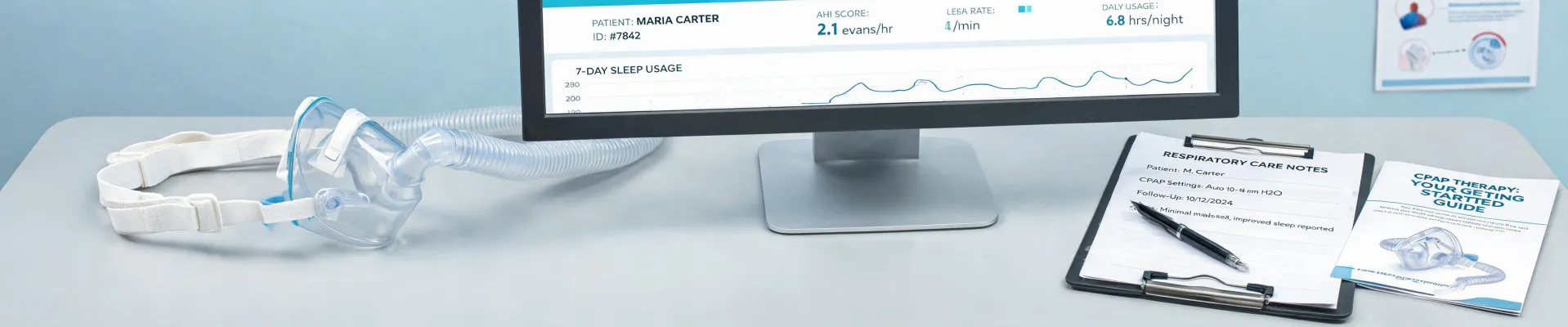
The CPAP Mask Puzzle: Why Your Sleep Center's Inventory Is Costing You More Than You Think
· Elena Varga
The One-Off Mask Problem
If you manage purchasing for a sleep center—or any medical practice that fits CPAP masks—you know this scene.
A patient calls, frustrated, because the nasal pillows from their ResMed P10 mask are irritating their nostrils. They need a different size. Or they want a full face mask instead. You check your storage room. You have a box of AirTouch F20 full face masks, but only in size Medium. They need Small.
So you order one. Just one.
That's where the trouble starts.
When I took over purchasing for a 4-physician sleep center in 2020, I was ordering CPAP masks the same way I'd order office supplies. Need a thing? Buy the thing. It felt logical. It was also, in retrospect, a slow-motion disaster.
What I Thought the Problem Was
At first, I chalked it up to the sheer variety. ResMed's mask ecosystem alone is impressive—the AirFit P10, the AirFit F20, the AirTouch F20 with its memory foam cushion, the various headgear and tube setups. Each mask type comes in small, medium, large, and sometimes wide. Matching the right mask to the right patient profile felt like a constant logic puzzle.
I thought my problem was inventory complexity. And that was true. It was complex. But I was missing the deeper issue.
The Real Headache: The $39 Mask
The real problem wasn't the complexity. It was the unit economics of a single order.
Processing 60-80 medical supply orders annually, I started noticing a pattern. A single mask from a medical distributor might cost $39. The shipping? $8-12. The time spent—finding the SKU, processing the PO, reconciling the invoice—that's real, even if you don't track it. Let's say 20 minutes. At $40/hour loaded cost, that's $13 in admin overhead.
$39 for the mask. $10 shipping. $13 in my time. Total cost: $62. For a mask that's reimbursed to the practice at maybe $45.
That's a loss of $17 per single-mask order.
People think expensive inventory is what costs you. Actually, the cost of managing that inventory—especially when it's fragmented—is what eats your margin. The causation runs the other way.
The 'Just Order Extra' Trap
So the natural next thought is: order more to save on shipping and processing. Buy 10 masks at once to get a better per-unit price.
I tried that. I bought a case of AirTouch F20 masks (size Medium) in 2022 because the per-unit price was 12% lower. Smart, right?
Well, we had two patients that month who wanted the AirTouch F20 Medium. And then... nothing. The next five patients all needed Large, or the P10 nasal pillows, or the AirFit F20 (which is different from the AirTouch F20, critically). That case of masks sat on my shelf for eight months. By the time someone needed them, they were within 6 months of their expiration date. (Yes, CPAP masks expire. The adhesive on the foam cushion degrades.)
Skipped the careful demand forecasting because it 'never matters.' That was the one time it mattered. Forced.
That $39 mask I bought in bulk was now a dead investment. A lesson learned the hard way.
The 'Big Vendor' Smile
I remember calling one of our larger distributors. I was ordering a mix of ResMed masks, a few replacement heated humidifier chambers, and some tubing. The order was maybe $600. The rep's tone was polite, but I felt it.
When I was starting out (in medical admin, not a buyer), the vendors who treated my small orders with respect are the ones I still use. But this one? Rushed.
Small doesn't mean unimportant—it means potential. That sleep center eventually grew to 6 physicians, and our annual spend with ResMed distributors increased significantly. But I never forgot that call. I remembered which vendors were patient with my 'what's the best mask for a person who sleeps on their stomach?' questions in 2020, and which ones just sent me a link.
Why 'Local CPAP Vendor' Is Not Always Safer
A common piece of advice I got was to stick with a local medical supply company. 'They know the doctors.' 'They're right down the road.'
The 'local is always faster' thinking comes from an era before modern logistics. That's changed.
I had a local vendor. They were friendly. They offered to let me inspect a ResMed AirFit F20 mask in person before ordering a lot. But their pricing was 15% higher than a national online distributor. And their inventory was limited—they only stocked the most popular sizes.
When I needed a P10 mask with a specific headgear type (the one with the smaller, more flexible clips), they couldn't get it. I waited a week. It was a mess.
The national distributor? They had it in stock. Shipped it next day. The price was better. The lesson was clear: a good national partner with a robust supply chain can beat a 'friendly local' one on speed and selection.
The Core Issue: 'Comfort' Is Not Just a Feature, It's a Logistical Variable
Here's the deepest issue, which most people don't understand until they've managed the inventory for a year. CPAP masks are not like office printers. Office printers work, or they don't.
CPAP masks are a patient compliance tool. If the mask isn't comfortable—if the P10 nasal pillows leak, if the AirTouch F20 memory foam feels too warm, if the headgear is too tight—the patient won't use the machine. Period.
ResMed makes great masks (I use a P10 myself, actually). But the 'best' mask is subjective. One patient loves the minimalist feel of the P10. Another needs the full seal of the F20. A third wants the softer, less rigid cushion of the AirTouch F20.
This wasn't just a purchasing problem. It was a patient outcome problem. The time I spent finding the right mask wasn't admin waste—it was a necessary part of therapy success. A vendor who couldn't provide a proper invoice cost me money; a vendor who couldn't provide a variety of mask types cost me a patient.
So, What Solved It?
I didn't find a magic bullet. But I found a better way.
- I stopped buying single masks as one-offs. I analyzed our 2023 data. We had consistent demand for three mask types: ResMed AirFit P10, AirFit F20, and AirTouch F20. I negotiated a quarterly standing order for a mixed pallet of those three, in the most common sizes (M, L) and the most common cushion options. The per-unit cost dropped, and the shipping was essentially free.
- I built a 'transition kit'. For patients switching from one mask type to another, I stocked a small inventory of the most common alternative sizes. Instead of ordering a single Medium AirTouch F20, I'd keep two on hand. Simple.
- I found a partner (ResMed's own channel) that accepted returns on a few masks. Not every vendor does this. Unopened masks in the original packaging, within a certain window. This changed everything. Suddenly, my 'medium AirTouch F20' on the shelf wasn't a dead investment. It was a swap.
The solution wasn't more storage space. It wasn't a complex ERP system. It was understanding that a mask inventory isn't a static thing—it's a fluctuation of patient need, and the right partner understands that.
Funnily enough, the vendor I switched to (a national distributor who also worked directly with ResMed) was the same one I'd been avoiding because I thought they were too big. They weren't. They were just more organized. My job got easier. Our patients got their masks faster. Our margins improved.
And I never had to eat another $39 mask out of my department budget.

Elena Varga
Elena Varga is a medical imaging systems analyst covering CT scanners, MRI systems, ultrasound platforms, digital radiography, mammography, and ophthalmic imaging equipment. She references IEC 60601-2-44 for CT safety and essential performance while examining CTDIvol, dose-length product, spatial resolution, slice thickness, field uniformity, throughput, uptime, and DICOM interoperability. Her work helps radiology leaders, medical physicists, biomedical engineers, and procurement teams compare image quality, radiation management, workflow integration, serviceability, and lifecycle cost.