I Spend Our Clinic's Money on Medical Equipment. Efficiency Beats Price. Every Time.
· Elena Varga
I've been the administrator at a 12-physician specialty clinic for four years now. I manage all medical equipment and supply ordering—roughly $800,000 a year across about 20 vendors—and I report to both operations and finance. It's a job that sounds administrative, and mostly it is. But the thing that surprised me is how much small purchasing decisions compound into real money, one way or the other.
So here's my opinion, stated plainly: efficiency in procurement beats a low price, every single time. By efficiency I don't just mean faster checkouts. I mean the full chain—how quickly a vendor can give me an accurate quote, how well the equipment actually works once it lands, how much staff time it absorbs afterward, and how predictable the next order is. That last part is the one most people forget.
The Low-Price Trap
In 2022, I found a supplier offering an endoscope bundle at roughly 30% below our regular vendor. Same model number. Same spec sheet. The quote looked almost too clean. I placed the order without running my usual two-reference check, because the savings were that good and the gastroenterologist needed it before the end of the quarter.
That was a mistake.
The system arrived three weeks late, missing the light source adapter that the quote had listed in the fine print. Our GI department couldn't schedule procedures for six days. I spent hours on the phone with a support line that seemed to have exactly one representative and no sense of urgency.
Looking back, I should have asked for an itemized parts breakdown. At the time, the price was so compelling that I talked myself into skipping the diligence. The total cost of that decision was about $2,800 in expedite fees, plus the lost procedure time. I want to say the exact figure was $2,740, but don't quote me on that—the invoice is buried in our accounting system and I've never wanted to dig it out.
Everyone had warned me about this. When I started the job, our operations director told me to always verify parts lists down to the cable standard. I didn't truly believe it until I ate that loss myself.
What ResMed Taught Me About Buying Smarter
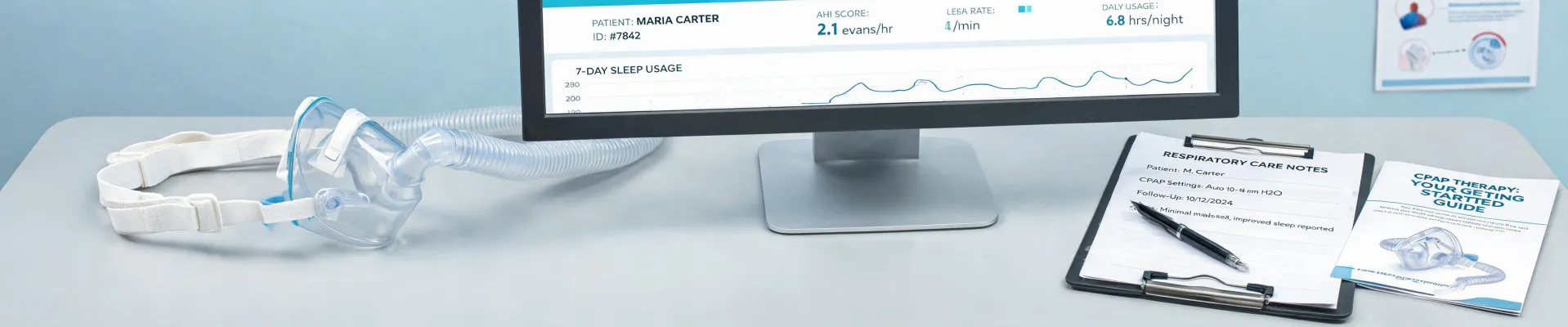
Our sleep medicine department runs on ResMed CPAP equipment, and we standardized on it about three years ago. The contrast with my endoscope experience could not be sharper.
Take the ResMed P30i mask. It's become the default first fitting in our clinic, not just because patients like the top-of-head tube connection, but because from my seat the winning feature is compatibility. One mask platform, a short and well-documented list of frames and cushions and headgear. When I order for new patients, I know exactly what pairs with what. Our billing team fields fewer "this doesn't fit" calls, and reorders take minutes instead of an afternoon of cross-referencing SKUs.
The ResMed AirSense 10 humidity setting is another small thing that turned into a time-saver. Patients can adjust the humidity themselves from the device menu, or through the MyAir app, so they solve the "my throat feels dry" issue without calling us, booking an appointment, or asking our respiratory therapist to walk them through it over the phone. That might sound trivial. But when you're running a small practice, every support question that doesn't require a human is free hours for the humans you did pay for.
Is ResMed the cheapest option in the catalog? I honestly wouldn't claim that. Put another way: we probably pay a modest premium over bare-bones alternatives. But the price delta is smaller than the cost of the problems we don't have anymore.
The Counterintuitive Part: Technology Knowledge Is a Procurement Tool
Here's an argument I didn't expect to make when I took this job: the more I understood the products we buy, the better every purchasing decision became.
Last year, our imaging center's MRI maintenance contract came up for renewal. I don't have an engineering background, so I found myself googling "how does an mri machine work" at 11pm—magnets, radio-frequency coils, gradient coils, the superconducting magnet that needs constant chilling. It felt like homework. But when the vendor's service rep mentioned that certain components "typically require replacement" on a fixed schedule, I could ask a real question about expected duty cycles instead of nodding along.
The rep paused.
"You're asking sharper questions than most administrators."
I'll take that as a compliment. The maintenance contract came in 9% lower, mostly because I asked the vendor to decouple labor and parts pricing—something they'd never had to justify before. One hour of studying physics for non-physicists paid for itself many times over.
Dental implant procurement, for our affiliated oral surgery clinic, was a harsher lesson. I'd been comparing invoices from two different suppliers and couldn't understand why the same catalog part number appeared at two very different prices. It took me six months to realize the difference was in surface treatment and packaging configuration—essentially the same implant, but with a coating and sterile package that carried a legitimate premium. I'd been missing it because I didn't know the right question to ask. Which is exactly the point.
But What About Budget?
I can hear the finance side pushing back: "This is all well and good, but we have hard budget targets, and the cheaper quote is the cheaper quote." I get it. I report to finance. I've written the variance analyses.
Here's what I tell them. Per FTC guidelines on advertising and marketing, any performance or compatibility claim a vendor makes has to be truthful and substantiated. That's a legal floor, not a ceiling. And in my experience, vendors who are sloppy about documentation—who can't or won't produce itemized invoices, who give vague answers on spec compatibility—tend to generate hidden costs that never show up in the initial quote comparison.
(Should mention: we've kept two lower-cost vendors on our roster for items where the risk is low and verification is easy. The goal isn't to buy expensive. The goal is to buy without surprises.)
I'll also admit openly that not everything I've tried has worked. In 2024, I consolidated our vendor list down to eight core suppliers, and the transition was bumpier than expected. One wholesaler sent mixed inventory twice in the same quarter. I considered reverting. But we've mostly stabilized now, and the reduction in weekly coordination meetings is real.
Honestly, I'm not sure why some suppliers are like this. My best guess is it comes down to internal discipline—the companies that run clean processes are usually the same ones that answer their email on time. But I don't have a study to cite for that. I have four years of vendor lunches and late delivery notifications.
So Here's What I Actually Believe
After four years of buying everything from CPAP masks to MRI maintenance contracts, my conclusion is simple: efficiency is the real competitive advantage in medical purchasing.
The lowest price is not the lowest cost. The best-known brand is not always the best partner. But a vendor—and a product—that makes the process more predictable, more transparent, and less demanding on our staff will save more money over a year than any discount on any single quote.
These days I evaluate purchasing through one question first: how much friction does this solve, and how much does it create? If the answer is strong, the price nearly always takes care of itself.
Does that mean every clinic should buy the way we do? I'd put it this way: low-cost options always deserve a fair look. Just do the verification math honestly. Because the time you spend checking is the most expensive thing you have—until you skip it, and then it gets a whole lot more expensive.

Elena Varga
Elena Varga is a medical imaging systems analyst covering CT scanners, MRI systems, ultrasound platforms, digital radiography, mammography, and ophthalmic imaging equipment. She references IEC 60601-2-44 for CT safety and essential performance while examining CTDIvol, dose-length product, spatial resolution, slice thickness, field uniformity, throughput, uptime, and DICOM interoperability. Her work helps radiology leaders, medical physicists, biomedical engineers, and procurement teams compare image quality, radiation management, workflow integration, serviceability, and lifecycle cost.