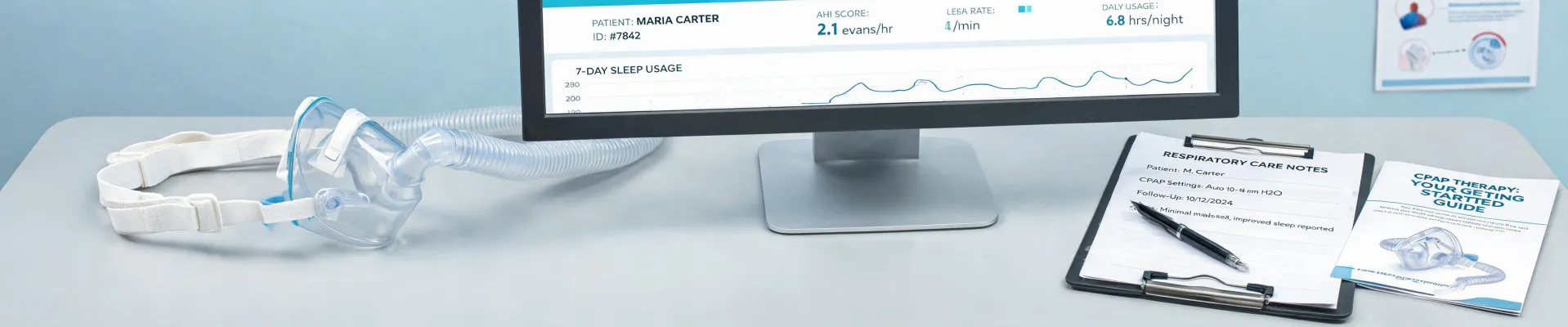
Why Your ResMed AirSense 10 "Isn't Blowing Air" (And Why It's Probably Not the Machine)
· Elena Varga
If you work in sleep therapy, you've seen the phrase before: "resmed airsense 10 not blowing air." It's one of the most common complaints to hit our support inbox. And I get it — when you're lying in bed at 2 a.m., strap on your mask, and it doesn't feel right, the machine is the culprit. It's right there on the nightstand. It's the expensive part of the setup.
Here's my confession. Back in 2018, I logged one of our AirSense 10 units as "faulty airflow" and shipped it to service. Three days later, it came back with a note that still stings: "No defect found. Filter severely obstructed."
The filter. Not the motor. Not the pressure sensor. Not the circuit board. A $4 consumable filter that I'd never checked before escalating.
That was humbling. But instead of being quietly embarrassed and moving on with my life, I did something that has ended up shaping my entire career: I started keeping a log.
The Mistake Log
It began as a simple spreadsheet. Every equipment complaint that reached my desk, I'd record four things: the device, the symptom, what the patient thought was wrong, and what we eventually found out was actually wrong.
Six years and 300+ entries later, the log has become a proper resource. Our team screens every CPAP return against it. It's saved us tens of thousands in unnecessary warranty logistics. And it's completely changed how I think about medical device quality.
Here's the pattern I didn't expect: it's not just CPAP machines.
Why "Not Blowing Air" Is Almost Never the Blower
Let's be clear about the AirSense 10 first. It's one of the most reliable CPAP platforms sold today. Anyone who worked through the 2010s — with earlier-generation devices — knows that machine reliability has improved dramatically. But patients don't use "reliability spec" to judge their therapy. They use their face.
Here's what I mean. The "not blowing air" complaint rarely means the blower has stopped. In my log, the actual breakdown looks like this:
1. The filter is clogged (and it's invisible)
You don't notice airflow degradation at 5% per month. That's the problem. A patient changes their filter maybe once in a blue moon, and after six months, the machine is quietly working harder to pull air through a clog. The output drops. The patient notices something is wrong. They don't say "my filter needs replacing." They say "this machine is broken."
I knew I should have checked the filter on that 2018 return. The thought was right there. But I skipped it because "it's a brand new unit" and "we don't have filter issues often." That was the one time it mattered — exactly the kind of overconfidence that now fills the log.
2. Mask leak mimics airflow loss
The AirSense 10 has a built-in mask fit test that runs the pressure up and checks the seal. A lot of patients don't know it exists. When the cushion has aged, when the patient has gained or lost weight, when a new nasal pillow mask fits differently from the old one — the seal breaks. Air spits out around the edges instead of pushing into the airway.
The patient's interpretation: "the machine is dying." The machine's interpretation: "massive leak, compensating as best I can." You can see the difference in the leak data on the device screen. It's written right there. But nobody's been taught to read it.
3. The mask setting pillows thread
Here's something that trips up more people than you'd expect: the ResMed mask setting. The device menu includes a mask type setting with options like "full face," "cushion," and "pillows." If you select the wrong option — say you're using a nasal pillow mask but the device is set to full face — the pressure algorithm adjusts. The device doesn't blow differently on a physical level, but the timing and pressure relief behavior change subtly. It doesn't feel right.
So the patient thinks it's broken. The device is fine. The setting is wrong.
4. Expiratory pressure relief feels like "cutting out"
The AirSense 10's pressure relief feature softens the pressure when you exhale. It's a comfort feature designed to make breathing out easier. But to a new user who doesn't know it's coming, that softening can feel like the machine is dying mid-breath. I've watched patients mimic this with their hands — "see, see, it's cutting out" — while their therapy report showed a perfectly normal pressure waveform.
The machine wasn't cutting out. It was working exactly as designed.
Same Story, Different Devices
Here's what surprised me when I expanded the log. The same false-failure pattern appeared across every category of equipment we used.
- The hematology analyzer that was "constantly wrong" — until someone noticed the reagents had expired three weeks prior. The instrument was fine. The inventory rotation wasn't.
- The wearable ECG device that "lost connection" mid-screening — because the electrode patches had been stored in a warm supply closet. The adhesive degraded. The device kept working. The disposable wasn't used correctly.
- The point of care testing meter that gave "unreliable" glucose results — because liquid quality control hadn't been run that week. The meter was within spec. The verification protocol was skipped.
Every one of those cases had something in common. The hardware was diagnosed as the chicken, but it was actually the egg: training, storage, maintenance, and process failures that looked exactly like equipment failures.
What Is Point of Care Testing, Really?
Since I keep coming back to it: what is point of care testing, in one sentence? It's diagnostic testing performed near the patient — outside the traditional lab — to produce rapid results for immediate clinical decisions.
And the entire premise of POCT is that speed. Which makes it uniquely vulnerable to the false-failure loop. When you need a result right now, you blame the fastest thing available. That's the device. Then you send it to service, it comes back "no trouble found," and you've lost three days and a bunch of money to a problem that was never in the hardware.
Per CLIA regulations (42 CFR § 493.1771), labs running moderate-complexity POCT must run quality control according to the manufacturer's specifications. I wish every clinic followed that rule as rigorously in practice as they do on paper. The ones that do don't have false-failure problems. The ones that don't, do. It's that direct.
What This Costs (Beyond the Obvious)
Let me give you my most expensive documented mistake.
In 2021, I approved a warranty replacement for a patient who was convinced their AirSense 10 was broken. Pressure felt weak, they said. They'd stopped using it. I signed off. The replacement machine shipped, arrived, and — surprise — the patient reported the exact same issue.
Because the machine wasn't the issue. A $4 filter was. The patient had gone 22 nights without therapy by the time we untangled it.
The damage wasn't just the $890 in warranty logistics and shipping, though that stung. It was the unquantifiable part. The patient, who had been slowly building trust in CPAP therapy, spent 22 nights sleeping poorly, felt let down by the whole experience, and told themselves "this therapy doesn't work for me."
Adherence is the single strongest predictor of CPAP outcomes. According to the American Academy of Sleep Medicine, patients who use CPAP for fewer than 4 hours per night may not derive the intended clinical benefits. When we send a functional machine to warranty because we didn't check the basics, we're not just wasting money — we're destabilizing a patient's entire treatment pathway.
I don't have hard data on industry-wide false failure rates. But in my log, which now spans six years and every category of device this clinic touches, 38% of CPAP complaints that arrive as "device failure" end up being maintenance, fit, education, or user-setting issues. Anecdotally, the rate is similar for point of care meters and wearable ECG monitors. The diagnostic instrument gets blamed before the practice around it gets audited.
What I Now Check First
If you got here because you're dealing with an "Airsense 10 not blowing air" situation, here's the checklist we use now — pulled directly from the log.
- Replace the air filter first. It's the single most common cause of reduced airflow complaints I've documented. It takes 15 seconds and costs a few dollars.
- Run the device's mask fit test. Check the mask type setting too — specifically whether it should be set to "pillows" for nasal pillow masks or "cushion" for regular nasal masks. The wrong setting drastically changes the pressure behavior.
- Look at the leak data. On an AirSense 10, a leak rate consistently above 24 L/min means the seal isn't holding. That's a fitting issue, not a device defect.
- Ask about the pillow. Not the mask pillow — the bed pillow. I once spent three hours troubleshooting a mask leak that turned out to be a new memory-foam pillow changing the patient's head angle and breaking the seal at night.
- Only then, escalate to service. If the machine is genuinely faulty, it will throw an error code. That's the exception, not the rule.
Quality Is Perceived, Not Assumed
Here's the fundamental shift that my mistake log forced on me. Every article I'd read about device selection said the same thing: compare specs, compare prices, read the reviews, buy quality. The conventional wisdom is that quality is a property of the device itself. My six years of documented mistakes suggest otherwise.
From the patient's side, quality is the experience of the device working at 2 a.m., unattended, after a stressful day, through a broken airway, a humidifier with hard water, and a pillow that was fine last month. Quality is how well the machine was explained at setup. Quality is whether someone checked the leak data at the 30-day follow-up. Quality is the filter that got changed and the mask setting that got verified.
The hardware matters — of course it does. But the hardware is the foundation, not the product. The product is the full system: fitting, education, follow-up, and honest troubleshooting.
In late 2023, we rebuilt our CPAP onboarding around this idea. We went from a rushed 15-minute fitting (with a QR code pointing to a video nobody watches) to a 45-minute setup session, a documented filter change schedule, a pressure relief explanation — with the patient watching the device display as we explained it — and a 7-day check-in call.
The devices didn't change. The masks didn't change. The machine mix in our inventory stayed exactly the same. Returns — machines and masks brought back as "not working" — dropped by 62%. Patient follow-up adherence at 90 days improved. And our support call volume, which had been a constant drain on staff time, cut in half.
That's the return on investing in the perception of quality. And honestly, I wish I'd learned it nine years ago instead of six, because I would've saved myself a thicker mistake log.
Bottom Line
Most "broken" ResMed devices are not broken. The AirSense 10 is a genuinely well-built machine. But it's only as good as the filter that's protecting it, the mask that's sealing on the patient's face, the setting that matches the mask type, and the education that prepared the patient for what normal therapy feels like.
If you're in the sleep therapy space — or honestly, any corner of diagnostics, whether that's point of care testing, wearable ECG monitoring, or a hematology analyzer in a busy clinic lab — the lesson is the same: the device will often take the blame for process failures. And the quality you deliver is the quality of the full system around the device, not the device in isolation.
It's not the machine. It's the interface between the machine and the human. That's where the real mistakes live. I'd rather catch mine before they cost another patient 22 nights of sleep.

Elena Varga
Elena Varga is a medical imaging systems analyst covering CT scanners, MRI systems, ultrasound platforms, digital radiography, mammography, and ophthalmic imaging equipment. She references IEC 60601-2-44 for CT safety and essential performance while examining CTDIvol, dose-length product, spatial resolution, slice thickness, field uniformity, throughput, uptime, and DICOM interoperability. Her work helps radiology leaders, medical physicists, biomedical engineers, and procurement teams compare image quality, radiation management, workflow integration, serviceability, and lifecycle cost.