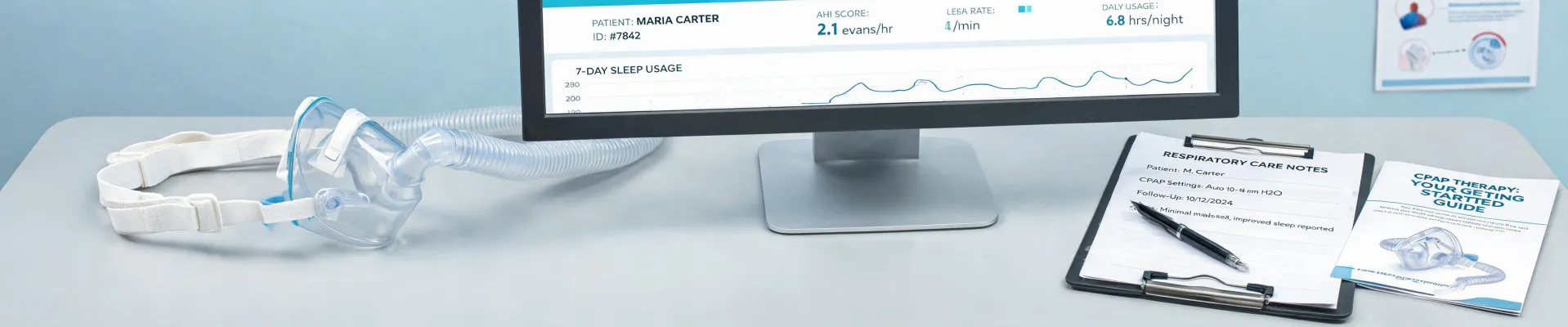
Why I Choose the ResMed AirFit P30i Over Cheaper CPAP Masks: A Cost Controller’s Honest Take
· Elena Varga
If you’re picking CPAP masks by unit price, you’re not saving money. You’re just moving the cost somewhere else.
I’ve spent six years managing the respiratory equipment budget at a 200-bed sleep center. In that time, I’ve processed more than 1,200 mask orders and built a cost-tracking spreadsheet that our finance team probably laughs at. But the spreadsheet changed what I buy. The cheapest option, over and over, turned out to be the most expensive.
This post is about the ResMed AirFit P30i nasal pillow mask, and the “30i” family around it. Before you search for the model you actually saw: yes, “ResMed X30i CPAP mask” shows up in search suggestions. I’ve never found an official X30i. It’s usually someone mixing up the AirFit P30i and the AirTouch N30i. I did it myself once.
Why the ResMed ecosystem saves real money
Here’s a mistake I made early on. We didn’t have a formal verification process for third-party masks, so I ordered 100 “universal” nasal pillows that were supposed to fit our ResMed frames. They fit. They just didn’t seal. About 30% of our patients came back with leak scores that looked like a fire hose on full blast. We had to replace 45 of those low-cost pillows with proper ResMed AirFit P30i ones.
Do the math with me.
100 pillows at $28 each. That’s $2,800. Then 45 replacements at around $38 each for the next-tier option. That’s $1,710 more. Plus the clinician time to troubleshoot, plus the reordering, plus the patient who just gave up and bought a different mask online. The actual total was over $5,000 — to save $67 per pillow.
Put another way: $5,000 in chaos to avoid spending $4,500 on the right thing from the start. The cheap option wasn’t cheap. Period.
That was the year I learned about compatibility costs. ResMed’s real advantage isn’t the mask alone — it’s the frame, cushion, and tubing configuration that all work together. The AirFit P30i has the top-of-head tube design, which makes it easier for side sleepers to move around at night. But the key is fit. A nasal pillow mask is only going to work if the cushion size is right and the patient tolerates pressure.
Compliance is the hidden cost
A cheap mask that ends up in a drawer is not a bargain. It’s worse than not buying anything, because it still cost something and delivered nothing.
Our center tracks compliance through MyAir and our own follow-up calls. After we moved to fit-tested ResMed masks across our nasal pillow patients, our first-month compliance rate went up from about 68% to 79%. I’m not saying the mask alone did that — we also improved our onboarding follow-ups. But the mask was the variable we changed.
Here’s the tradeoff: a $105 mask that gets used six hours a night is cheaper per year than a $45 mask that gets abandoned after two weeks. This is not an opinion. It’s our reorder and re-fitting data.
But I’m not going to say the P30i is for everyone. If you have a patient with significant nasal collapse, or someone who is a consistent mouth breather, a nasal pillow may be the wrong starting point. I’d still suggest a full face mask like the ResMed AirFit F30i for those cases. That’s not a sales dodge. That’s the honest limitation of any nasal pillow mask.
The same pattern shows up in biosafety cabinets, CT scanners, and coagulation testing
If you work in any large facility, you know this story repeats in different departments.
Our lab manager ordered a budget biosafety cabinet because the budget was tight. Fourteen months later, it failed HEPA certification, and the repair quote was more than the difference between that cabinet and the better one we should have bought.
Our radiology team saw the same thing with refurbished CT scan machines. The low purchase price looked great until the service contract kicked in. One major breakdown and all the savings disappeared.
Even routine diagnostics follow this pattern. For anyone who hasn’t spent time in a lab — what is coagulation testing? It’s a blood test that measures how well blood clots. It’s used before surgeries, for monitoring anticoagulant therapy, and in emergency workups. It’s also a classic example of cutting in the wrong place: cheap reagents lead to bad results, which lead to repeats, which cost more than the reagent savings.
I’m not a doctor, so don’t take that as clinical advice. I’m a procurement guy. But I’ve watched the same movie in four departments: sticker price is not total cost.
“But we don’t have the budget for premium masks”
I hear this a lot. And I understand. Annual budgets are brutal. But this is where I push back.
We compared 212 mask orders in 2024. The average third-party mask was about $42. A current ResMed AirFit P30i was around $95 to $105, depending on configuration. But the return rate on the third-party stuff was 18%. The ResMed return rate was about 3%. After accounting for returns, reprocessing, stocking errors, and clinician troubleshooting, the ResMed P30i was actually around 11% cheaper per completed therapy start. The price tag was higher. The total cost was lower.
Of course, I might be slightly off on the exact numbers. That’s from memory; I’d have to pull the spreadsheet for precise figures. But the direction is clear enough.
And one more thing: be careful about vendors making miracle claims. Per FTC guidelines (ftc.gov), advertising claims have to be truthful and substantiated. If a mask or device is advertised as a “cure” for sleep apnea, that’s a red flag. CPAP is a treatment, not a cure. We buy devices that treat conditions properly. We don’t buy fantasies.
Bottom line
I recommend the ResMed AirFit P30i for most of our nasal pillow patients, and the AirTouch N30i when a softer nasal cushion seems more appropriate. That’s a real distinction, and the N30i is often better for people who don’t like direct pressure in the nostrils.
But if a patient won’t wear a nasal pillow, no mask in this family will save them. There’s no universal “best” mask. There’s only the best fit for the face and the therapy.
So stop comparing sticker prices. Calculate the cost per night that actually gets used. Track returns. Count the time your respiratory therapist spends on troubleshooting. That’s what matters.
Buy the fit. Track the outcome. The price will make sense later.

Elena Varga
Elena Varga is a medical imaging systems analyst covering CT scanners, MRI systems, ultrasound platforms, digital radiography, mammography, and ophthalmic imaging equipment. She references IEC 60601-2-44 for CT safety and essential performance while examining CTDIvol, dose-length product, spatial resolution, slice thickness, field uniformity, throughput, uptime, and DICOM interoperability. Her work helps radiology leaders, medical physicists, biomedical engineers, and procurement teams compare image quality, radiation management, workflow integration, serviceability, and lifecycle cost.