ResMed CPAP Equipment: A Procurement Manager's FAQ on Masks, AirCurve 11 & Pulse Oximetry
· Elena Varga
-
1. What's the Difference Between the ResMed AirCurve 11 and AirSense 11?
-
2. Which ResMed CPAP Masks Should Our Sleep Center Actually Stock?
-
3. How Does a Pulse Oximeter Work, and Why Does Our Clinic Need One?
-
4. Are Compatible CPAP Masks a Real Cost Saving?
-
5. What Hidden Costs Inflate CPAP Procurement Budgets?
-
6. How Often Should CPAP Masks and Supplies Be Replaced?
-
7. Should We Standardize on One or Two CPAP Mask Models?
-
8. Is ResMed's myAir Platform Actually Useful for Procurement?
Six years into managing medical equipment purchasing for a regional health system, I've fielded requests for everything from fundus cameras to biosafety cabinets. But nothing generates more questions from our own staff than CPAP orders. This FAQ covers what our sleep center and respiratory team ask me about ResMed CPAP masks, the AirCurve 11, and pulse oximetry—plus a few questions I wish they'd ask.
1. What's the Difference Between the ResMed AirCurve 11 and AirSense 11?
When I first started buying CPAP equipment, I assumed the AirCurve 11 was just a "deluxe" version of the AirSense 11—same thing, higher price. That assumption cost me a budget argument with our CFO. They're actually different devices. The AirSense 11 delivers a single continuous pressure (CPAP). The AirCurve 11 is bilevel: it pushes a higher pressure when the patient inhales (IPAP) and drops to a lower pressure when they exhale (EPAP), with modes like S, ST, and VAuto depending on how much support is needed.
From a procurement standpoint, the AirCurve 11 is justifiable when there's a documented clinical need—central sleep apnea, COPD overlap, or patients who can't tolerate exhaling against high pressure. But it's not a default device. A $950 AirSense AutoSet handles most patients fine. The $2,000+ AirCurve 11 needs a physician's indication on paper before it goes on a purchase order.
2. Which ResMed CPAP Masks Should Our Sleep Center Actually Stock?
My first mask inventory was a lesson in humility. I ordered volume based on the distributor's recommendation, skipped the data review, and ended up with a storage shelf full of masks our clinicians rarely prescribed. So let me save you that mistake. You need a mix of three categories:
- Nasal pillows (AirFit P10 or P30i): minimal contact, great for low-to-mid pressure patients who want less "gear" on their face.
- Nasal masks (AirFit N20 or N30i): the workhorse category. Covers the nose with a more stable seal—probably your highest-volume SKU.
- Full-face masks (AirFit F20 or F30i): essential for mouth breathers and anyone needing higher pressure who can't tolerate leaks.
Before you commit to a new mask SKU, pull 90 days of prescription data from your own EMR. Not the vendor's suggested forecast. Your data.
3. How Does a Pulse Oximeter Work, and Why Does Our Clinic Need One?
A pulse oximeter shines red light (around 660 nm) and infrared light (around 940 nm) through a fingertip. Oxygenated hemoglobin absorbs more infrared; deoxygenated hemoglobin absorbs more red. The sensor measures the ratio and calculates SpO₂—the percentage of hemoglobin saturated with oxygen.
In a sleep center, a pulse oximeter is essential for CPAP titration. You're verifying that the prescribed pressure actually maintains oxygenation through the night. A patient can feel fine while their oxygen is still dropping. But the sensor is only as good as its placement—and the device's algorithm matters more than people expect. Our first batch of pulse ox units were the cheapest on the market. After two maintenance calls and a calibration failure, I understood why reputable vendors publish accuracy data (typically ±2% for SpO₂ in the 70–100% range).
4. Are Compatible CPAP Masks a Real Cost Saving?
Here's a confession: in 2023, I purchased several hundred compatible CPAP masks to "save" 40% over genuine ResMed masks. It was a mistake. The silicone quality was inconsistent, seals broke down faster, and our clinicians lost time wrestling with poor fits. When we totaled the clinical labor and replacement orders, the experiment cost us roughly $1,800 more than buying genuine would have.
CPAP masks are regulated by the FDA as Class II medical devices. A compatible mask can be registered without being validated for the same fit, leak performance, and patient adherence as the original. The way I see it, "looks like a ResMed mask" isn't the same as "performs like one." Not every third-party mask is bad—some are acceptable. But total cost of ownership rarely favors the cheap alternative when patient outcomes and clinical time are on the other side of the equation.
5. What Hidden Costs Inflate CPAP Procurement Budgets?
After tracking every equipment invoice since 2018, the budget leaks appear in the same places year after year:
- Discontinued models with orphaned accessories. You stock headgear or cushions for a mask line that gets phased out, and that inventory becomes dead weight.
- Missing sizing kits. You can't just order a case of medium full-face masks. Patients need to try different sizes in the clinic. If your distributor doesn't have a sizing program, your "fit rate" will eat your margin.
- Rush shipping. Clinics that don't forecast cushion and tubing consumption pay two to three times list price for expedited delivery. Set reorder points and stick to them.
These three items account for most of the budget variance I see across clinics.
6. How Often Should CPAP Masks and Supplies Be Replaced?
Typical clinical guidance—and Medicare's allowance schedule—looks like this:
- Mask cushion: every 3 months
- Headgear: every 6 months
- Tubing: every 3–6 months
- Full mask assembly: annually, or per payer rules
The procurement reality is that replacement needs track usage, not calendar dates. A patient on CPAP eight hours a night wears out a cushion in half the time of someone using it three hours. Instead of a rigid schedule, use the adherence and leak data your ResMed devices already collect (via myAir or the clinic dashboard) to justify replacements when equipment is actually degrading. It's better for the patient, and it gives you a documented basis for reorder decisions.
7. Should We Standardize on One or Two CPAP Mask Models?
This is the question nobody asks their procurement manager, but they should. A sleep center carrying 15 different mask SKUs isn't patient-centered—it's inventory-heavy. After we reviewed our fit data, we standardized on four masks: one nasal pillow, one nasal mask, one full-face, and one pediatric option. Inventory carrying costs dropped 31% over two quarters. Fit success went up because clinicians became genuinely expert with the masks they used every day.
Do we lose flexibility for unusual anatomies? Sure. We special-order those. But the lesson: vendor marketing drives SKU creep. Your fit data should drive the list, not the sales rep's portfolio.
8. Is ResMed's myAir Platform Actually Useful for Procurement?
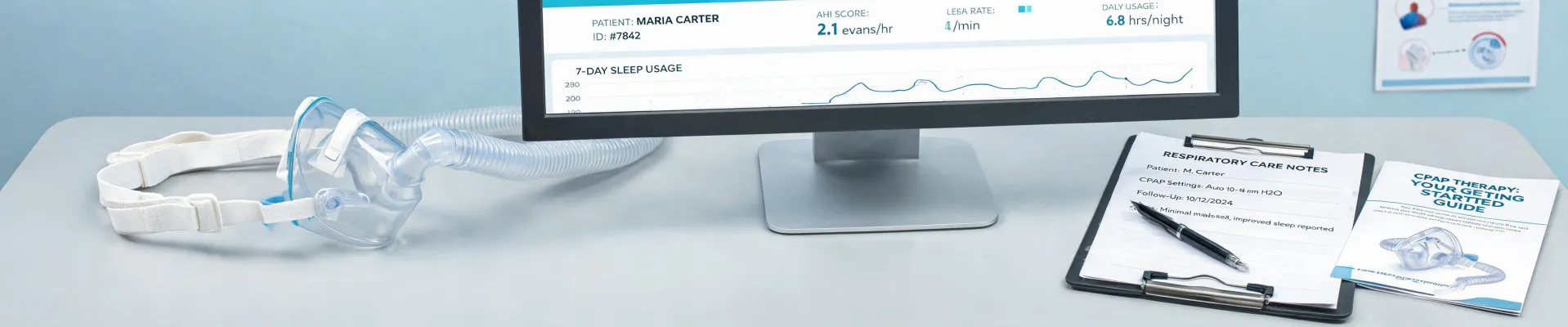
Honestly, I assumed myAir was a patient-facing app with a few charts and didn't matter for purchasing. Then our ResMed rep showed me the clinic-side dashboard. Aggregate usage hours, leak rates, and mask-fit scores across our entire patient population—that's procurement intelligence, not just a feel-good patient feature. Run those reports and you'll see exactly which masks perform and which get reordered for "poor fit" repeatedly.
We discovered two mask models with average leak rates above 24 L/min—past ResMed's threshold for effective therapy—across our patient population. We phased them out, switched to alternatives, and mask-related "doesn't fit" complaints dropped by nearly 50%. If you're buying ResMed equipment anyway, ask your rep about the clinic dashboard. It's an underrated cost-control tool.

Elena Varga
Elena Varga is a medical imaging systems analyst covering CT scanners, MRI systems, ultrasound platforms, digital radiography, mammography, and ophthalmic imaging equipment. She references IEC 60601-2-44 for CT safety and essential performance while examining CTDIvol, dose-length product, spatial resolution, slice thickness, field uniformity, throughput, uptime, and DICOM interoperability. Her work helps radiology leaders, medical physicists, biomedical engineers, and procurement teams compare image quality, radiation management, workflow integration, serviceability, and lifecycle cost.