I Buy $30,000 Medical Devices, but I Judge a Vendor by Its $200 Orders
· Elena Varga
I manage purchasing for a 12-provider community clinic. That means I order everything from exam table paper to a $30,000 slit lamp, and since I took over the job in 2020, I've handled roughly $120,000 a year in medical equipment and supplies across 20-plus vendors. I do not have an MBA. I do have a very precise sense of which vendors respect our clinic and which ones are merely tolerating us until a bigger fish swims by.
Here's the opinion that gets me odd looks at clinic administrator meetups: I trust a vendor more after a smooth $200 order than after an impressive $30,000 sales pitch. The big purchase gets the red carpet. The small reorder is where a vendor's true attitude toward small clinics shows up.
The $200 Order That Ceased to Be Abstract
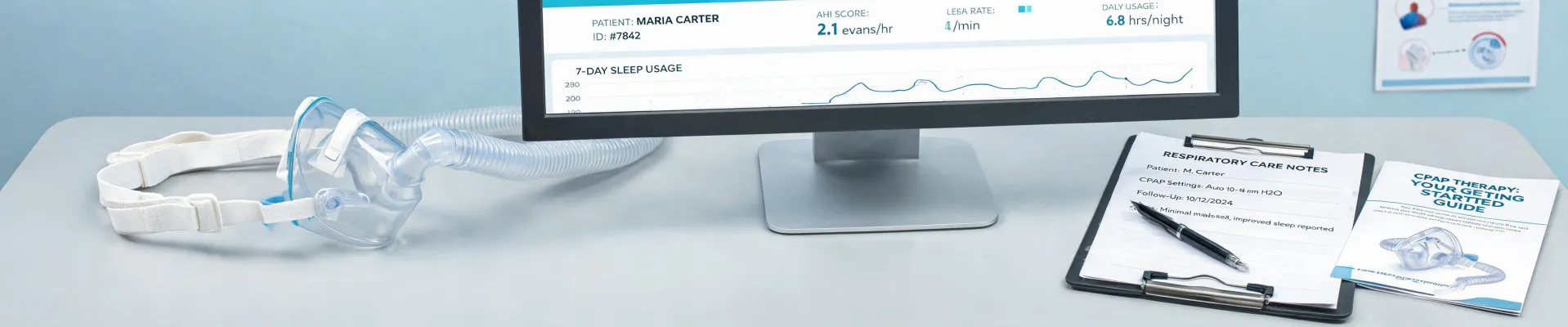
In 2024, one of our sleep physicians asked me to source a ResMed AirTouch N20 nasal mask for a patient who was struggling with leaks on their current mask. The order itself was small: one mask, a couple of cushion refills. If I remember correctly, the total came to about $220. For a patient at risk of abandoning CPAP entirely, that mask was anything but small. Globally, an estimated 936 million adults aged 30–69 are living with obstructive sleep apnea, most of them undiagnosed (Source: The Lancet Respiratory Medicine, 2019). A lot of them end up getting treated in community clinics like ours—one mask at a time.
Things I now know about the AirTouch N20 (which, honestly, I only learned because I had to): it's the memory foam version of ResMed's AirFit N20, designed for people who find standard silicone cushions irritating. According to ResMed (resmed.com), the foam cushion conforms to the face with gentle contact and handles facial oils differently than silicone, which is why some CPAP users prefer it even when a silicone option would work fine.
Here's what made that order memorable. When I had a question about compatibility—whether the AirTouch cushion fits the same frame as the AirFit N20, which size to order, how often the cushion needs replacing (I want to say about a month of daily use, but don't quote me on that)—our distributor answered in under ten minutes. No runaround. No “we'll get back to you.” That's the kind of quiet efficiency a small clinic lives on.
Now contrast that with a capital purchase we made the same year.
Red Carpet for Capital, Silence for Supplies
When we bought a new autoclave machine for sterile processing, the vendor sent a sales rep, an applications specialist, and sandwiches. The quotation process was lovely. The machine itself runs fine (121°C at 15 psi for the standard wrapped cycle, though I might be misremembering the exact parameters). But when we called a month later with a question about maintenance records and spore testing? Voicemail. Two weeks. Then a forwarded PDF manual with no note attached. (Should mention: we'd asked for the manufacturer's recommended maintenance schedule before purchase, and were told “it's in the manual.”)
Something similar happened with the slit lamp we purchased for our growing ophthalmology service. Big sale, smooth quote, nice demonstration. Six months later, when we needed replacement bulbs and a calibration check, the support team clearly didn't have us in their files. Not that we expected VIP treatment—but a single emailed acknowledgment of the order would have been nice. (Surprise, surprise: the lamps arrived, the calibration service didn't.)
I should add that this isn't a universal problem with capital equipment vendors. It's a pattern: the more expensive the order, the warmer the courtship. The smaller the order, the quieter they get. And that's exactly backwards.
The most frustrating part of managing supply and equipment procurement at a small clinic: you'd think a written PO would trigger the same response regardless of line-item total. But interpretation varies wildly. Some vendors treat every order as a transaction; a rare few treat it as a relationship. It's kinda ridiculous that the biggest purchase orders come with the warmest salespeople, and the smallest ones get the thinnest support.
Small Orders Are How Relationships Get Tested
Here's where I'll say something that might sound strange to procurement purists: being taught is a form of being respected.
We keep a small inventory of the common ResMed nasal mask types—the AirFit N20, the AirTouch N20, the AirFit N30i, and a couple of full-face options like the AirFit F20—but we can't stock every size and style. A small clinic doesn't have that kind of storage or cash flow. So we order as needed, and we rely on the compatibility charts and product pages to be accurate, and on the distributor to pick up the phone when a patient's mask doesn't fit and they have an appointment tomorrow morning.
This means a product ecosystem matters as much as the price of a single unit. ResMed's range of nasal mask types (nasal, nasal pillow, nasal cradle, full face) gives our clinicians options to match the patient, instead of forcing a one-size-fits-all approach. The myAir app and patient-facing guides reduce the number of calls we have to field. I do not need a vendor to take me out to lunch. I need the mask to arrive, the documentation to be right, and someone to explain the difference between the AirTouch and AirFit cushions without making me feel like an idiot.
The same standard applies outside the sleep space. Around the same time the autoclave vendor was ignoring us, I had to figure out how does an infusion pump work because the pump vendor's “training” consisted of a laminated card. I spent an evening piecing it together: an infusion pump delivers fluids through IV tubing at a controlled rate, using a peristaltic mechanism for larger volumes or a syringe driver for smaller, precise doses, and it alarms when the line is occluded or the fluid runs out. The technique was straightforward. But the vendor's assumption that a small clinic would figure it out was exactly the message we'd received from the autoclave rep: you're not a big enough account to deserve our time.
But Really, a $200 Order Doesn't Matter—Right?
I can already hear the sales leaders objecting: “Of course vendors prioritize larger accounts. A $200 order doesn't move the revenue needle for ResMed, let alone for an infusion pump manufacturer. That's not discrimination—that's allocation of sales resources.”
Here's why I think that objection misunderstands the market.
First, small orders scale. There are thousands of community clinics and private practices in this country. A vendor that treats a monthly $200 mask order from our clinic as a boring obligation will never get the chance to fail at our bigger orders. When we consolidated from one location to three in 2024 and expanded our equipment budget, nearly every vendor on the shortlist was a company that had handled our small orders well. The ones who had treated us as paperweights? Gone. (The $30,000 slit lamp vendor included.)
Second, pricing trust is built on small orders. It's easy for a sales rep to throw in a discount on a large capital deal. But the vendor who keeps consumable pricing fair on a single-mask order—who doesn't quietly inflate prices because we're small and unlikely to comparison-shop—earns a loyalty that no rebate program can match.
Third, order size is a terrible predictor of future value. In 2020, the conventional wisdom I read about procurement said to get three quotes and always go with the lowest price. What I've learned from 200-plus orders is the opposite: relationship consistency beats marginal cost savings. The vendor who answers my small order today is the one I'll call when we're a 20-location group someday. That's not a vague hope—that's a procurement policy I've already used.
So here's my final, unapologetic position: small orders are not a nuisance to be endured. They're a conversation a vendor chooses to have with a long-term partner. The vendors who answer with a clear catalog, a patient phone call, and a price that doesn't punish our size are the ones we keep calling. The $200 ResMed mask order told me more about a vendor relationship than any six-figure capital proposal ever did.
I don't know if ResMed considers our clinic a “small” account. What I know is that the company builds its ecosystem—multiple mask types, compatibility documentation, patient apps, distributor support—so that a community clinic can practice good sleep medicine without a full-time supply chain staff. That's what respect looks like on a purchase order. And respect, not revenue, is why I keep sending them the small ones.

Elena Varga
Elena Varga is a medical imaging systems analyst covering CT scanners, MRI systems, ultrasound platforms, digital radiography, mammography, and ophthalmic imaging equipment. She references IEC 60601-2-44 for CT safety and essential performance while examining CTDIvol, dose-length product, spatial resolution, slice thickness, field uniformity, throughput, uptime, and DICOM interoperability. Her work helps radiology leaders, medical physicists, biomedical engineers, and procurement teams compare image quality, radiation management, workflow integration, serviceability, and lifecycle cost.