How to Choose Medical Imaging Equipment (And What a ResMed AirSense 11 Leak Taught Me)
· Elena Varga
Seven years ago, I started handling clinical equipment orders for our sleep clinic. I didn't know what I didn't know. In that time, I've personally made (and documented) 14 significant mistakes, totaling roughly $32,000 in wasted budget. That's not a brag. It's why I now maintain our team's equipment checklist—so the next person doesn't repeat what I did. If you are trying to choose medical imaging equipment, a blood pressure monitor, a diagnostic instrument, or even a CPAP mask, I hope this helps.
First, a 'bargain' blood pressure monitor
Let's go back to early 2022. Our clinic had just moved back into a renovated space. We needed basic equipment: a few blood pressure monitors for intake, a diagnostic instrument for sleep studies, and supplies for the CPAP machines we already owned. The deadline was tight, and the renovation had eaten the budget.
I started with the blood pressure monitors. The cheaper option had the same cuff sizes, the same measuring method, and the same memory capacity. It was 25 percent less. I ordered six of them. We saved $180. I felt like a hero.
Then the first patient arrived. The tube was too short to reach the exam bed from the wall mount. The display was tiny and dark. A nurse had to lean over and squint. One asked me whose idea this was. By the end of the second week, we replaced them with the recommended model. The additional cost was $340. The $180 savings vanished. When I placed the cheap monitor next to the one our clinical team had recommended, side by side, I finally understood why we don't buy equipment by spec sheet alone. Specs describe what a device can do. They don't tell you how it behaves in a real room.
The ResMed AirSense 11 air leak that changed my process
A week later, I made another brilliant decision. A supplier offered us a deal on masks that were 'compatible' with ResMed machines. The price was lower than the masks our respiratory therapists had requested. I bought a box and put them on the ResMed AirSense 11 devices we were setting up for patients.
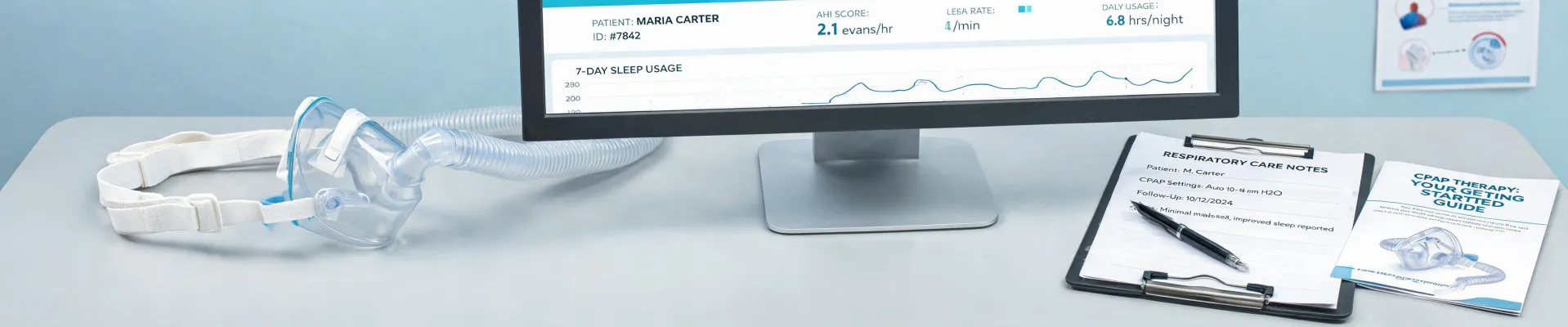
The results showed up quickly. Patients complained about air leaking around the mask. The ResMed AirSense 11 air leak report flagged leak scores above target. One patient asked if the machine was broken. It wasn't. The mask was wrong.
It's tempting to think a mask is just a mask. But mask fit, cushion material, and interface geometry change how pressure is delivered and how much air leaks. The cheap mask looked fine on paper. It didn't fit real faces.
We switched to the ResMed F20 mask, the one our therapists had recommended. It wasn't the most exciting purchase. But patients recognized it, the leak scores improved, and the next night went better. According to ResMed's support guidance (resmed.com), checking the mask size and cushion is the first step when leak is high. We ended up using the sizing guide and doing a proper fit for each patient. A great mask in the wrong size is still a problem.
The diagnostic instrument that didn't connect
The same pattern repeated with the diagnostic instrument. The one I picked had good sensors and an impressive screen. It also had no practical way to send results into our patient records. I didn't think about that because I was busy comparing sensor accuracy and price.
Most buyers focus on the obvious factor, clinical accuracy, and completely miss the overlooked factor: how the instrument fits into your workflow. The question everyone asks is 'is it accurate?' The question you should ask is, 'how long does it take from test to report?' In our case, it added an extra ten minutes per patient and a lot of manual data entry.
How to choose medical imaging equipment without repeating these mistakes
This brings me to the question I started with: how to choose medical imaging equipment. I'm not a radiologist, but I'm the person who signs purchase orders. Our clinic recently helped a smaller facility evaluate imaging vendors, and I almost repeated every mistake above. My first instinct was to compare image resolution, scan speed, and price. Those matter. But after the mask and diagnostic instrument failures, I forced myself to slow down.
We asked each vendor about training, maintenance, workflow integration, and service response time. We called references at clinics of a similar size. Then we compared the total cost over two years, not just the first invoice. The vendor with the higher price included a written 48-hour replacement guarantee. The lower-price vendor said they would 'do their best' if something failed. In a diagnostic setting, downtime means canceled patients and delayed answers. Paying for certainty is not the same as paying for speed. It's buying insurance.
Don't hold me to the exact number, but the premium was about 8%—roughly $6,000 on imaging equipment. A single week of downtime would have cost more than that. The guarantee wasn't an upgrade. It was the cheapest part of the deal.
The checklist I now use
These mistakes led to a checklist that I update every time we catch a new problem. Here's the current core list:
- Use, not specs: Test one unit in your actual workspace before ordering in volume. This applies to a blood pressure monitor, a diagnostic instrument, or a mask.
- Workflow integration: Ask how data gets from the device to your record system. If it requires manual steps, factor that into the cost.
- Sizing and fit: For CPAP masks and anything patient-facing, don't buy without a fit plan. The ResMed F20 mask, for example, comes in multiple sizes.
- Total cost over two years: Include shipping, training, maintenance, consumables, and service response.
- Guaranteed turnaround: For critical equipment, get a written commitment. A lower quote without a deadline is not a lower price; it's a gamble.
I'm not saying the expensive option is always right. We've had cheap products work perfectly. But 'probably okay' is not a procurement strategy. Whether you're choosing a blood pressure monitor, a diagnostic instrument, a CPAP mask, or medical imaging equipment, ask one question: what happens when it doesn't work? The answer tells you if the price is worth it.

Elena Varga
Elena Varga is a medical imaging systems analyst covering CT scanners, MRI systems, ultrasound platforms, digital radiography, mammography, and ophthalmic imaging equipment. She references IEC 60601-2-44 for CT safety and essential performance while examining CTDIvol, dose-length product, spatial resolution, slice thickness, field uniformity, throughput, uptime, and DICOM interoperability. Her work helps radiology leaders, medical physicists, biomedical engineers, and procurement teams compare image quality, radiation management, workflow integration, serviceability, and lifecycle cost.