How I Streamline ResMed CPAP Supply Orders for Our Sleep Center (Without Losing My Mind)
· Elena Varga
-
When This Checklist Saves You Time (And When It Won't)
-
Step 1: Map Your Device Inventory (Don't Assume Anything)
-
Step 2: Calculate Filter Consumption Based on Usage, Not Assumptions
-
Step 3: Standardize Mask and Cushion Sizes Before Ordering
-
Step 4: Confirm Heated Humidifier and Tubing Compatibility
-
Step 5: Check Your Digital Management Platform Integration
-
Step 6: Build Your Order and Verify Before Submitting
-
Common Mistakes I See (And Made) With ResMed Orders
When This Checklist Saves You Time (And When It Won't)
If you're the person responsible for ordering CPAP supplies for a sleep center, clinic, or hospital ward, you know the drill: everyone needs different masks, filters run out at different times, and somehow you're the one troubleshooting why a patient's AirSense 10 won't turn on.
I've been managing these orders for a 12-physician sleep clinic since 2021—roughly $180,000 annually across 8 vendors. This checklist covers the six steps I follow every quarter to keep our ResMed inventory stocked without emergency orders or wasted budget.
Quick heads-up: This is for standard CPAP/BiPAP consumables and accessories. If you're sourcing ultrasound machines or ECG equipment, the compliance and vendor vetting process is completely different—I won't pretend this applies there.
Step 1: Map Your Device Inventory (Don't Assume Anything)
Sounds obvious, right? Here's where I made my first rookie mistake.
In early 2022, I ordered 200 AirFit N30i nasal pillows—only to discover half our patients were using the AirFit F20 full face mask. Turns out our respiratory therapists had switched protocols six weeks earlier. Nobody told purchasing.
Now, I start each quarter by pulling the actual device list from our equipment log. I need to know:
- How many AirSense 10 vs. AirSense 11 units are active? They use different filters. The 10 uses a standard rectangular filter; the 11 uses the smaller ResMed AirSense 10 air filter compatible type? Actually, wait—the 11 uses a different filter. Check the part number. (I learned this one the hard way when I ordered 500 filters for the wrong model.)
- What mask types are prescribed most? Full face (like the F20 or F30), nasal pillows (P10 or N30i), or nasal masks? Each has different replacement cycles.
- How many patients use heated humidifiers? This affects whether you need the ClimateLineAir tubing or standard tubing.
Checkpoint: If you don't have an accurate device inventory in the past 30 days, do this first. Everything else depends on it.
Step 2: Calculate Filter Consumption Based on Usage, Not Assumptions
This is the step most people rush through. Manufacturers say "replace every 4 weeks" or "every 6 months"—but real-world usage varies.
Here's what I've found working across 400 patients:
- Hypoallergenic (gray) filters: Patients in dusty environments or with allergies need them every 3-4 weeks. For others, 6-8 weeks is fine. I budget 14 per patient per year.
- Standard (white) filters: The ones that catch larger particles. These last longer—I budget 6-8 per patient per year, but I always keep a 15% buffer because people lose them.
I used to order exactly to the manufacture's schedule. Big mistake. In 2023, we ran out of ResMed AirSense 10 air filter stock in week 48. The rush shipping cost us $240 on one order. Now I add 20% to my filter calculations for the last quarter—holiday season always means more lost items and forgotten replacements.
Step 3: Standardize Mask and Cushion Sizes Before Ordering
Here's where things get tricky with ResMed masks. The same patient might use a small cushion one month and try a medium the next—if their therapist is experimenting with fit.
I made the classic overconfidence error here. I knew I should confirm with the clinical team before placing any mask order, but I thought "we've been ordering these sizes for six months, why would it change?" That was the quarter the therapists switched three patients from the AirFit F20 to the F30, and I'd already ordered $800 worth of F20 cushions.
Now I follow this process:
- Get a mask size preference list from the clinical team every 60 days. Not 90. (I found 90 days is too long—patients change, protocols change.)
- Order cushions and frames separately. They have different replacement cycles—cushions every 3-6 months, frames annually. Ordering them as a bundle wastes budget because one always wears out before the other.
- For the ResMed AirFit P10 nasal pillows (very popular in our clinic), I order the pillow pack—small, medium, large—because it's often cheaper than individually and patients can switch sizes.
Checkpoint: Have you verified mask sizes with the clinical team this month? If not, pause the order.
Step 4: Confirm Heated Humidifier and Tubing Compatibility
The AirSense 10 and 11 both have heated humidifier options, but the tubing differs. The 10 uses the ClimateLineAir (with the blue connector at the mask end); the 11 uses the ClimateLineAir 11 (with a different connector).
I cannot tell you how many times I've seen clinics order standard tubing for a heated humidifier setup. The patient complains of rainout (condensation in the tube), the therapist blames the equipment, and suddenly I'm on a call explaining we only ordered what was on the requisition.
My checklist here is simple:
- If the patient has a heated humidifier, they need heated tubing. Period.
- Verify the tubing model matches the device. AirSense 10 ≠ AirSense 11 tubing. They look similar but they aren't interchangeable.
- Order a spare. Patients drop things. (Budget for at least 10% replacement rate on tubing.)
Step 5: Check Your Digital Management Platform Integration
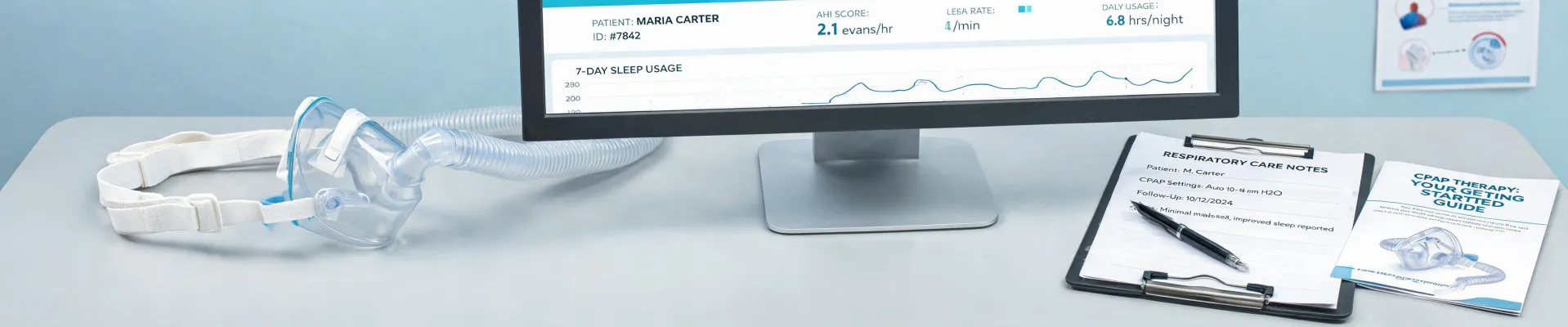
ResMed's AirView and myAir platforms track patient compliance data—hours of use, leak rates, pressure settings. If your clinic uses this data for insurance compliance or follow-ups, your consumable orders need to align with what the data says.
Here's the insight that changed my ordering:
Patients with low compliance (using the device less than 4 hours/night) will need less frequent consumable replacements—but they also need more education, not just new filters. I started filtering our AirView reports to identify low-compliance patients and worked with the nursing team to address the root cause before sending a new mask cushion. This cut our cushion replacement orders by 12% in one quarter.
I'm not saying skip orders for low-compliance patients—but don't blindly auto-ship based on schedule.
Step 6: Build Your Order and Verify Before Submitting
This is where I do the final sanity check. Here's my list:
- Quantity check: Did I order enough for the next 90 days? (I aim for 90-100 days of supply to avoid running out over weekends or holidays.)
- Vendor verification: Is this vendor authorized for ResMed products? We got burned in 2023 when a cheaper vendor couldn't provide proper invoicing—our billing team rejected $2,400 in expenses because the invoice wasn't itemized. Now I verify invoicing capability before any order.
- Shipping timeline: Do I need rush delivery? Standard ground from most ResMed distributors is 3-7 business days. If I'm ordering for a new patient starting next week, I bump to expedited.
- Backup stock: Do I have emergency stock for filters and masks? I keep a 15-day buffer of the most common items (AirSense 10 filters, F20 cushion medium, P10 pillow pack).
Common Mistakes I See (And Made) With ResMed Orders
1. Assuming all ResMed masks fit the same. They don't. The AirFit F20 and F30 have different headgear designs. The P10 and N30i fit differently. Always verify the model number.
2. Ordering filters without checking the device model. The AirSense 10 uses a rectangular filter (part #36971). The AirSense 11 uses a smaller filter (part #39393). They don't cross-fit. I've seen entire orders sent back because someone selected "ResMed air filter" without checking the part number.
3. Ignoring the humidifier setting. If a patient's heated humidifier is set to max, they'll burn through filters faster (the moisture attracts dust). Adjust your replacement schedule accordingly.
4. Not using the myAir app data. If patients aren't using their devices, sending them new filters every month is wasteful. Check compliance data first, then order.
Based on publicly listed prices from major online CPAP supply vendors, March 2025. ResMed AirSense 10 filter pricing: $8-15 per pack of 2 (standard), $12-18 per pack of 2 (hypoallergenic). Individual vendor pricing varies; always verify current rates.

Elena Varga
Elena Varga is a medical imaging systems analyst covering CT scanners, MRI systems, ultrasound platforms, digital radiography, mammography, and ophthalmic imaging equipment. She references IEC 60601-2-44 for CT safety and essential performance while examining CTDIvol, dose-length product, spatial resolution, slice thickness, field uniformity, throughput, uptime, and DICOM interoperability. Her work helps radiology leaders, medical physicists, biomedical engineers, and procurement teams compare image quality, radiation management, workflow integration, serviceability, and lifecycle cost.