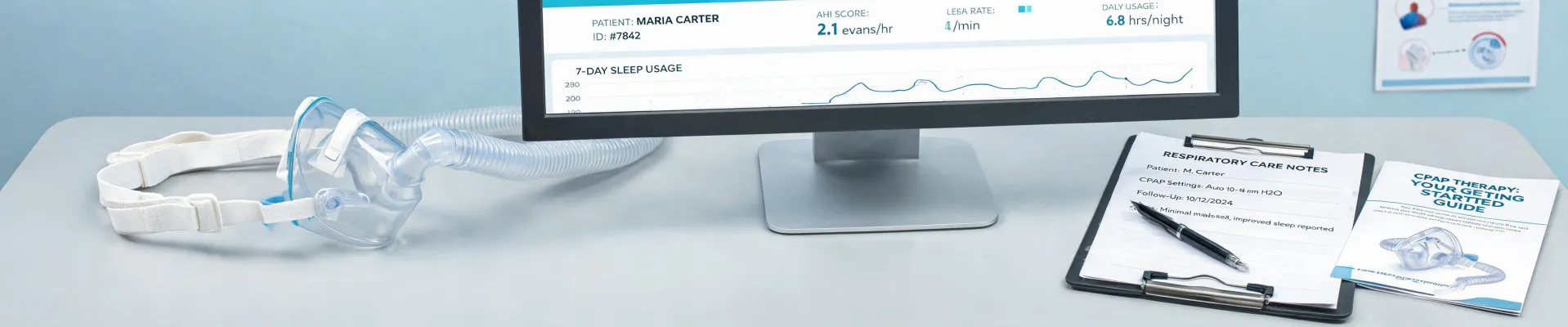
How I Learned to Look Beyond the Price Tag: A Procurement Manager’s Tale of Choosing the Right CPAP Equipment
· Elena Varga
It was a Tuesday afternoon in March 2022 when Dr. Evans from the sleep center called. "We need more CPAP machines—our patient base has grown by 30% this quarter. Can you order five units by next week?" I'd been managing purchasing for about eighteen months at that point, handling everything from office supplies to lab gear. My territory covered sleep medicine (CPAP machines), lab equipment (yes, PCR machines), imaging (C-arm systems), and even nursing supplies like ostomy products. Each category had its own quirks, but I figured a machine was a machine—find the best price, order, move on. Boy, was I wrong.
The First Mistake: Chasing the Lowest Unit Price
I jumped on the first quote I got from a distributor I hadn't worked with before. The brand wasn't ResMed—it was a lesser-known name that promised "equivalent performance" for about 40% less. The unit price was $550, compared to ResMed’s AirSense 11 at around $890. In my head, I was saving $1,700 across five units. I placed the order without digging into specs or compatibility.
Two weeks later, the shipment arrived. The machines looked fine, but when the respiratory therapists started setting them up, the problems exploded. The standard masks didn't attach securely. The heated tubing wasn't compatible with our existing universal humidifier docks. One patient complained the machine was too loud at night. Another said the interface was confusing for older users. Within a month, we had three units sitting unused and two more that needed expensive adapter kits.
I remember standing in the supply closet, staring at those beige boxes, thinking: What did I miss?
The Hidden Costs No One Told Me About
I went back and added up everything. The original quote was $2,750 for five units. Then came the adapter kits—$80 each. New compatible masks because the old ones didn't fit—$120 per patient. Additional training time for therapists to learn the different interface—roughly 4 hours of staff time. Lost goodwill with patients who had to wait an extra week while we sorted out the mess. By the time I tallied it, the real cost per machine was closer to $920. Even the ResMed unit, with its reputation, came in at $890 all-in (machine, mask, tubing, and full warranty). The “cheaper” machines ended up costing more.
I felt like a rookie—because I was one. I'd made the classic rookie mistake: assuming price was the only variable. But in medical equipment, especially CPAP therapy, total cost includes compatibility, training, support, and patient adherence. If a patient can't use the machine comfortably, it doesn't matter if you saved $300 on the purchase.
The Pivot: Switching to ResMed AirSense 11
After that debacle, I approached Dr. Evans with my findings and proposed a standardize around ResMed’s AirSense 11. I'd read that the platform had built-in cellular connectivity (myAir app) for remote monitoring, which meant fewer follow-up calls from patients. The mask cushion options were more versatile—full face, nasal pillow, nasal mask—so we could cover different sleep apnea needs without stocking a dozen variants. Plus, the heated humidifier was integrated, no extra adapters.
We placed a trial order for three units. This time I checked everything: compatibility with our existing mask cushion inventory, the spec sheet against our patient profile, the warranty terms, and the distributor's invoicing process. I even called the manufacturer’s support line to ask about typical lead times. (Hint: that phone call alone saved us from a two-week delay when the first batch got held up at customs.)
The transition wasn't seamless—nothing ever is. We had to retrain two therapists who were used to a different interface. But the training was straightforward, and within a month our patient satisfaction scores improved. The myAir app reduced the number of “how to change air pressure” calls by about 60% according to our front desk logs.
The Real Lesson: Total Cost Thinking
I've now been managing purchases for over three years, and I apply the same framework to every equipment category—whether it's PCR machines for the lab, C-arm systems for orthopedics, or ostomy supplies for home care. The principle is the same: look beyond the unit price. I calculate what I call the “five hidden costs”: shipping, setup/adaptation, training, downtime, and risk (like incompatibility that leads to returns). Per FTC guidelines (ftc.gov), any health-related claim like “compatible with all masks” must be substantiated—so I ask vendors for proof before ordering.
Even now, when I need to buy a resmed mask cushion, I don't just grab the cheapest listing. I verify part numbers, check if our current patients need a specific size, and factor in the reorder cycle. It adds maybe ten minutes to the ordering process, but it saves hours of headaches later. And the best part? Finance stopped rejecting my expense reports because every invoice is clean, clear, and traceable.
What I'd Tell Any Procurement Colleague
If you're starting out in medical equipment buying (or even if you've been at it a while), here's my honest advice:
- Never buy on price alone. The cheapest option often has hidden costs that surface after the order is placed.
- Verify compatibility before you commit. Especially for CPAP machines—masks, tubing, and humidifiers aren't universal.
- Build relationships with a few trusted vendors. I consolidated from eight vendors to three, and our total ordering time dropped from 12 hours per month to 6. That's real savings.
- Don't be afraid to admit a mistake. I learned more from that failed purchase than from any training manual. Now I have a checklist I run through for every high-value item.
It's been two years since that Tuesday afternoon. Our sleep center now runs almost exclusively on ResMed equipment—AirSense 11 machines, with a mix of full face and nasal pillow mask options stocked for every patient. Patients report better adherence, therapists have fewer troubleshooting calls, and I sleep a little better knowing I didn't just pick the cheapest option. Total cost thinking isn't just a finance concept—it's the difference between looking smart in front of your VP and eating a $2,400 mistake out of your department budget.
P.S. – If you're wondering about that initial $550 machine, I ended up returning four of them. The distributor didn't have a restocking fee, but the return shipping and handling cost us $175. Another hidden cost I'll never forget.

Elena Varga
Elena Varga is a medical imaging systems analyst covering CT scanners, MRI systems, ultrasound platforms, digital radiography, mammography, and ophthalmic imaging equipment. She references IEC 60601-2-44 for CT safety and essential performance while examining CTDIvol, dose-length product, spatial resolution, slice thickness, field uniformity, throughput, uptime, and DICOM interoperability. Her work helps radiology leaders, medical physicists, biomedical engineers, and procurement teams compare image quality, radiation management, workflow integration, serviceability, and lifecycle cost.