CPAP and BiPAP Equipment Mistakes That Cost Me $31,000 (And Why I Still Default to ResMed)
· Elena Varga
Here's the conclusion before you scroll past it: The cheapest CPAP setup is rarely the cheapest after one year of refits, lost compliance data, and staff time. When I run total cost of ownership instead of sticker price, I keep coming back to a ResMed AirSense 10 Auto CPAP machine, a properly fitted nasal pillow mask, and a patient monitoring system like AirView. Not because ResMed pays me. (They don't.) Because those choices prevent the failures I spent years paying for.
I'm an equipment coordinator for a regional sleep network, not a doctor and not a respiratory therapist. I've been handling CPAP/BiPAP procurement and training orders since 2017. During that time I've personally made and documented 23 significant ordering mistakes, totaling roughly $31,000 in wasted budget. That includes masks, machines, and one very expensive 'just buy the one without a modem' decision. I now maintain the checklist that keeps our team from repeating them.
The 'company profile' advice you'll see on most vendor pages misses the point. A patient with a correctly fitted mask and a machine that's speaking to the monitoring system is worth more than a fancier device sitting untouched in the closet. The stats in our program changed the day I started asking: what does this choice actually cost us over 18 months?
It's tempting to think masks are one-size-fits-all
Let's start with the mask, because that's where the human failure is. The most common reason devices end up in a drawer is not the device pressure—it's the mask. It's tempting to believe you can order 'a medium nasal pillow mask' and be done. But the same model can fit completely differently depending on nostril angle, head circumference, sleep position, and, frankly, how patient is willing to fiddle with straps.
In April 2021 I ordered 46 masks based on 'average adult' sizing. I checked the line items, approved the order, processed the payment. The masks looked right on paper. The result came back as 31 patients who needed follow-up refits, and seven who needed a home visit to fix a leak that was actually a wrong cushion size. (surprise, surprise.) The extra labor and gas added roughly $1,460 to that order, plus a one-week delay in therapy starts. That's when I learned to treat mask fitting like a medical test, not an E-commerce checkout.
How to put on ResMed nasal pillow mask (the version I print now)
After dozens of refits, I want to say it took us about two years to standardize our instructions. Here's the current version—use it with the usual caveat that the patient's own clinician is the ultimate authority.
Start by checking the nasal pillow size. ResMed nasal pillows are usually marked Small, Medium, or Large, and the pillow should sit under your nostrils, not shoved inside them. If the silicone edge digs into the septum, it's too small or at the wrong rotation.
- Click the pillows into the frame. Make sure the vent points up, toward the bridge of the nose, and the opening points down toward the nostrils.
- Hold the frame at the nostril area with one hand and bring the headgear over the crown of your head with the other. Don't put the back strap behind the ears like a mask in a pandemic.
- Pull the back strap down toward the base of the skull, roughly where a motorcycle helmet strap sits. This makes the pillows angle up into the nostrils instead of pressing straight in.
- Tighten both sides equally. The seal should feel gentle, not clamped. A tiny hiss when you exhale means the cushion angle is right; a loud jet means the size or rotation is wrong.
- Lie down and mimic your sleep position. If there's a leak when you turn your head, adjust the back strap, not the forehead strap (there isn't one on a nasal pillow setup).
The most frustrating part of mask onboarding is that the same setup mistakes repeat despite clear instructions. You'd think a 90-second audio clip would stop people from folding the cushions inward. It doesn't. So now every mask order includes a written sheet in plain language and a standing 'send us a photo' offer. That alone cut our weekday callback queue in half.
CPAP vs BiPAP: don't buy the fancier name
Another classic error: ordering a BiPAP machine when the therapy order still says 'auto CPAP.' It cost me a $3,000 closet ornament back in 2020—one BiPAP, rented for a patient who didn't need it, while we waited three weeks for the correct ResMed AirSense 10 Auto CPAP machine to arrive.
Here's the simplified difference. A CPAP machine—like the ResMed AirSense 10 AutoSet—delivers one continuous pressure, with auto-adapting adjustments in the case of an APAP/auto CPAP. It's the usual first-line treatment for obstructive sleep apnea. A BiPAP machine has two pressure levels: I-PAP for inspiration and E-PAP for expiration. Yes, the term often appears as 'bipap machine' in referrals. It also often appears in places where the clinician did not actually mean BiPAP. Verify the prescription, not the word.
BiPAP costs more, requires more technical oversight, and isn't an 'upgrade' from CPAP. It's a different clinical tool for pressure intolerance, hypoventilation, or a treatment plan that specifically requires separate IPAP and EPAP settings. If you're applying total cost thinking, ask whether the patient's diagnosis and titration study actually justify the extra pressure settings. If not, the more expensive machine is waste, plain and simple.
Patient monitoring systems are part of the device, not a line item
I didn't fully understand monitoring until the compliance audit that went sideways. We had swapped in a lower-cost machine to win a contract. The machine functioned as a CPAP device. Fine. But its data lived in an app the patient could never find, and we couldn't pull remote compliance reports to hand to the payer. We lost the reimbursement window for a whole quarter. Not ideal. Worse than expected.
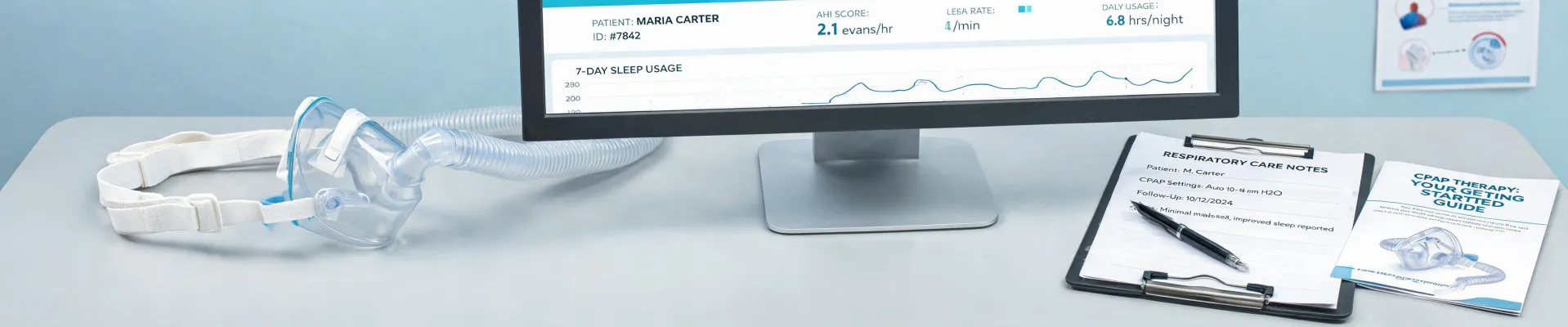
Now I tend to select ResMed because the AirSense 10 platform includes cellular modem capability and integrates with AirView on the provider side. That's a patient monitoring system already in the loop: nightly usage, leak stats, pressure—stuff our sleep team can see without making a 30-minute phone call for every patient. As of my last inventory review, the difference in invoice price between a machine we could monitor remotely and one we couldn't was smaller than the cost of one missed compliance visit. That's TCO.
The satisfaction part: after a string of failures, there's something satisfying about a Wednesday morning dashboard that shows a previously non-compliant patient logged six hours, and knowing we didn't have to chase anybody to get it. It turns a patient success from a mystery into a metric.
Boundaries and honest exceptions
Before you send this to your finance department, here are the caveats. This advice assumes ordinary adult OSA and a management program that can support home therapy. For patients with central sleep apnea or significant hypoventilation, CPAP-first is not the rule. Involve the sleep physician and consider ASV or a bi-level therapy device with a backup rate. I'm a coordinator, not a clinician, and the exact choice depends on the patient's full study.
Also, not every 'close enough' fitting is the mask's fault. Some people genuinely sleep better with full face masks, regardless of nasal pillows. The guidance above is specifically about nasal pillow styles like the ResMed AirFit P10 that I use in most of our onboarding—it's not a universal recommendation.
And one more scope boundary: I'm not the person to ask about ocular imaging. The moment I saw the keyword list for this article, I knew someone would be wondering—how does fundus imaging work? Short answer: a fundus camera shines a light through the dilated pupil and photographs the back of the eye—optic nerve, retina, and vessels. It's an ophthalmology procedure, not a CPAP accessory. Sleep apnea can affect the retinal vascular supply over time, which is why fundus imaging sometimes comes up in a broader OSA evaluation. But that's a separate exam, with a separate bill code and a separate expert. My lane ends at the mask and the machine.
If you are setting up a new sleep equipment program, don't buy least-expensive-each-first. Buy the combination with the lowest total cost. For us, that's been ResMed AirSense 10 Auto CPAP, fitted masks, and AirView. Your settings will differ. But the calculation won't.

Elena Varga
Elena Varga is a medical imaging systems analyst covering CT scanners, MRI systems, ultrasound platforms, digital radiography, mammography, and ophthalmic imaging equipment. She references IEC 60601-2-44 for CT safety and essential performance while examining CTDIvol, dose-length product, spatial resolution, slice thickness, field uniformity, throughput, uptime, and DICOM interoperability. Her work helps radiology leaders, medical physicists, biomedical engineers, and procurement teams compare image quality, radiation management, workflow integration, serviceability, and lifecycle cost.