A Procurement Manager's Checklist for Medical Device Purchases: From CPAP to Portable Ultrasound
· Elena Varga
-
Who This Checklist Is For
-
Step 1: Define Clinical Requirements Before Talking to Any Vendor
-
Step 2: Calculate Total Cost of Ownership (TCO) — Not Just the Quote
-
Step 3: Assess Compatibility and Ecosystem Lock-In
-
Step 4: Verify Vendor Support and Regulatory Compliance
-
Step 5: Evaluate Digital Management and Efficiency Tools
-
Common Mistakes to Avoid
Who This Checklist Is For
If you're a procurement manager responsible for sourcing medical equipment across multiple departments — respiratory, imaging, lab, and long-term care — you've probably noticed that each category has its own quirks. This checklist is designed for someone like me, who manages a hospital's capital and consumable budget and needs a repeatable process that doesn't get bogged down in vendor hype.
I've been doing this for about six years now, and I've made plenty of mistakes. The checklist below is what I wish I'd had when I started. It covers five essential steps, and it's built around the idea that total cost of ownership (TCO) matters more than the sticker price.
Step 1: Define Clinical Requirements Before Talking to Any Vendor
This sounds obvious, but I've lost count of how many times I've seen teams ask for quotes without a clear spec. For CPAP machines (like the ResMed AirSense 10 or 11), you need to know: is it for a sleep lab or home use? Does it need built-in cellular connectivity for remote monitoring? What mask types (full face, nasal pillow) will be stocked?
For portable ultrasound, the key questions are: which clinical department will use it (radiology, emergency, OB/GYN)? What depth and frequency ranges are needed? For PCR machines, you're looking at throughput (how many samples per run) and multiplexing capability. And for incontinence products — adult briefs, pads, liners — the main variable is absorbency level and skin compatibility, not just price per unit.
Checkpoint: Write down at least three must-have features for each device category before opening a single brochure. Otherwise you'll end up with a shiny feature you didn't need that inflates the cost.
Step 2: Calculate Total Cost of Ownership (TCO) — Not Just the Quote
When I first started managing equipment procurement, I assumed the lowest initial quote was the best deal. That was wrong. Really wrong. In Q2 2023, I compared three CPAP vendors. Vendor A quoted $1,200 per unit; Vendor B quoted $1,050. Vendor B looked like a clear winner until I requested a breakdown of accessories and service.
Vendor B charged separately for heated tubing ($85), modem activation ($120), and had a $200 annual software licensing fee per machine for the cloud portal. Vendor A included all of that in the $1,200. Over a five-year lifespan, Vendor A's TCO was $1,200 (no extras), while Vendor B's TCO came out to $1,050 + $85 + $120 + ($200 × 5) = $2,255 — almost double.
Apply the same thinking to other devices. Portable ultrasound transducers wear out and need replacements. PCR machines require regular calibration kits. Incontinence product cost isn't just per case — factor in storage space, disposal costs, and nursing time for changes.
Checkpoint: Always request a full TCO breakdown for at least three years. Ask about consumables, service contracts, training, and software subscriptions. If they won't give it, that's a red flag.
Step 3: Assess Compatibility and Ecosystem Lock-In
In my experience, the biggest hidden cost comes from vendor lock-in. ResMed, for example, has a well-integrated ecosystem: CPAP machines, masks, tubing, humidifiers, and the myAir app for patient engagement. That's great if you're all-in with one brand — everything works together. But if you try to mix a ResMed machine with a third-party mask, you might lose some auto-adjustment features or data integration.
Similarly, portable ultrasound probes are often brand-specific; you can't use a GE probe on a Philips machine. PCR reagents are also proprietary in many systems. And incontinence product types — disposable briefs, pull-ups, underpads — vary widely in fit and absorbency. A cheap brief that leaks means more linen changes and nursing time, which blows up your labor costs.
Checkpoint: For each device, ask: Can I use compatible consumables from another supplier? If not, what's the long-term cost of staying within that ecosystem? Sometimes the premium brand saves money in the long run through fewer compatibility hassles.
Step 4: Verify Vendor Support and Regulatory Compliance
This step gets skipped way too often. For medical devices, you need to know: are they FDA-cleared (or CE-marked for EU)? Do they offer service contracts with guaranteed response times? For devices like CPAP machines, a common error code like ResMed error 12 indicates a communication failure — usually fixable with a factory reset or firmware update, but only if the vendor provides remote support.
I'm not a clinical engineer, so I can't troubleshoot device protocols. What I can do from a procurement perspective is verify that the vendor has a tech support hotline, spare parts availability, and a clear return policy. For portable ultrasound and PCR machines, calibration and repair turnaround is critical — a down imaging system can delay patient diagnoses.
Checkpoint: Request at least three references from similar-sized institutions. Ask about their service experience. Also, check the vendor's regulatory history — any FDA warning letters or recalls in the past five years.
Step 5: Evaluate Digital Management and Efficiency Tools
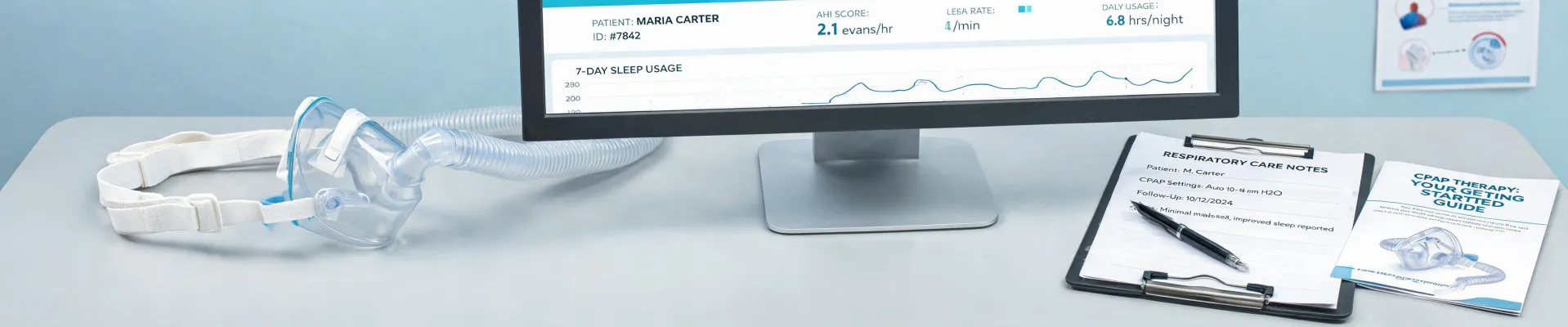
Efficiency is where you really save time and money. ResMed's myAir platform gives clinicians remote access to CPAP compliance data, which cuts down on manual charting. Switching to digital monitoring at my previous facility reduced follow-up call time by about 40%. The automated alerts also flagged low mask leak rates earlier, improving patient outcomes — and that makes the ROI case easier to defend.
For portable ultrasound, look for systems with cloud storage and AI-assisted measurements. For PCR machines, integrated lab information system (LIS) connectivity reduces data entry errors. Even for incontinence products, some vendors offer inventory management dashboards that predict usage and automate reordering — eliminating the last-minute rush orders that cost us $450 in hidden fees last year.
Checkpoint: Ask each vendor to demonstrate how their digital tools reduce manual work. Get a timeline for implementation and training. If they can't show a concrete time savings estimate, their platform probably isn't mature enough.
Common Mistakes to Avoid
- Ignoring nursing and clinician input. I once chose a CPAP mask based solely on cost — the staff hated it because it leaked, and compliance tanked. Now I always include end-users in the evaluation.
- Underestimating training costs. A fancy portable ultrasound machine is useless if the techs can't operate it. Budget for at least two days of onsite training.
- Relying on outdated pricing. This pricing was accurate as of Q4 2024. Medical device costs fluctuate with raw materials and supply chain changes. Always ask for current quotes within 30 days of purchase.
- Forgetting about spare parts. For PCR machines, a broken thermal cycler module can idle the whole lab for weeks. Factor in a spare parts kit or an extended warranty.
Look, I'm not a biomedical engineer, so I can't speak to the clinical nuances of each device type. But from a procurement perspective, this checklist has saved my facility roughly $8,400 annually (about 17% of our equipment budget) compared to our old vendor-hopping approach. If you follow these steps, you'll probably avoid the worst mistakes — and your CFO will thank you.

Elena Varga
Elena Varga is a medical imaging systems analyst covering CT scanners, MRI systems, ultrasound platforms, digital radiography, mammography, and ophthalmic imaging equipment. She references IEC 60601-2-44 for CT safety and essential performance while examining CTDIvol, dose-length product, spatial resolution, slice thickness, field uniformity, throughput, uptime, and DICOM interoperability. Her work helps radiology leaders, medical physicists, biomedical engineers, and procurement teams compare image quality, radiation management, workflow integration, serviceability, and lifecycle cost.