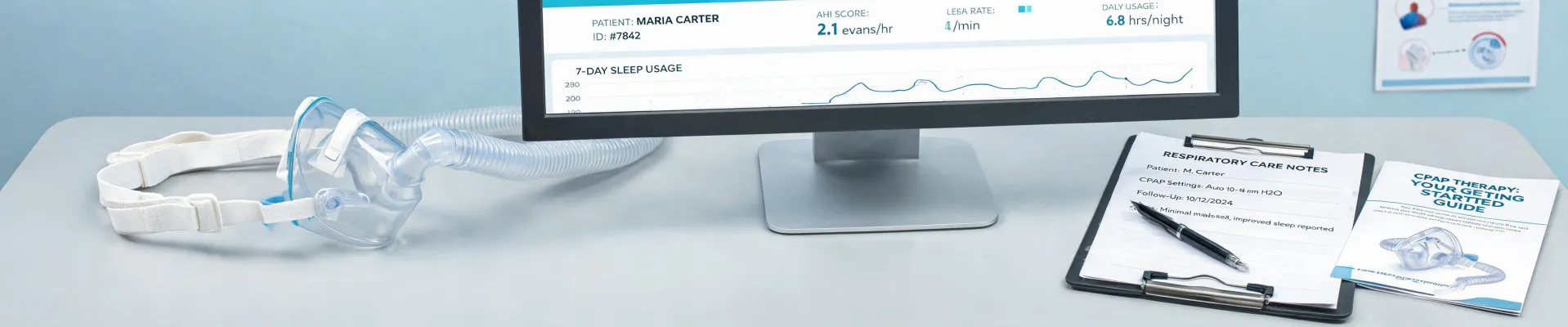
ResMed Sleep Machines and Mask F40: Procurement Questions I Wish More Sleep Centers Asked
· Elena Varga
-
1. Should I standardize on ResMed sleep machines?
-
2. Is the ResMed Mask F40 worth the higher price?
-
3. Does the ResMed Mask F40 need a sterile barrier system?
-
4. Should a wearable ECG device be in the sleep equipment budget?
-
5. Why do energy devices in surgery show up on medical device bids?
-
6. What's the smartest way to negotiate a ResMed CPAP contract?
-
7. What hidden costs make a ResMed Mask F40 order less cost-effective?
I've managed equipment purchasing for a sleep center for the last six years. In that time, I've approved more CPAP orders than I can count—and made a few mistakes that ended up in our cost tracking spreadsheet. The most frustrating part of this job: the same avoidable confusion shows up again and again.
So here's a practical FAQ. If you're evaluating a ResMed sleep machine, adding the ResMed Mask F40 to your inventory, or trying to figure out whether certain line items belong in your capital plan, this is for you.
1. Should I standardize on ResMed sleep machines?
I'm not going to tell you "yes, just because it's ResMed." But I'll tell you what our 2023 audit found. We were using 11 different CPAP models across 4 locations. It looked flexible, but it was expensive:
- Clinicians had to learn 11 different error codes.
- We stocked 17 different tubing and filter variants.
- We spent roughly $5,000 a year on expedited shipping because the right parts weren't on the shelf.
We cut down to two ResMed sleep machine models and one backup model. Training time dropped, and our consolidated parts order saved us about 14% on accessories. The lesson isn't "buy ResMed"; it's "pick a platform, then commit enough to make it operational." ResMed happens to have the ecosystem to support that—but only if you actually standardize your masks and accessories along with it.
2. Is the ResMed Mask F40 worth the higher price?
The ResMed Mask F40 is one of the masks I stopped apologizing for. It sits under the eyes with a small frame, and in our patient feedback, it leaks less than the mask we used before for full-face therapy. But "worth it" depends on your stock sizes.
Here's where I got burned. I bought a batch of mask cushions because the unit price was lower. I didn't check the compatibility line carefully. The box said "fits ResMed mask F40 frame" but not the version our patients were using. Actually, wait—it was the frame, not the cushion. We had to return 60 units and pay restocking. The 'cheap' option cost us $1,100 and a week of delays.
My advice: choose one mask geometry, standardize your size range, and buy from a supplier who lets you order individual sizes instead of forcing a multi-size box. The premium disappears once you stop throwing away unused sizes.
3. Does the ResMed Mask F40 need a sterile barrier system?
No. Most CPAP masks—including the F40—are non-sterile medical devices. They should be clean and properly packaged, but that's not the same as a sterile barrier system.
I started paying attention to this after a vendor sent a quote with a "sterile barrier system upgrade" on every mask. We didn't ask for it. I almost dismissed it as a standard part of packaging. Then I saw the price: $4.75 per mask. For our volume, that was almost $900 unnecessary cost.
Always ask: "What, exactly, is the sterile barrier system for? Is the product labeled sterile? If not, remove that charge." It's not a malicious upsell in every case—it's often a default category in a hospital supply database. But defaults can cost you.
4. Should a wearable ECG device be in the sleep equipment budget?
This one surprised me. A wearable ECG device can be useful for patients with atrial fibrillation or other cardiac comorbidities that appear alongside sleep apnea. But it's not a CPAP accessory, and it doesn't talk to a ResMed sleep machine the way people expect.
We piloted wearable ECG monitors with 30 patients. The wearable was comfortable—much better than a Holter monitor in our cardiology group. But it generated a separate clinical workflow, separate battery charging, and separate data platform. Our sleep center couldn't just "add it to the ResMed contract" and hope for the best.
Budget it separately. If you combine it with your sleep machine order, make sure someone owns the integration. Otherwise, you'll pay for two devices and a data gap that no one wants to cover.
5. Why do energy devices in surgery show up on medical device bids?
This is the question that makes me crazy. "Energy devices in surgery" are things like electrosurgical pencils, ultrasonic shears, or vessel-sealing instruments. They have nothing to do with CPAP therapy. But in group purchasing contracts, unrelated categories sometimes get bundled to hit volume pricing.
One year, a bid sheet lumped our ResMed sleep machine order in with surgical energy devices. The combined price looked 12% lower than last year. But when I asked for the sleep therapy breakdown, it was actually 4% higher. The savings in surgery was covering the increase. We didn't know until we separated the lines.
If you see energy devices in surgery on the same quote as sleep products, pause. Separate the categories, compare each one to its own historical cost. If a vendor won't split the bid, that's a red flag.
6. What's the smartest way to negotiate a ResMed CPAP contract?
After comparing 5 vendors over 5 years—and making a lot of mistakes—I use a simple rule: negotiate the total cost of care, not the machine price.
That includes:
- Masks and cushions, with realistic replacement schedules
- Tubing, filters, and humidifier chambers
- Clinical training for your staff
- Access to the ventilator management dashboard
- Returns and warranty handling for defective units
The cheapest ResMed sleep machine price can look great until you add the "standard" mask that doesn't fit half your patients. The reverse is also true: a slightly higher machine price with guaranteed fit and a reliable exchange policy is basically insurance.
I only believed this after ignoring it once. We chose a lower quote, saved $2,400 upfront, then paid $3,100 in exchange shipping, overnight replacements, and clinician time. I'm not going to tell you that every premium is worth it. But I will tell you to model returns and fit failures before you sign.
7. What hidden costs make a ResMed Mask F40 order less cost-effective?
Look at your reject or exchange rate. In our system, mask returns aren't resellable. A 10% exchange rate is normal for a full-face mask now? Our rate for the F40 is just under 6%, which is good. If your vendor's price quote assumes a 2% exchange rate, you'll eat the difference.
Other hidden costs: compatibility with the model of mask frame and headgear, shipping insurance, patient education materials, and whether the vendor includes a sizing tool or trial set. We now ask vendors to include a first-fit trial set with our initial order, and it's dramatically reduced mismatch returns.
That's the kind of detail you don't see on the first quote. Ask before you budget.

Elena Varga
Elena Varga is a medical imaging systems analyst covering CT scanners, MRI systems, ultrasound platforms, digital radiography, mammography, and ophthalmic imaging equipment. She references IEC 60601-2-44 for CT safety and essential performance while examining CTDIvol, dose-length product, spatial resolution, slice thickness, field uniformity, throughput, uptime, and DICOM interoperability. Her work helps radiology leaders, medical physicists, biomedical engineers, and procurement teams compare image quality, radiation management, workflow integration, serviceability, and lifecycle cost.