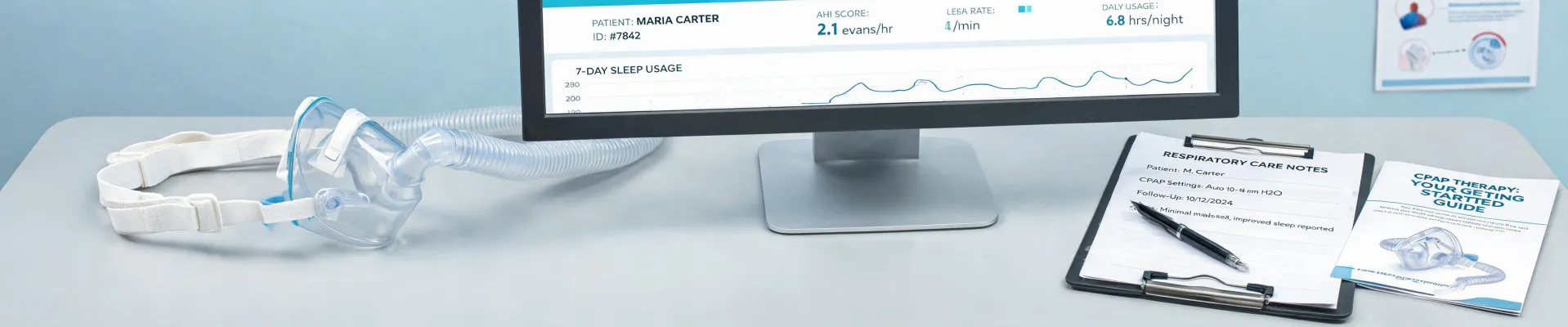
What Is Nasal CPAP? ResMed AirFit, AirSense 10 Error 006, and an Admin Buyer's Story
· Elena Varga
I'm the office administrator for a 140-person clinic. I manage all the medical supply ordering—roughly $220,000 a year across 12 vendors. I report to both operations and finance, which is a polite way of saying I'm the one who gets called when something shows up late.
In March 2024, three urgent requests landed on the same day. Neurology wanted a quote for a neuromonitoring system. The infusion center was almost out of IV catheters. And the sleep center manager walked in holding two ResMed AirSense 10 machines with error 006 on the screens. 'What's this one?' I asked. 'Motor fault,' she said. 'And also, we're out of ResMed AirFit masks in the size patients actually use.'
That morning, I realized the sleep therapy supply process needed fixing for good.
How I got here
I took over purchasing in 2022. Before that, this clinic had no central process for sleep therapy supplies. Each department picked its own vendors, kept its own spreadsheets, and basically hoped for the best. Within six months, I saw the pattern: we were paying too much, waiting too long, and ordering the wrong sizes.
Part of the problem was that I didn't understand the product. If you've ever googled 'what is nasal CPAP,' the short answer is continuous positive airway pressure through a small mask that covers just the nose. It keeps the airway open during sleep. That sounds simple, but the mask has to fit, the machine has to be serviced, and the supplies have to be stocked in the sizes your patients actually use.
The cheap-vendor mistake
In late 2023, I found a vendor that said it could save us 18% on ResMed products. The quote for ResMed AirSense 10 devices and ResMed AirFit masks was about $1,400 a year lower than our regular distributor. I did the math, presented it to finance, and placed an order.
The first shipment was a disaster. The AirSense 10 units weren't new. When we powered one up for patient setup, it showed error 006. According to ResMed's support documentation (resmed.com, accessed May 2024), error 006 means a motor fault—the blower has stopped working. That is not something you can reset. It needs service. The masks were also wrong. We ordered a mix of AirFit sizes, but the boxes were mislabeled, so the sleep center couldn't fit patients.
I don't have hard data on how often that vendor shipped defective returns, but based on that one experience, my sense is they were selling refurbished inventory as 'open-box' without checking it.
Here's the part I don't like admitting. Return shipping, restocking fees, a rescheduled sleep study, and an emergency rental device cost us more than $2,000. We saved $1,400 on the quote and lost at least $2,000 on the execution. That was my penny-wise, pound-foolish moment. Like most beginners, I focused on unit price and forgot to check what happens after the invoice. A vendor who can't handle defective devices isn't a vendor; it's a liability.
The fix
I went back to our authorized ResMed distributor. Their price was slightly higher, but they included three things the discount vendor didn't: warranty handling for error 006, mask fit guidance, and a digital ordering portal. That portal alone cut our CPAP order processing time from about 5 days to 1 day.
The support team gave me one useful rule: if an AirSense 10 shows error 006, don't try to troubleshoot it. Log the serial number, mark it 'return for service,' and get a replacement device from the distributor. That one rule saved us days of back-and-forth.
We also started using the distributor's fit-testing reports to stock ResMed AirFit masks in the sizes our patients actually requested. Not a best guess—actual data.
Applying the same lesson to everything else
The same logic trickled into the rest of my purchasing. The neuromonitoring system quote? I made the neurology team write their evaluation criteria before we asked for proposals. The IV catheter order? We moved to a standing monthly order instead of waiting for someone to run out.
That is what efficiency looks like in a small department. It is not about squeezing the last dollar out of every purchase order. It's about removing friction so the right supplies get to the right place on time.
What I'd tell another admin buyer
Most buyers focus on per-unit pricing and completely miss the cost of a failed delivery. If a vendor can't provide proper invoicing, handle returns, or answer the phone when a device shows error 006, the lower quote is not a saving.
I do not recommend making the same mistake I made. Design a process that avoids the $2,000 surprises. Pay a little more for support if you have to. It's worth it.
And if you're still wondering what nasal CPAP has to do with administrative work? More than you'd think. Nasal CPAP keeps people breathing at night. My job is to make sure we have the right machine, the right mask, and a process that works when something goes wrong. That's it.
Take it from someone who learned the hard way: the cheapest order isn't cheap if it arrives on a Friday afternoon with error 006 on the screen.

Elena Varga
Elena Varga is a medical imaging systems analyst covering CT scanners, MRI systems, ultrasound platforms, digital radiography, mammography, and ophthalmic imaging equipment. She references IEC 60601-2-44 for CT safety and essential performance while examining CTDIvol, dose-length product, spatial resolution, slice thickness, field uniformity, throughput, uptime, and DICOM interoperability. Her work helps radiology leaders, medical physicists, biomedical engineers, and procurement teams compare image quality, radiation management, workflow integration, serviceability, and lifecycle cost.