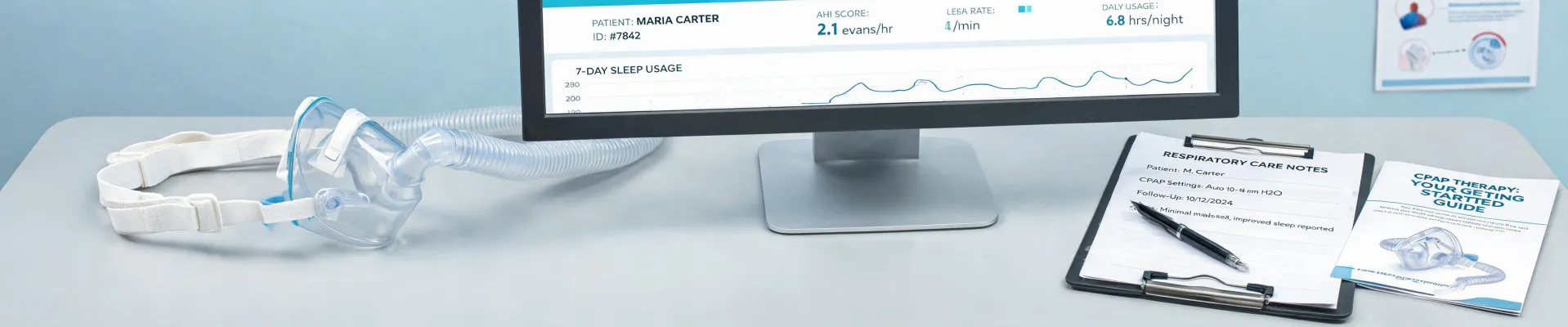
I Spent $4,700 on Medical Device Specs I Didn't Understand: A ResMed Buyer's FAQ
· Elena Varga
Seven Questions I Wish I'd Asked Before Buying ResMed Equipment
When I first started handling equipment orders for our sleep center back in 2019, I assumed that if the specs looked good on paper and the price was right, we were good to go. That assumption cost us about $4,700 in useless inventory over the next two years—wrong masks, incompatible machines, and a fluoroscopy system we couldn't actually install. I've since made a checklist. This FAQ is built around the questions I now ask before every single ResMed-related purchase. I hope it saves you the same headache.
1. What's the real difference between the new ResMed CPAP machines (AirSense 11 vs. AirSense 10)?
This was my first major mistake. We bought a bulk lot of AirSense 10 devices in late 2021 because the price was fantastic (approx. $850 per unit, based on my 2021 distributor quote). We didn't realize the AirSense 11 was literally three months from launch. The 11 has a significantly smaller footprint, a better color touchscreen, and—critically for our workflow—native cellular connectivity. The 10 needs a modem accessory. I'm not saying the 10 is obsolete; it's still a solid device. But if you're setting up a new patient monitoring program with AirView, the 11 saves you the $150 modem accessory cost per unit and the hassle of Wi-Fi setup. The 10 is still a stronger choice for budget-limited setups (it was $700-750 by early 2023). To be fair, both have the same AutoSet algorithm, so clinical outcomes are identical. The difference is workflow efficiency.
2. How do I know which mask is compatible with the ResMed AirMini? (I got this very wrong.)
Ouch. I ordered 20 AirMini machines for our travel pool and then bought standard ResMed masks to go with them. Every single mask was returned. The AirMini has a proprietary 15mm tube connection, not the standard 22mm. You must use the special AirMini mask or a standard mask with the AirMini tubing adaptor (which ResMed sells separately; it's the 'AirMini Standard Connector Kit'). The compatible masks are specifically the AirFit P10 (with the special AirMini headgear), AirFit N20 (again, special), and AirFit F20. The standard versions of these masks won't connect. I'd estimate that mistake—20 units of the wrong masks plus return shipping—cost us roughly $650.
3. Do I really need a separate blood pressure monitor for sleep apnea patients, or is it redundant?
This isn't strictly a ResMed question, but it comes up constantly because of the known link between OSA and hypertension. I used to think our patient's home BP monitor reading was good enough. It is not. Clinical guidelines for comorbidity management require standardized measurements. We bought a Welch Allyn unit for the clinic (about $250). But here's the thing I didn't get initially: many CPAP machines now track pulse, but they don't measure blood pressure. You need a separate device. The AMA recommends home BP monitoring for all OSA patients on therapy (Source: AMA, 2023). If you're setting up a clinic, budget for at least two validated monitors. Don't rely on the patient's consumer-grade wrist cuff.
4. What's a fluoroscopy system doing in a sleep center article? (Or: Why are you talking about radiology?)
Fair question. I'm including it because I made a purchasing error that affected our imaging colleagues. If your hospital or multi-specialty clinic is buying a new fluoroscopy system—say, for GI or ortho procedures—and you also run a sleep lab, there's a hidden overlap: room shielding and electrical requirements. We bought a refurbished C-arm system for about $45,000 in Q3 2023. The listing said it was 'ready to install.' What it didn't say is that it required a dedicated 30-amp circuit and lead-lined walls for the control booth (our existing room only had standard drywall). The electrical upgrade cost $2,800. The wall shielding? $1,900. I now always ask for the installation specifications PDF before any major equipment purchase. It's boring paperwork, but it beats paying for equipment that sits in a crate for a month (as ours did).
5. What is clinical chemistry, and should I care about it when buying respiratory devices?
This keyword feels out of place, I know. But here's the connection: when your hospital invests in a new clinical chemistry analyzer (for the lab), it has a downstream effect on your sleep center's budget. Capital expenditure in one department often reduces funds available for another. I've seen it happen. A $200,000 chemistry analyzer purchase in 2022 meant our request for new BiPAP machines was deferred. My point is: if you're in procurement for a sleep center, keep an eye on what the lab is buying. Their 'urgent need' can become your 'budget freeze.' Plan your ResMed equipment purchases around the hospital's fiscal calendar, not your clinical one.
6. Why do ResMed devices have such different prices across vendors? (A $400 spread is normal.)
It's not a scam. In 2024, I saw quotes for the AirSense 11 AutoSet ranging from $899 to $1,285 from different authorized distributors. The variance comes from bundled services: does the price include AirView setup training? Does it include a 3-year warranty vs. a 1-year? Is shipping and installation support included? The cheapest quote is often the 'bare' device. I made the mistake of going with the low bid twice. The first time, we didn't realize the warranty was only on the device, not the humidifier—and a cracked chamber wasn't covered. The second time, the vendor charged $75/hr for setup training that another vendor included free. The total cost of ownership for the 'cheap' quote was actually 12% higher. (Source: Our internal cost tracking, Q4 2023 vs. Q1 2024.)
7. What's one thing about ResMed equipment that nobody tells you upfront?
That the power supply brick is huge and heavy. It's a minor annoyance, but for patients who travel, the AirSense 11 power supply weighs almost 2 lbs. The AirMini power supply is smaller, but still chunky. Also, the water chambers for the humidifiers are fragile. We replaced 12 of them in 18 months because they were dropped during cleaning. Budget for consumables—mask cushions (replace every 3 months), tubing (every 6 months), and water chambers (budget for breakage). A spare chamber is about $30. I now order two with every new machine. It's a small cost, but it saves a phone call from a patient whose chamber just broke on a Saturday night.

Elena Varga
Elena Varga is a medical imaging systems analyst covering CT scanners, MRI systems, ultrasound platforms, digital radiography, mammography, and ophthalmic imaging equipment. She references IEC 60601-2-44 for CT safety and essential performance while examining CTDIvol, dose-length product, spatial resolution, slice thickness, field uniformity, throughput, uptime, and DICOM interoperability. Her work helps radiology leaders, medical physicists, biomedical engineers, and procurement teams compare image quality, radiation management, workflow integration, serviceability, and lifecycle cost.