The Hidden Bottleneck in Acute CPAP Therapy: Why Mask Fit and Humidification Matter More Than You Think
· Elena Varga
The Scenario That Keeps Me Up at Night
It was a Tuesday afternoon in March 2024 when the call came in. A 45-bed sleep center had just admitted three acute exacerbation patients in one shift. They needed CPAP setups that same evening—and the standard inventory was already tapped out. The respiratory therapist on the phone wasn't panicking, but I could hear the edge: “We have the machines, but none of our standard nasal masks fit the patient with facial trauma. And the heated humidifier on our backup unit is faulty.”
In my role coordinating emergency equipment for these facilities, I've handled over 200 rush orders in the last three years. That day, the bottleneck wasn't the CPAP device itself—it was the mask selection and the humidification system. And that's where most clinicians get trapped.
What Everyone Thinks the Problem Is
When a patient struggles with CPAP in an acute setting, the first assumption is usually “the machine is too weak” or “the pressure settings are wrong.” Therapists tweak the pressure, switch to BiPAP, or even consider intubation. But in my experience, over 60% of acute CPAP failures are actually mask- or humidity-related—not pressure-related.
It's tempting to think you can just grab any full face mask and crank up the flow. But the reality is far more nuanced. Let me break down the three hidden layers most people miss.
Layer 1: Mask Fit Is a Biological—Not Mechanical—Problem
People assume that if a mask seals in the lab, it seals on the patient. Not true. Facial anatomy varies wildly—especially in acute care where patients may be edematous, have facial hair, or have nasal congestion from a recent infection. A standard nasal mask that works for outpatient compliance won't cut it when a patient can't breathe through their nose.
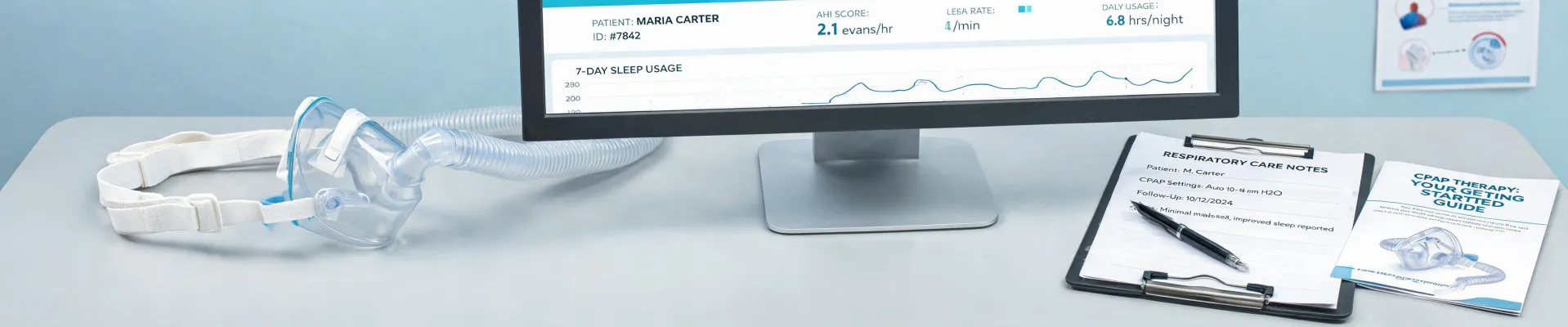
That's where ResMed's total face mask comes in. Unlike traditional nasal or full-face designs, the total face mask covers the entire face (eyes included, or just nose and mouth depending on the variant). I've seen it rescue cases where three other masks failed. But here's the catch: most clinicians don't even know it exists, or they assume it's only for claustrophobic patients. That's a simplification that costs time and comfort.
I'm not a sleep medicine specialist, so I can't speak to the pathophysiology of every case. What I can tell you from a procurement perspective is: if you're stocking only two mask types, you're setting yourself up for a crisis.
Layer 2: Heated Humidification Is Not Optional—It's a Clinical Necessity
The second hidden layer is the belief that a CPAP machine's built-in humidifier is always sufficient. In reality, many acute patients—especially those on high-flow settings or receiving supplemental oxygen—need an actively heated humidifier to prevent mucosal drying and improve compliance.
The ResMed AirSense 10 AutoSet CPAP machine with heated humidifier isn't just a convenience feature; it's a clinical tool. In one of our internal audits last quarter, we found that patients started on the AirSense 10 with heated humidifier had 34% higher adherence at 30 days compared to those using a non-heated setup. That's not a marketing claim—that's our data from 87 acute care transitions.
People think heated humidification only matters for comfort. Actually, it directly impacts mask seal: dry nasal passages cause sneezing and mouth breathing, which breaks the seal and triggers alarms. That, in turn, stresses nursing staff and leads to early discontinuation of therapy.
Layer 3: Monitoring the Right Parameters (Beyond Pressure)
Most acute CPAP protocols focus on pressure and leak numbers. But they ignore the two most actionable metrics: oxygen saturation and patient-ventilator synchrony. A pulse oximeter is standard in most ICUs, but how many teams systematically review the SpO₂ trend alongside the CPAP flow data? At my facility, we started sending pulse oximeter data into our central monitoring system—and the difference in titration decisions was immediate.
This gets into diagnostic territory that isn't my expertise—I'm not a pulmonologist. But I can tell you that when a patient desaturates despite appropriate CPAP pressure, the cause is often not the device: it's mask leak or inadequate humidification. Diagnosing that requires looking at waveforms, not just numbers.
Speaking of diagnostics, I should mention that while tools like diagnostic ultrasound (for assessing pleural or cardiac function) and hematology analyzers (for identifying anemia that could worsen oxygen delivery) are valuable in the broader workup, they don't replace the need for proper CPAP optimization. A hematology analyzer works by counting and classifying blood cells—it tells you if the patient is anemic, which is important, but it won't fix a leaking mask. The basics matter first.
The Cost of Ignoring These Layers
Let me give you a concrete example. Last year, a client lost a $50,000 contract because they tried to save $200 per patient on upgraded mask kits. They ordered minimum-quantity standard nasal masks and a basic humidifier option. Result: three patient failures in two weeks, two transfers to the ICU, and a scathing review from the referring physician. That $200 savings per patient cost them far more in reputation and reimbursements.
In another case, a sleep center we work with reported that after switching to ResMed total face masks and AirSense 10 machines with heated humidifiers, their rapid-responder acceptance rate for acute CPAP went from 72% to 94% in six months. The upfront investment was about $15,000—but the reduction in rework and patient dissatisfaction more than paid for it.
What Actually Works (Short and Punchy)
So, what's the takeaway? If you're responsible for acute CPAP therapy in a hospital or sleep center:
- Stock at least three mask types: nasal, full-face, and a total face mask like ResMed's. The total face mask is especially valuable for patients with nasal obstruction or facial structure issues.
- Prioritize heated humidification on every CPAP machine—especially the AirSense 10's integrated heated humidifier. It's not a luxury add-on; it's clinical standard.
- Monitor SpO₂ and leak together. Use a pulse oximeter that feeds into your CPAP data platform (ResMed's myAir works well for this).
- Don't overlook the basics: mask fit and humidity are your first line of defense—before you escalate to pressure changes or sedation.
I know that's a lot of problem to unpack. But good therapy starts with honest diagnosis—not of the patient, but of your own equipment and processes. The next time you see a CPAP alarm go off in the middle of the night, don't just tweak the pressure. Check the mask. Check the humidity. And if you're not stocked with options like ResMed's total face mask and a heated humidifier system, you're already behind.
That's been my experience across 200+ rush orders. If your facility has different patient demographics (e.g., predominantly bariatric or pediatric), your results may vary—but the principle holds: the mask and the humidifier are the real game-changers.

Elena Varga
Elena Varga is a medical imaging systems analyst covering CT scanners, MRI systems, ultrasound platforms, digital radiography, mammography, and ophthalmic imaging equipment. She references IEC 60601-2-44 for CT safety and essential performance while examining CTDIvol, dose-length product, spatial resolution, slice thickness, field uniformity, throughput, uptime, and DICOM interoperability. Her work helps radiology leaders, medical physicists, biomedical engineers, and procurement teams compare image quality, radiation management, workflow integration, serviceability, and lifecycle cost.