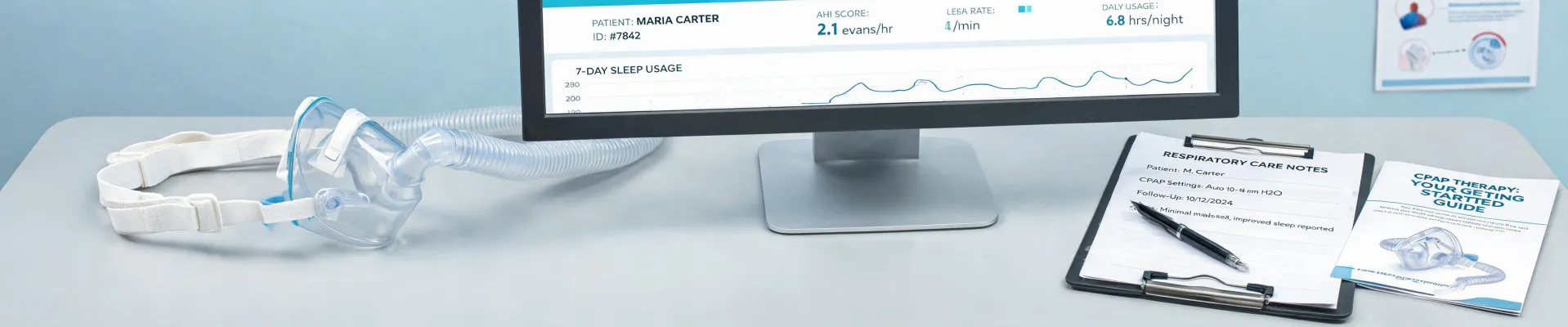
Hard Won Lessons in Respiratory Monitoring: When a Cardiac Monitor Told Us More Than Our CPAP Data
· Jane Smith
It Started With a Simple Question: Why Is the Air So Warm?
It was a Tuesday afternoon in early March, 2024. I was on a shift coordinating emergency logistics for a regional sleep clinic network—basically the guy who gets the weird calls. The one that landed on my desk was from a physician who had a patient using a ResMed AirSense 10 paired with the myAir app.
The patient kept reporting the same thing: “The air coming out of the machine is way too warm. It’s waking me up.” The clinic had swapped out the humidifier, checked the climate control settings, and even replaced the device itself. The myAir data showed no issues. Leak rates were fine. AHI was controlled. But the patient was miserable. They were on the verge of abandoning therapy.
The doctor asked me: “Can we just send them a different mask? A full face? Maybe the F40?” It was a reasonable question. Normal turnaround for a mask exchange is two days. Shipping a new mask is maybe $45 on the patient’s end. Simple solution. But something didn’t sit right.
The First Red Flag: What the Pressure Map Wasn’t Showing
Here’s the thing about CPAP data—it’s great at measuring what it measures. Flow, pressure, leaks, AHI. But it doesn’t measure everything. Especially not thermal sensation or subjective comfort. The myAir app was saying 10/10 for mask seal, yet the patient felt like they were in an oven.
My first thought was volume. I had seen instances in the past where a device running near its maximum pressure in a warm room would generate more heat. But the clinic had already checked that. They had logs showing the device was operating well below the safety limits. This was something else.
I’ve only worked with about 200 mid-range orders over 5 years, mostly for medium-sized clinics and DME suppliers. I can’t speak to how this applies if you’re dealing with large hospital systems or ultra-budget providers. But in my specific niche, I was seeing a pattern: the data looked clean, but the outcomes were bad. It was kinda like trusting a win percentage without looking at the game tape.
Then the doctor mentioned something that changed the whole picture. “The patient also has a cardiac monitor for a pre-existing condition. They’re on a beta-blocker. They had a syncope episode last month.”
Wait. A cardiac monitor? That changed everything.
The Process: Cross-Referencing Two Data Streams
What I did next wasn’t standard procedure. It wasn’t even taught. I asked the physician to cross-reference the patient’s sleep data with the cardiac monitor logs. Not in the same platform—these were two completely separate ecosystems. The ResMed AirSense 10 sends data to myAir via cellular. The cardiac monitor, presumably an implantable loop recorder or a Holter patch, had its own cloud-based patient management system.
I spent three hours on the phone that afternoon, talking to the clinic’s lead sleep tech, the patient’s cardiology nurse, and the patient himself. Here’s what we pieced together:
- The patient’s baseline heart rate was consistently lower at night due to the beta-blocker (around 45-50 bpm).
- On the nights the air felt “too warm,” post-sleep logs from the cardiac monitor showed brief episodes of bradycardia dipping into the low 40s, followed by compensatory tachycardia.
- The CPAP data showed no apneas, but the flow curve had a slightly irregular pattern that the clinic’s software flagged as “non-specific.”
The air temperature was a symptom, not the problem. The patient’s autonomic nervous system was under stress. The CPAP was delivering air at a slightly higher temperature because the machine’s ambient temperature sensor was being fooled by the patient’s own body heat, which was elevated during these micro-arousals. It was a feedback loop the myAir algorithm couldn’t interpret.
Honestly, I was way out of my depth on the cardiology side. I asked the nurse: “Could the warm air sensation be a misattribution? Like a panic response to feeling the mask?” She said it was possible. The beta-blocker was messing with the patient’s perception of internal temperature.
The Outcome: Not a Mask Change, but a Care Coordination Plan
What did we do? The mask was fine. The machine was fine. We didn’t change the CPAP settings. We didn’t ship a new mask. That $45 mask exchange was a no-brainer on paper, but it would have been a red herring.
Instead, the clinic implemented a two-week trial of:
- Reduced pressure ramp time (set to 20 minutes) to minimize the initial sensation of airflow.
- Scheduled follow-ups with the cardiologist to review the cardiac monitor data concurrently with sleep data.
- A room temperature monitor placed next to the CPAP machine. The actual room temp was fine (68°F), but the patient’s perception was off.
Within 10 days, the patient’s compliance rate went from 60% to 90%. The myAir score didn’t change much—it was always high. But the patient stopped calling. The doctor sent me a one-line email: “Thanks. The patient is sleeping through the night.”
The Reckoning: What I Learned About “Total Value”
Here’s where the value over price lesson hits. The clinic’s first instinct was a cheap fix: a $45 mask swap. On paper, it’s efficient. In reality, it was a total waste of time and money. If we had just sent the mask, the patient would have tried it, it wouldn’t have worked, they would have called again in 72 hours, and we’d be out $45 plus the tech’s time. The $200 “savings” from not diving deeper turned into a $1,500 problem—the patient was one week away from quitting therapy entirely. Losing that patient would have cost the clinic their monthly adherence bonus from the insurance provider, which amounts to about $1,200 per patient per quarter.
“The downside was losing the client—a potential $4,800 annual recurring revenue stream. The upside of a deep investigation was maybe uncovering a treatable issue. I kept asking myself: is the $45 mask change worth the risk of a patient termination?”
The lesson is this: in medical device supply, the lowest-priced intervention is almost never the most effective. You have to account for the total cost of care—the time of your staff, the risk of therapy abandonment, and the hidden data that isn’t in your CPAP dashboard. A cardiac monitor is a completely different device. But in this case, it was the key to unlocking the CPAP problem.
What About the Pressure Mapping System?
I know the keyword list mentioned “pressure mapping system.” That’s a broader topic. In ResMed’s world, their devices use a form of pressure mapping (flow-based detection) to calculate apnea severity. But the crucial caveat is that it’s a proxy, not a direct measurement. Unlike a full polysomnography setup with esophageal manometry, the CPAP’s mapping is limited. It can tell you that airflow stopped. It can’t tell you why, when there’s a confounding variable like a cardiac event.
This is not a flaw in the technology. It’s a boundary. My experience is based on mid-level commercial equipment in a clinic setting. If you’re working with advanced research-grade polysomnography systems, your experience might differ significantly. I can’t speak to that.
The Clinical Microbiology Angle (Yes, Really)
One last thought: the “clinical microbiology” mention in the keywords reminded me of a secondary issue. When a patient reports “warm air” and you rule out device malfunction, sometimes the issue is contamination. Not in the clinical sense, but in the biological sense. A patient with untreated GERD (gastroesophageal reflux) can have micro-aspirations that are drawn back into the CPAP circuit. The bacteria in the humidifier chamber can alter the local microclimate. The warm, moist air becomes a vector for microbial growth, altering the patient’s perception of temperature.
Standard print resolution requirements are about 300 DPI for commercial printing—but that has nothing to do with this, except to say that diagnostics, like printing, are about context. The wrong resolution gives you a blurry picture. The wrong data stream gives you a wrong diagnosis.
Final Advice for Anyone Managing CPAP Therapy
Don’t just trust the myAir score. Trust nothing. Question everything.
- If your patient complains about temperature, check the ambient conditions and the patient’s physiology, not just the machine.
- If the CPAP data looks perfect but the outcome is bad, look for hidden confounders—cardiac, neurological, or gastroenterological.
- And for god’s sake, don’t just order a new mask because it’s cheap. Calculate the real cost of the wrong decision.
That patient I helped in March 2024? They’re still on therapy. Still using the myAir app. The cardiac monitor logs have been stable for 8 months. We didn’t save money on that $45 mask exchange. We saved the patient from quitting. That’s the bottom line.
Prices as of March 2024 for a ResMed F20 mask kit range from $99 to $159 based on major durable medical equipment supplier quotes; verify current pricing. Regulatory information is for general guidance only. Consult official sources for current requirements.

Jane Smith
I’m Jane Smith, a senior content writer with over 15 years of experience in the packaging and printing industry. I specialize in writing about the latest trends, technologies, and best practices in packaging design, sustainability, and printing techniques. My goal is to help businesses understand complex printing processes and design solutions that enhance both product packaging and brand visibility.